
White-Label SEO Reporting: Evaluate Ownership, Disclosure and Client Access
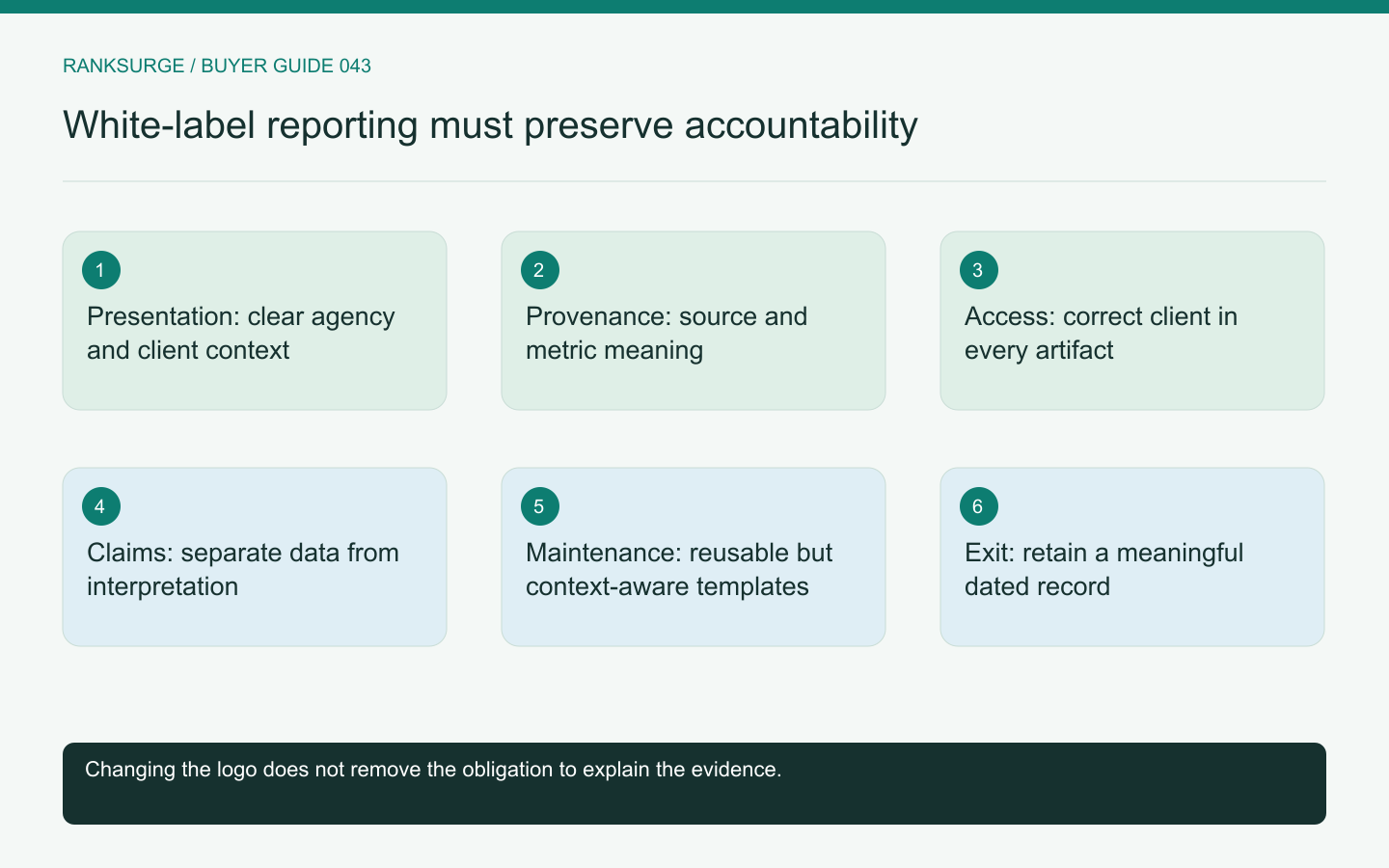
Evaluate white-label SEO reporting by checking responsibility, data provenance, client permissions and what remains portable after the engagement ends.
TL;DR
- Decide that white-label presentation does not transfer responsibility: agencies must define client expectations and still explain definitions, limitations and recommendations even when branding replaces source labels.
- Use hands-on access tests: create fictional client projects, invite a test reviewer to only one, and verify sharing, authentication and revocable links before trusting a branded view.
- Treat offboarding and clarity as a success check: export the trial report and context, and expect a successful trial to produce a report the client can understand, question and keep.
Separate presentation from responsibility
White-label SEO reporting lets an agency present information within its own client experience. Replacing a logo can be useful, but it does not transfer responsibility for understanding the data. The agency still needs to explain definitions, limitations and recommendations accurately.
Start by defining what the client expects from the report. They may want a concise account of progress, access to underlying evidence or a place to review agreed actions. The buying decision should prioritize those needs before custom colors and domain names.
Make provenance understandable without clutter
A client does not need every technical detail on the first screen. They do need a way to understand where important measures came from and what they mean. Ask whether the reporting product preserves source, date range, filters and any estimate labels.
A third-party visibility estimate should not appear as the client's verified traffic simply because the agency's brand surrounds it. First-party search clicks and observed rank positions should retain their distinct definitions.
Google's Search Console performance documentation is one example of a source definition that remains relevant after data is moved into a branded report. White labeling should simplify presentation without removing the context needed to interpret the evidence.
Test client access with an actual boundary
Create two fictional client projects and invite a test reviewer to only one. Inspect the report, navigation, downloadable files and shared links. The reviewer should not be able to infer or access another client's data through a convenient account switcher or reused export.
Ask what happens when the reviewer forwards a link. Determine whether access depends on authentication, a revocable share token or a public URL. Choose the model that fits the material you intend to share rather than treating an obscure address as sufficient protection by itself.
Do not assume a platform's agency marketing language establishes a granular permission model. Verify the available controls in the plan and deployment you are evaluating, including any limits on external reviewers.
Review the agency's own claims
A branded report can accidentally imply that the agency collected or independently verified every number. Decide how to describe sourced data and original analysis accurately.
For example, the agency may provide the interpretation and recommended action while a data provider supplies the underlying search observations. That is a legitimate service, but it should not be presented as a proprietary measurement method unless it actually is one.
Ask the reporting tool to preserve analyst notes and uncertainty separately from automated summaries. The final client-facing conclusion should be reviewed by someone accountable for the engagement, especially when it recommends spending money or changing an important website flow.
Compare customization with maintenance
Create a template that includes the agency's identity, the client's identity and a small set of agreed measures. Then change one measure's definition or remove an unavailable source. Inspect whether the template makes that change visible across reports.
Extensive customization can create maintenance work if each client has a copied layout with hidden differences. A reusable structure should support legitimate client-specific context without turning every report into a separate fragile implementation.
RankSurge's MCP documentation describes saved reports and report briefs. These can support repeatable reporting work, but they should not be read as a claim that every white-label portal or external access feature described here exists in RankSurge. Verify the exact presentation and sharing requirements before buying.
Related reading: SEO for Startups: A Founder’s Handbook.
Related reading: How to Prompt Claude Code for SEO.
Rehearse a client question
Give the trial report to someone unfamiliar with the project and ask them to challenge one conclusion. Can the agency trace the claim to a defined page set or query set and explain the comparison period?
A useful report makes that conversation easier. It should not require the analyst to reconstruct the entire dataset in another tool while the client waits. The branded interface earns its place when it improves understanding and follow-through, not merely when it looks more polished than a spreadsheet.
Also test a negative result. The template should allow a clear explanation of a decline, missing data or an inconclusive period without forcing every section into a celebratory progress narrative.
Inspect offboarding before committing
Export the trial report and its essential context. Ask whether the client can retain a useful record after portal access ends. Identify which live charts stop working and whether a dated snapshot can preserve the conclusions discussed during the engagement.
Clarify account ownership, renewal responsibility and access revocation separately. An agency canceling its software subscription is not the same event as a client ending one project.
Choose white-label reporting software that lets the agency remain accountable for clear interpretation while preserving appropriate client boundaries. A successful trial produces a report the client can understand, question and keep. The branding should support that relationship rather than conceal how the evidence was produced.