
Website Audit Tool Selection: Test Discovery Before Counting Issues
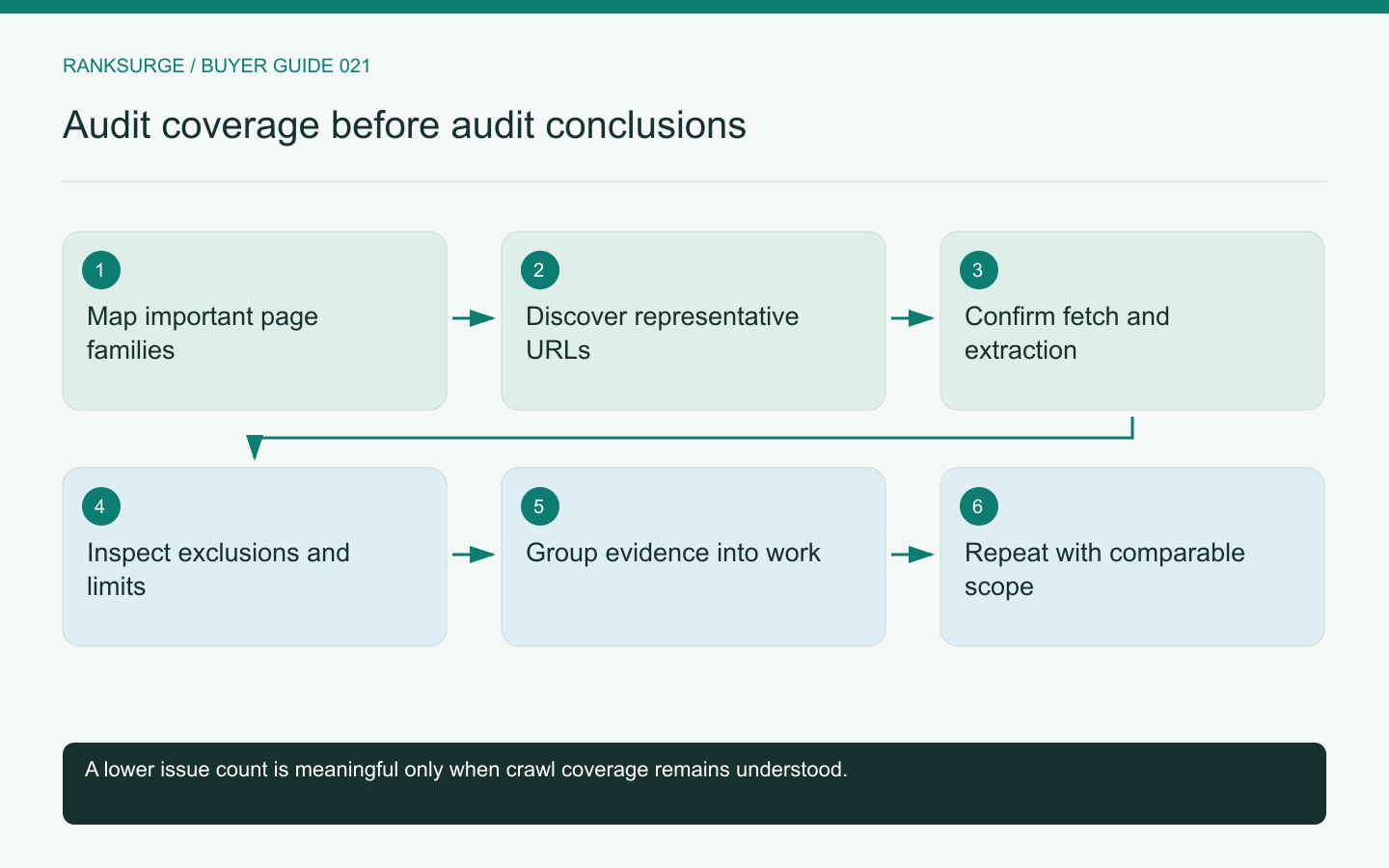
Choose a website audit tool by testing page discovery, rendering assumptions and affected-URL evidence before comparing health scores or issue counts.
TL;DR
- Prioritize crawler discovery over headline issue counts: confirm the audit actually examined the page families that matter before treating a health score or issue total as meaningful.
- Use a bounded, reproducible coverage fixture: pick representative URLs (navigation, sitemap, deep, redirect, rendered) and require the tool to show whether it discovered, fetched and extracted each page.
- Treat limits and comparisons as success checks: verify exclusions, stopping rules, settings and exports so runs are comparable and visible rather than attributing changes to site quality alone.
A crawl cannot diagnose pages it never saw
Website audit tools often summarize their results with an issue count or health score. Those summaries are only useful after you understand which pages were examined. A clean report that missed an important directory can be more misleading than a noisy report with broad coverage.
Begin the buying evaluation with a map of your site's page families. Include product pages, documentation, articles, collections and any other public sections that matter. Identify areas intentionally excluded from search. The trial should establish whether the crawler discovers and inspects the relevant families, not merely whether it finishes successfully.
Prepare a coverage fixture
Choose representative URLs with different discovery paths. Include a page linked from navigation, one found through a sitemap, a deeper page, a redirect and a page whose meaningful content depends on browser rendering. Use your own site or an authorized test environment.
For each URL, write the expected observation and the reason it belongs in the sample. Ask the tool to show whether it discovered the page, fetched it and extracted the relevant fields. Those are separate stages; a discovered URL is not necessarily an analyzed page.
Do not intentionally expose private or authenticated content simply to increase crawl coverage. The evaluation should respect the intended public boundary.
Inspect exclusions and stopping rules
Ask how the crawler handles robots directives, URL patterns, query parameters, depth and page limits. Determine whether the interface shows when a limit stopped the crawl. A report should not look complete when it represents only the first portion of a much larger site.
Use a bounded test to inspect parameter behavior. A catalog can expose many URL variants, some useful and some repetitive. The buyer needs control sufficient to avoid spending the crawl budget on irrelevant combinations while missing important product pages.
Document the chosen settings with the report. Without them, a later difference in issue count may reflect a changed crawl scope rather than an improvement or regression in the site.
Test what the crawler actually sees
A crawler may inspect server-returned HTML, rendered browser output or a mixture of signals. Ask which mode applies to your test and inspect the extracted title, text, links and canonical information for a representative dynamic page.
If the result differs from the browser, identify why before interpreting it as a site defect. The tool may have a rendering limitation, a timing difference or an access problem. Conversely, a browser view that looks correct does not prove the server response contains every signal the audit checks.
RankSurge's site audit page describes page-level crawl signals and optional Lighthouse findings. Evaluate each output within its stated scope rather than assuming the optional performance sample covers every crawled URL.
Related reading: The Best Open Source SEO Tools in 2026.
Related reading: SEO for Startups: A Founder’s Handbook.
Compare issue evidence, not issue volume
Choose one repeated issue and inspect the affected URLs. Can you tell whether it comes from a shared template, a content pattern or isolated pages? Does the report expose enough evidence for an implementer to reproduce it?
A thousand duplicate-title rows may represent a single generation rule. Ten broken links may affect a critical conversion path. Your prioritization needs page importance and implementation context, not only the tool's severity label.
Ask a developer to review a sample finding. If they cannot start an investigation without recreating the crawl, determine whether the export or your report needs more context.
Evaluate comparison across runs
After a harmless authorized correction in a test environment, repeat the relevant audit scope. Check whether the tool makes it possible to distinguish resolved findings, newly observed findings and pages that simply disappeared from coverage.
Keep settings consistent when comparing runs. A smaller issue count after reducing the page limit is not evidence of improvement. Record deployment changes and crawl configuration together so the history remains interpretable.
Do not require the product to attribute every search outcome to an audit fix. The immediate verification is that the intended technical behavior changed. Search performance can be observed separately with appropriate time and context.
Check exports and work assignment
Export a representative issue set and preserve URLs, observed values, crawl time and settings. Ask whether the team can group findings into practical work items. A report that loses the evidence during export may create repetitive manual investigation.
Determine who can access the audit and whether sharing a report exposes unrelated project data. If your issue tracker remains the work-management system, test the handoff rather than expecting the audit tool to replace it.
Include the cost of repeated crawls and optional checks in the comparison. The relevant budget depends on your site's size, change frequency and investigation needs, not just the advertised maximum page count.
Choose a tool that makes its limits visible
The final buying note should identify covered page families, known blind spots, useful evidence and the work required outside the tool. An explicit limitation is manageable; an invisible coverage gap is harder to detect.
Choose the audit product that helps your team find, explain and verify important changes. A health score can summarize a defined crawl, but it should never substitute for understanding what was actually examined. Discovery comes first because every later conclusion depends on it.