
Unknown Keyword Volume: Separate Missing Data From No Demand
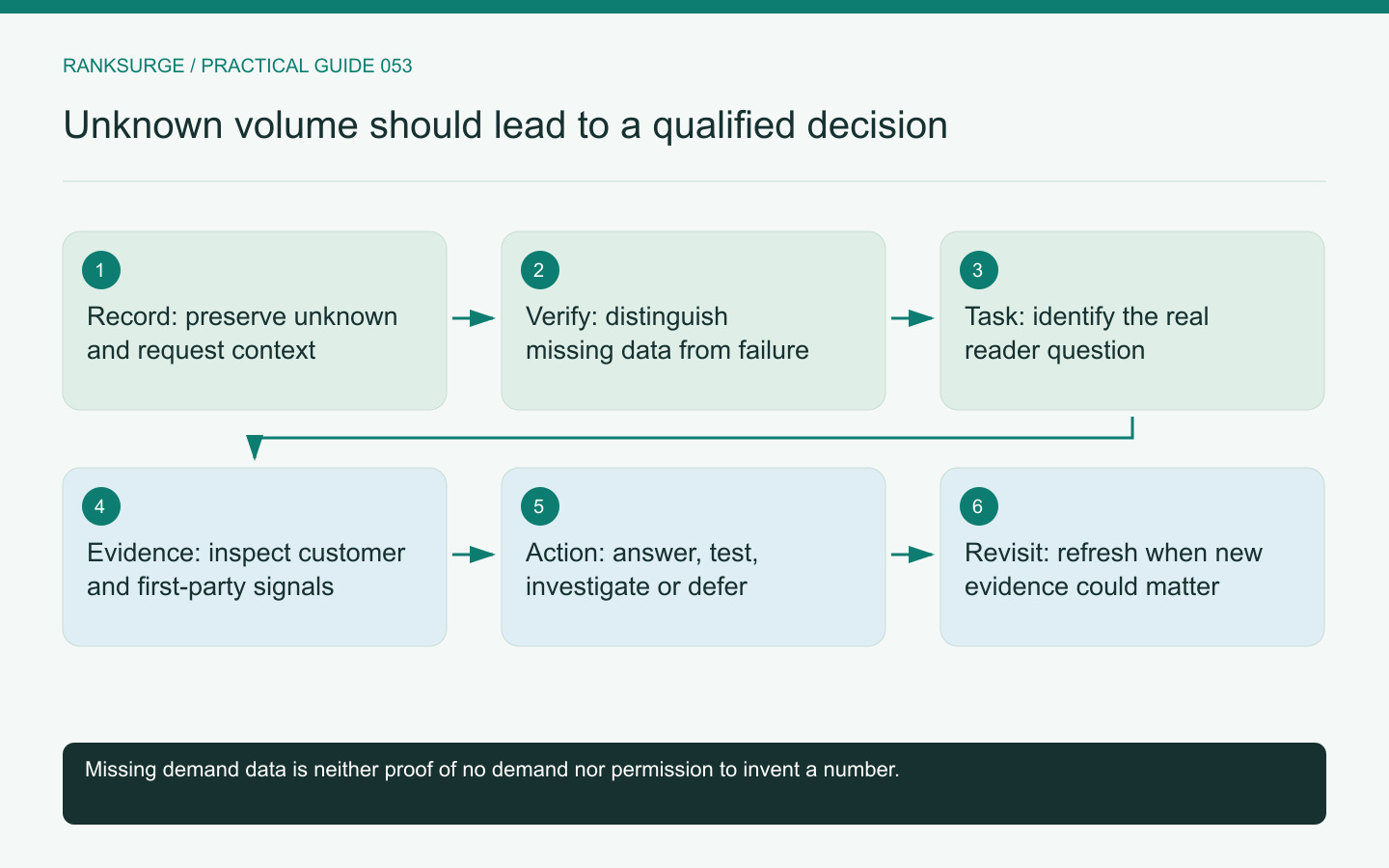
Handle unknown keyword volume by preserving missingness, checking source scope and using customer and page evidence without inventing demand estimates.
TL;DR
- Treat unknown keyword volume as missing data, not zero demand: preserve the missing value and record source, market, language and lookup date so another analyst can understand what was attempted.
- Confirm the query spelling, requested location or endpoint before interpreting absence; keep the original or a sanitized response so the lookup's status details can be revisited without repeating the request.
- Choose a proportionate content action—answer in an existing page, create a focused new page, investigate further or defer—and only revisit the topic when new evidence could meaningfully change the decision.
Keep unknown distinct from zero
Unknown keyword volume means the dataset did not provide a usable volume value for that query in the requested context. It does not automatically mean nobody searches for the topic. It also does not justify assuming hidden demand is large.
Preserve the missing value explicitly in the research record. Add the source, market, language and lookup date so another analyst can understand what was attempted. A blank cell without context is ambiguous; a labeled unknown is honest evidence.
Check the request before interpreting the absence
Confirm the query spelling and the requested location or language. Inspect whether the task succeeded and whether the response represents the correct endpoint. A failed request should not be converted into a valid keyword with zero volume.
DataForSEO's search-volume endpoint documentation describes the request and response model for that data product. Use the relevant provider's definitions to distinguish a returned metric, an unavailable field and an operational error.
Keep the original response or a sanitized evidence reference when practical. This makes it easier to revisit the interpretation without paying for the same lookup simply because the earlier record lost its status details.
Review the actual reader task
Write the question the keyword represents in plain language. A narrow software phrase may describe a real configuration problem, a specific buying requirement or an awkward wording nobody would naturally use.
Ask whether the product serves that task and whether customers have raised it through support, sales or product research. Those sources can justify useful documentation or a focused article even when search-volume evidence is incomplete.
Do not relabel customer evidence as measured search demand. The distinction matters. “Several customers asked this question” is a different statement from “this query receives a known number of searches.” Both can inform a decision when accurately described.
Related reading: The Dark Query Problem: Why Search Console Hides Most of Your Searches.
Inspect related evidence without substituting it
Look at broader or closely related queries to understand the topic space. Their metrics may provide context, but they should not be copied into the original query's volume field.
For an illustrative phrase about a specific email error, a broader email-delivery topic may have measured demand. That does not establish the narrow phrase's exact volume. It may suggest that the issue belongs as a section within an existing guide rather than a separate page.
Record that page decision explicitly. Supporting a narrow question inside a broader useful resource can serve readers without pretending every wording variant needs its own demand forecast.
Use first-party evidence where available
An existing site may already receive impressions or visits related to the topic. Review the relevant first-party data with its own limits and filters. It can show observed activity for your site, not the entire market's demand.
Search Console's performance documentation explains its reporting measures and context. Keep those observations separate from third-party volume estimates so the research table does not mix unlike numbers.
A new site may have no such evidence yet. That absence should remain visible. The team can still make a limited editorial experiment based on product fit and customer need, while acknowledging that search demand is uncertain.
Choose a proportionate content action
Use four possible outcomes: answer within an existing page, create a focused new page, investigate further or defer. Unknown volume does not force any one of them.
A frequent support question with a clear, verified answer may deserve a concise help page immediately. An obscure phrase with weak product relevance may be deferred. A commercially important task may justify a small research or content experiment rather than a large cluster of speculative articles.
The amount of work should follow the strength of the complete case. Avoid compensating for missing demand evidence by making the article longer or adding a current year to its title.
Keep the backlog sortable without distorting it
If the planning system sorts unknown metrics poorly, add a separate evidence-status field rather than filling them with zero. You can prioritize by product fit, observed customer need or review status while retaining the original missingness.
RankSurge's research workflow can help organize opportunities, but your team should inspect how unknown values appear in its actual interface and exports. Do not assume a displayed blank has the same meaning as a provider-returned zero without checking.
Use notes that a future reviewer can understand: metric unavailable in the selected market, request failed, or not yet measured. These states lead to different next actions.
Related reading: SEO for Startups: A Founder’s Handbook.
Revisit only when new evidence could matter
Set a reason to recheck the topic, such as a product launch, new customer questions or a scheduled research review. Repeating the same lookup every day rarely improves a decision that remains unchanged.
The goal is disciplined uncertainty. Keep the metric unknown, preserve the evidence you do have and choose a bounded content action that serves a real reader. That approach is more useful than either discarding every unmeasured query or inventing numbers to make the backlog look complete.