
Site Audit Prioritization: Connect an Issue to Affected Pages and Business Value
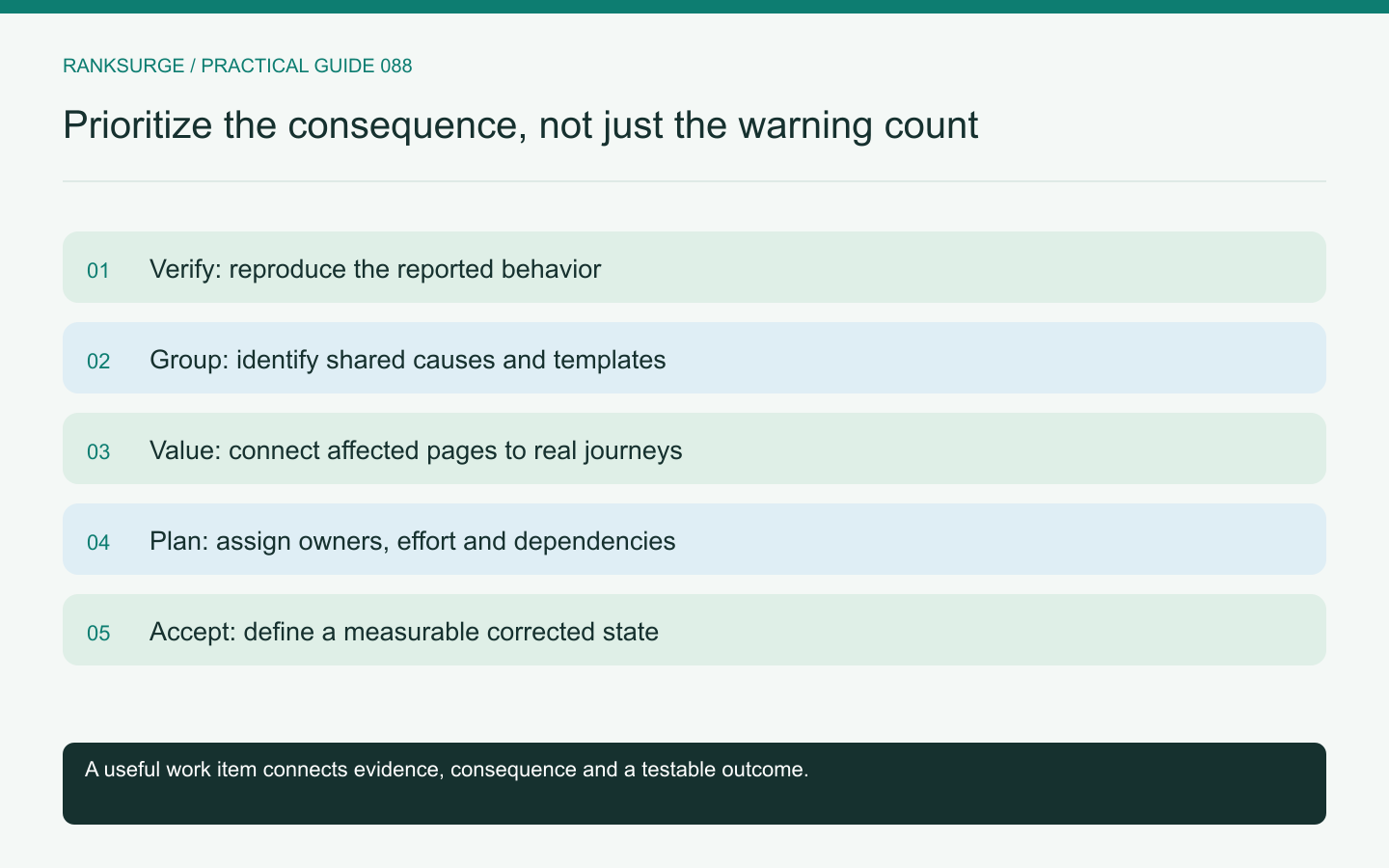
Prioritize site-audit findings by affected journeys, page importance, confirmed evidence and implementation scope rather than sorting only by tool severity.
TL;DR
- Prioritize audit findings by translating each tool flag into a user or discovery problem, identifying the affected page family, and creating an actionable work queue engineers and content owners can evaluate.
- Use a verification-and-grouping workflow: confirm observations on representative URLs, then group findings by probable cause and page family so one implementation task replaces redundant tickets.
- Limit claims and define checks: describe business relevance without inventing revenue, record deferral reasons, and set clear acceptance criteria that demonstrate observable post‑fix behavior.
Tool severity is an input, not the final queue
An audit tool can label a finding as an error or warning, but it does not know every commercial dependency of the website. A missing page on a critical purchase journey can deserve attention before a larger count of minor metadata issues.
Start by translating each finding into a specific user or discovery problem. Then identify the affected page family and the evidence confirming that problem.
This creates a work queue that engineers and content owners can evaluate. “Fix technical SEO” is too broad; “repair the category links that prevent users reaching current products” describes an actionable outcome.
Confirm the observation before estimating impact
Inspect representative affected URLs and verify the reported behavior. A crawler configuration issue, temporary response or duplicate reporting pattern can inflate an apparent problem.
Keep the original audit evidence and the verification result together. If the issue cannot be reproduced, mark it for investigation rather than silently deleting it or treating it as confirmed.
Google's traffic-drop debugging guidance is a useful reference for broader diagnosis. An audit finding should be connected to observed behavior without assuming that it explains every performance change.
Group rows by the underlying cause
Hundreds of affected URLs may share one template defect. Conversely, a small number of URLs may contain several unrelated issues requiring different owners.
Group findings by the probable cause and page family before assigning work. A title-generation bug should be one implementation task with representative examples and a validation set, not hundreds of nearly identical tickets.
Keep the complete affected list available for testing. Grouping reduces duplication in the work queue; it should not hide the actual scope of the problem.
Describe business relevance without invented revenue
Identify whether the affected pages support acquisition, comparison, purchase, onboarding or another important journey. Use known business context and available analytics carefully.
For an illustrative software site, a broken pricing-to-checkout link may be urgent even if the pricing page's organic traffic is modest. Its role in a conversion journey matters beyond a single search metric.
Do not assign a fabricated monetary loss to make the issue sound important. If revenue impact is unknown, say that the affected journey is commercially important and specify the evidence needed to estimate the consequence.
Separate urgency, scale and confidence
These dimensions answer different questions. Urgency asks how quickly the issue needs attention. Scale describes the affected surface. Confidence describes how well the cause and consequence are established.
A confirmed site-wide access failure can be urgent and high-confidence. A suspected content overlap affecting several articles may require research before implementation. A minor repeated formatting issue can be large in count but low in immediate business consequence.
Use a small set of understandable labels rather than a complicated score that hides subjective assumptions. The rationale should remain readable beside the priority.
Include effort and dependencies honestly
A straightforward template change may need a deployment, translation updates and a regression check. A content consolidation may depend on product and legal review. Record these dependencies before promising completion dates.
Do not automatically favor easy changes if they leave a more consequential problem untouched. Instead, separate quick independent improvements from work that needs coordinated planning.
For each task, name an owner and the system where the correction belongs. The SEO analyst should not be expected to repair application routing without the team responsible for that code.
Define success before the fix
A useful acceptance criterion describes observable behavior after the change. Examples include all affected internal links reaching the intended page, a corrected template producing distinct titles or a public page returning the expected response.
Ranking and traffic can be monitored afterward, but they are not the only way to verify that the implementation is correct. Search response may take time and can be influenced by unrelated changes.
Preserve a small regression sample that includes both affected and unaffected page variants. This helps confirm that a template fix did not create a new problem elsewhere.
Keep a deferred finding explainable
When a team postpones a verified issue, record the reason and the condition that would trigger reconsideration. A low-traffic legacy section may be deferred until a planned migration, for example. That is different from dismissing the finding as unimportant forever. A clear deferral note prevents repeated audit meetings from rediscovering the same decision without access to its original rationale.
Review the queue as a portfolio of decisions
In a prioritization meeting, ask which findings are confirmed, which journeys matter, which fixes share a cause and which uncertainties need investigation first. Revisit priorities when new evidence arrives.
RankSurge can supply audit observations and supporting research, while the team supplies business context and implementation ownership. The result should be a short, justified sequence of work, not a race to make every warning count reach zero regardless of its meaning.
Related reading: SEO for Startups: A Founder’s Handbook.
Related reading: The Best Open Source SEO Tools in 2026.