
SERP Features: Check How the Result Layout Changes the Click Opportunity
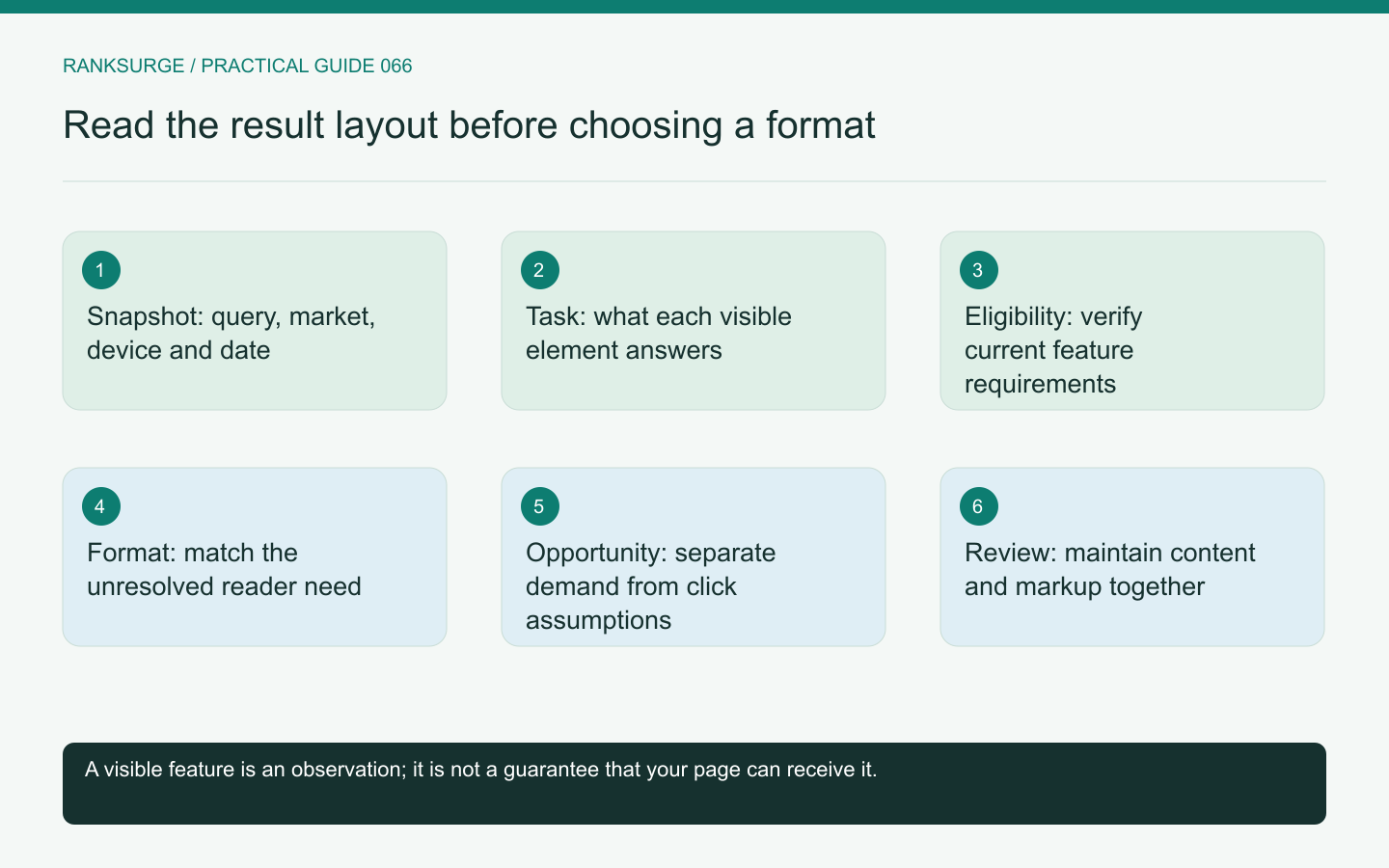
Evaluate SERP features by the reader task and available click path, then choose a useful content format without assuming every visible feature is attainable.
TL;DR
- Decide whether to build or improve a page by inspecting the actual result page (not just rank) and recommending the format your team can support for the reader's unresolved task.
- Use a practical method: inventory visible elements, ask what each contributes, then write the reader's unresolved question as the stronger starting point for the brief and format choice.
- Limit claims and verify success: avoid invented click forecasts, separate observed layout from demand and business value, then review first‑party performance in the same context to check impact.
Inspect the result page, not only the rank number
A keyword opportunity depends partly on what the searcher encounters before choosing a destination. A result page can contain different visual elements and answer formats, so a simple ranking number does not describe the whole experience.
Open a representative result in the relevant market and record the date, device context and query. Identify which elements address the reader's question directly and which invite a deeper visit. Treat the observation as a dated research snapshot, not a permanent description of every user's results across all locations and devices.
The goal is to understand the available reader journey before committing to a page format.
Describe the job each visible element performs
For an illustrative query about comparing appointment tools, a searcher may encounter vendor pages, editorial lists and other result elements. Ask what each contributes: a quick fact, a local option, a product choice or a detailed explanation.
Do not label every element simply as competition. Some may satisfy a different task from the one your page would serve. A concise answer can address a definition while a buyer still needs a comparison of implementation tradeoffs.
Write the reader's unresolved question after reviewing the result. That question is a stronger starting point for the brief than a desire to imitate a particular visual box.
Separate visibility from eligibility
Seeing a feature on another page does not prove that your page can receive the same treatment. Requirements vary by feature and can change. Check the current official documentation for the specific content type before proposing an implementation.
Google's structured-data introduction explains that markup should describe the page's actual content and follow the relevant feature guidance. Do not invent ratings, claims or hidden content to make a page resemble a richer result.
A technically valid implementation should still be reviewed for accuracy and reader usefulness. Eligibility is not a promise of a particular display or traffic outcome.
Match the format to the question you can answer
If the reader needs a calculation, a worked example or a tool may be more useful than a long generic article. If the reader needs to compare choices, clear criteria and limitations may matter more than a decorative layout.
For the appointment-tool example, a buyer might need to know whether shared staff calendars, approval steps or location rules affect selection. A useful guide can explain those decisions with accurate evidence, even if it cannot control which search feature appears.
Avoid changing the content format solely because a rival has a visually prominent result. The format must still fit your supported expertise and the user's task.
Estimate opportunity without inventing a click forecast
A crowded result page can change your expectations, but it does not justify assigning an arbitrary traffic discount. Unless you have a defensible model and evidence, describe the uncertainty in ordinary language.
For example: “The result contains several immediate answers, so the page needs a clear reason for readers to seek more detail.” That is an actionable observation. “This feature removes exactly half the traffic” is a quantitative claim requiring evidence you may not possess.
Keep reported demand, observed layout and expected business value as separate fields. This prevents the analysis from turning a screenshot into a precise revenue forecast.
Compare the proposed page with existing coverage
Read the current destination on your site. It may already contain the necessary answer but bury it under a broad introduction. A clearer summary, accurate table or direct example may be the appropriate improvement.
Do not create a new page for each visual feature associated with the same reader task. That can fragment useful information and make maintenance harder.
RankSurge's keyword research features can support investigation, while the editorial record should explain which existing page will serve the task and what information needs to improve.
Related reading: SEO for Startups: A Founder’s Handbook.
Related reading: How to Use Vellum and OpenSEO for Your SEO Engine.
Review performance with the same context
After a change, inspect relevant first-party page and query evidence over a suitable period. Record other changes that could affect interpretation, including the mix of queries and the observed result layout.
Avoid claiming that a markup change caused every movement in clicks. Search results and user behavior can vary for several reasons. The review should distinguish a verified implementation improvement from an uncertain performance attribution.
Also check the page itself. Accurate structured information can become stale when product details change, so the visible content and associated markup need coordinated maintenance.
Make the final recommendation about the reader
A useful recommendation states the observed result context, the unanswered task, the format your team can support and the evidence needed. It should also acknowledge any feature eligibility or performance uncertainty.
The strongest page is not necessarily the one that imitates the most search elements. It is the one that gives the intended reader a compelling, accurate reason to visit and a clear answer when they arrive.