
SEO Traffic vs Conversions: Trace the Measurement Boundary Before Judging the Page
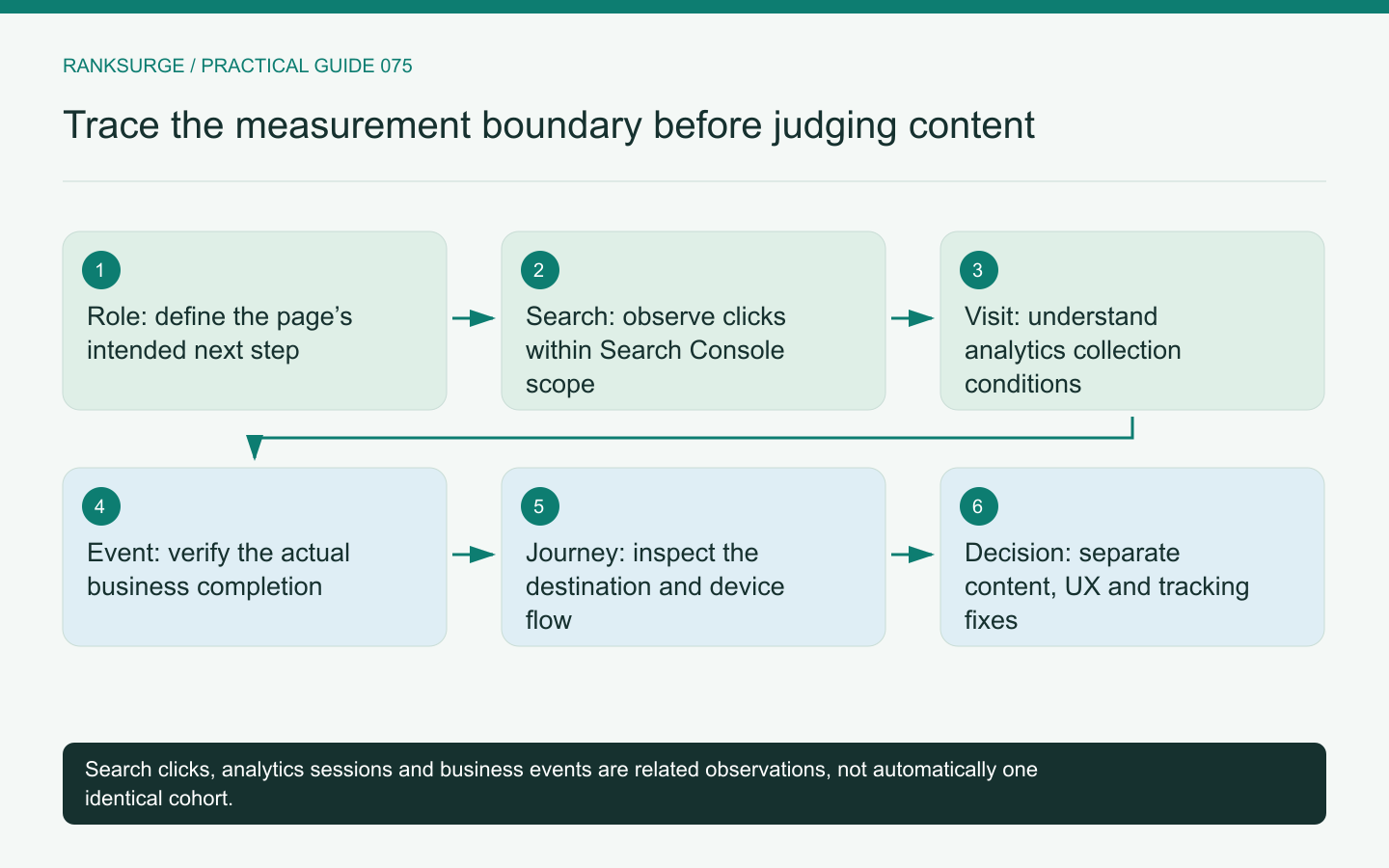
Compare SEO traffic and conversions by tracing clicks, measured visits and business events before concluding that a page attracts the wrong audience.
TL;DR
- Begin by naming the intended outcome before judging a page: define the page’s role and the business event to observe so search traffic without immediate purchase isn’t mistaken for failure.
- Trace measurement boundaries and verify events: map what Search Console, analytics and application records actually capture, and confirm the recorded conversion truly represents the business state.
- Limit conclusions with matching horizons and documented gaps: choose the observation window, declare outcome definitions and report exposures with known scope rather than implying a perfectly tracked funnel.
Name the outcome before judging the page
A page can attract search visits without producing an immediate purchase, and that fact alone does not establish failure. Start by defining the page's intended role and the business event the team expects to observe.
A comparison guide may help a prospect evaluate options. A setup article may help an existing customer complete an integration. Measuring both solely by same-session purchases would ignore their different jobs.
Write the expected next step and the evidence needed to assess it. Then examine whether the measurement system actually records that step reliably.
Trace the boundaries between systems
Search Console clicks, analytics sessions and recorded business events describe different parts of the journey. They should not be expected to match one-for-one without understanding their definitions and collection boundaries.
For an illustrative product site, a search click may lead to a page where analytics collection is affected by consent or technical conditions. A later signup may occur on another host or after the person returns through a different route.
Do not force these observations into a perfect funnel by inventing missing steps. Record what each system measures and where the connection is incomplete.
Verify the conversion event itself
Before diagnosing the audience, inspect how the desired event is created. Is it a completed account creation, a button click or merely a form view? Those are different outcomes.
For a demo-request page, the event should represent the intended business state rather than every press of the submit button, including invalid forms. Test the normal path, validation failure and duplicate submission behavior. Compare the event with the authoritative application record so a successful-looking analytics call cannot substitute for a business action that never completed.
The Google Analytics API schema defines available dimensions and metrics. Use the definitions appropriate to the report, and keep custom event meaning documented by the application team.
Check the path after the landing page
Follow the real next step on the devices and account states relevant to the audience. A useful article can send readers to a broken form, an unavailable market offer or an unclear pricing page.
For the product example, a mobile visitor may read the guide successfully but encounter a signup flow that hides a required field. The issue is in the journey, not necessarily in the article's keyword targeting.
Record the observed problem and fix it through the appropriate team. Avoid claiming a precise conversion loss from a usability observation unless you have measured evidence for that number.
Compare relevant audiences rather than all traffic
Inspect whether the page attracts the tasks it was designed to serve. A broad informational query, a branded query and a product comparison can have different expectations and readiness.
Use available query and landing-page evidence to form a careful interpretation. Do not assume that every non-converting visitor is irrelevant or that every visit from a commercial-sounding phrase represents an immediate buyer.
The Search Console performance report can support the search side of the investigation. Keep its evidence separate from claims about individual post-click behavior that it does not directly establish.
Match the reporting horizon to the decision
Some tasks can be completed immediately; others contribute to a longer evaluation. Decide what observation window and outcome definition fit the business question, and document the limitations.
For a setup article, a useful outcome might be reaching the correct documentation step or completing an integration, provided those events are measured appropriately. For a buyer guide, the team may examine qualified inquiries or later account activity with a clear attribution caveat.
Do not turn an attribution model into proof that the page caused the eventual sale. The model assigns credit according to its rules; causal impact requires a stronger design.
Separate a content hypothesis from an instrumentation fix
If the event is broken, repair measurement before using the count to judge the article. If the next step is unclear, improve the page's navigation or explanation. If the audience is mismatched, revise the topic or destination strategy.
Write the hypothesis explicitly. “The guide lacks a clear route to the relevant plan details” is a different problem from “the signup event fires twice.” They should not be bundled into a vague conversion optimization project.
A focused diagnosis makes the resulting work reviewable and avoids unnecessary rewriting of content that already serves readers well.
Report useful evidence without a false funnel
Present the observed search exposure, measured visits and defined business events with their scopes. Explain known gaps and avoid implying that the numbers represent the same perfectly tracked cohort when they do not.
RankSurge can support SEO research and performance context, while the application and analytics setup determine the business-event evidence. Judge the page after understanding those boundaries. That produces a more defensible decision about content quality, audience fit and the next improvement to make.
Related reading: SEO for Startups: A Founder’s Handbook.
Related reading: Ranking for the Wrong Half of Your Audience.