
SEO Tools for Website Migrations: Evaluate URL Mapping and Baseline Preservation
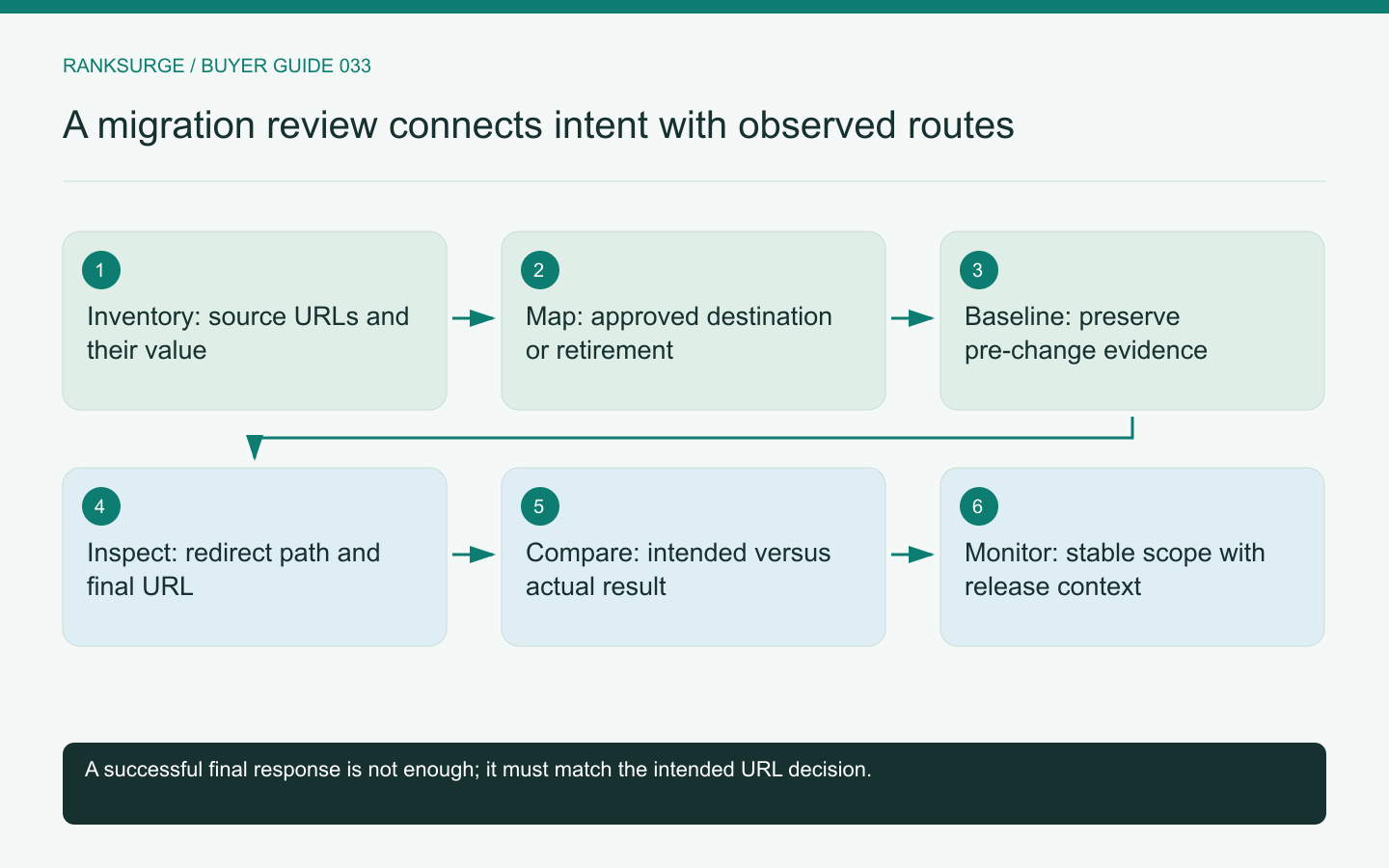
Evaluate SEO tools for website migrations by checking URL mappings, preserved baselines, redirect evidence and post-launch investigation workflows.
TL;DR
- Decide by collecting evidence, not by trusting a single score: require a URL map, a recorded baseline and a clear audit of what actually changed across the migration before purchase decisions.
- Evaluate tools by their mapping workflow: identify the migration type, include representative samples, and demand side-by-side expected versus observed destinations for inspected URLs.
- Verify success with preserved baselines and rehearsals: save pre-launch signals, compare a stable set of priority URLs post-launch, and run one rehearsal with a non‑production sample.
Buy evidence for a change, not a migration score
A website migration changes the relationship between existing URLs and their future destinations. An SEO tool should help your team understand that relationship before launch and investigate it afterward. A single health score cannot replace a URL map, a baseline and a clear record of what actually changed.
Start with the migration type. A domain change, a route restructuring and a platform move that preserves URLs create different evaluation needs. List the known changes and the things expected to remain stable. Then choose a trial sample that includes important landing pages, low-traffic pages and unusual route patterns.
Reconcile the source URL inventory
Collect candidate URLs from the current site, sitemaps, first-party performance data and other relevant records. Ask each tool to explain which sources it can ingest and what it leaves to your team.
The inventory should retain why a URL matters. A page may have meaningful search traffic, valuable external references or an important customer task even if it is not prominent in navigation. A crawler-only inventory can miss pages that are no longer well linked internally.
Do not assume every discovered URL deserves a one-to-one replacement. Some pages may be intentionally retired. The purchasing requirement is a reviewable decision for each relevant class, not a forced redirect for every historical string that resembles a path.
Make the mapping inspectable
Google's site-move guidance describes preparing URL mappings and handling a move through redirects and monitoring. Use that framework to evaluate whether the tool can preserve your intended mapping and compare it with observed behavior.
Create an illustrative sample with an unchanged path, a renamed page, two consolidated pages and one intentionally removed page. Ask the candidate to show the expected destination beside the actual result.
A useful report distinguishes an approved consolidation from an accidental many-to-one redirect to the homepage. The tool does not know business intent unless you provide it, so inspect how annotations or external mapping files become part of the review.
Preserve a baseline before launch
Save the current page status, canonical signals and relevant performance context for priority URLs. Record the observation date and collection scope. A baseline assembled after a problem appears cannot reliably describe the earlier state.
RankSurge's MCP documentation lists first-party Search Console performance and URL-inspection tools alongside research capabilities. These can contribute evidence, but they should not be mistaken for a complete automated migration manager. Evaluate the specific records and exports you need.
Keep search-performance context separate from crawl observations. A successful HTTP response is not proof that a page retains its search visibility, and a short-term traffic change is not proof that a redirect is wrong.
Related reading: The Best Open Source SEO Tools in 2026.
Related reading: SEO for Startups: A Founder’s Handbook.
Test redirect chains and final destinations
Have the candidate inspect the complete path from an old URL to the final destination. Record intermediate responses rather than only the final page title. This helps engineers distinguish a direct intended mapping from a chain that passes through obsolete routes.
Include both normal and edge-case URLs in the trial: trailing slashes, query parameters and a path with encoded characters if those occur on your actual site. The goal is not to invent endless synthetic complexity, but to confirm the tool can handle the route forms your migration contains.
Ask how the report is updated after a fix. A new run should preserve enough context to show which mapping changed and whether the observed result now matches the approved destination.
Plan post-launch investigation before purchasing
Define who reviews technical checks immediately after release and who monitors search performance over the following period. These are different responsibilities with different observation windows.
A useful tool should make it possible to compare a stable set of important URLs while also discovering unexpected failures. If the report's scope changes every day, an apparent improvement may reflect fewer checked pages rather than a repaired migration.
Keep release notes beside the evidence. A planned content rewrite, a navigation change and a URL move occurring together can complicate interpretation. The software should support a disciplined investigation even when it cannot isolate a single cause automatically.
Choose a tool combination with clear ownership
A specialist crawler can be valuable for mapping and redirect verification. First-party search data supports performance monitoring. A research platform can preserve priority queries, competitor context and important page observations. Buying several tools is justified only when each contributes evidence the team will use.
Run one rehearsal with a non-production mapping or a harmless representative sample. Ask an engineer to fix one deliberate mismatch and a reviewer to verify it independently. Prefer the workflow that preserves intent, observations and corrections together. That is more useful during a migration than a dashboard that looks healthy while nobody can explain where the old URLs now lead.