
SEO Tools for Technical Content Teams: Evaluate Topic Fit and Engineering Handoffs
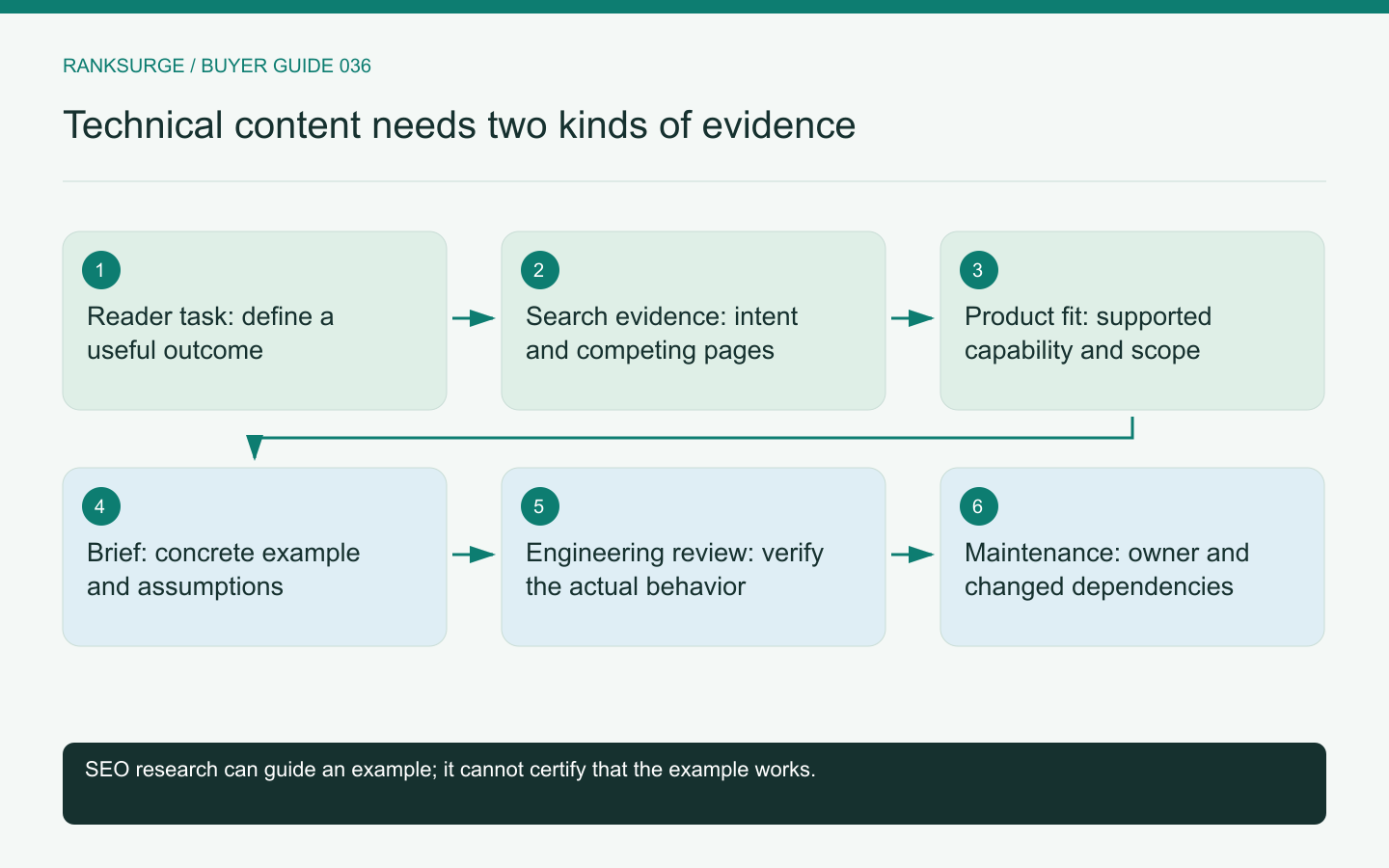
Evaluate SEO tools for technical content teams by tracing a keyword opportunity into a fact-checked brief, engineering review and maintainable page decision.
TL;DR
- Prioritize tools that produce reviewable briefs preserving reader task, evidence and separations between facts and examples so an author can execute and an engineer can verify the work.
- Use a hands-on trial method: ask candidates to research a concrete task with source context, then have an independent engineer identify which opportunities actually fit the product.
- Validate tool limits by checking maintenance and edge cases: keep research records for updates and ensure metrics or unknown values are preserved rather than misrepresented.
Start with the work a technical reader needs to finish
Technical content teams need SEO software that helps them identify useful reader tasks without weakening factual accuracy. A high-volume query can be attractive and still be a poor assignment if the product does not support the workflow or nobody can verify the proposed example.
Choose a real task for the buying trial: comparing deployment options, integrating an API or diagnosing a documented configuration problem. Write the intended reader, their starting knowledge and the result the page should help them achieve. The SEO tool should improve that brief, not replace it with a list of popular words.
Test the distinction between topic and product fit
Ask each candidate to research the task and return a small set of opportunities with their source context. Then have a product engineer identify which opportunities fit the current product and which require capabilities it does not offer.
For an illustrative developer platform, a query about self-hosting may attract relevant readers even when the product is hosted only. The team could publish an honest architecture comparison, but it should not commission a setup tutorial that implies unsupported installation options.
A useful research workflow retains the reason for rejecting a keyword. Otherwise, the same superficially attractive term can reappear in every planning cycle and consume repeated review time.
Inspect the evidence behind a brief
The brief should distinguish search evidence from product evidence. Search results help reveal likely reader intent and competing page formats. Product documentation and verified code behavior establish what your own article can accurately teach.
Google's helpful-content guidance emphasizes original value and reliable information. For a technical team, that means a brief should lead to an answer the author can substantiate, rather than a rewritten summary of pages already ranking.
Ask the tool to preserve query context, observed result URLs and the reasoning behind the recommended angle. The engineer reviewing the brief should be able to challenge a conclusion without repeating the entire research process from scratch.
Evaluate the handoff to engineering
Give the trial brief to an engineer who did not attend the vendor demonstration. Ask whether they can identify the proposed example, the assumptions that need verification and the product version or environment involved.
A request to write a complete guide to authentication is too broad to review efficiently. A brief about choosing between two supported credential scopes, with a concrete permissions fixture, gives the reviewer a bounded task. The SEO tool should help preserve that specificity.
RankSurge's MCP workflow can bring research into compatible agent clients and retain project context. That can support the handoff, but it does not make an unexecuted code sample tested. Keep research assistance and actual implementation verification separate in the content process.
Related reading: The Best Open Source SEO Tools in 2026.
Related reading: SEO for Startups: A Founder’s Handbook.
Compare update handling, not only new assignments
Technical pages age when APIs, configuration options or product behavior change. Ask how the candidate helps your team connect an existing page to its topic, evidence and owner. A research record that disappears after the article is commissioned is difficult to reuse during maintenance.
Use a fictional change in which one option is renamed and another is removed. The author should be able to identify the affected claim and decide whether to revise the page, narrow its scope or retire it. A generic freshness date is not enough to establish that the instructions remain correct.
Your team may keep this dependency record in its issue tracker rather than the SEO tool. That is acceptable if the handoff is explicit and the link survives exports and staff changes.
Check how the tool treats narrow demand
Technical queries may be highly specific and have unavailable or low reported volume. Ask whether the platform preserves unknown values and supports a qualitative decision based on customer need. Replacing an unavailable metric with zero can wrongly suggest that nobody needs the answer.
Conversely, technical relevance alone does not justify a separate page for every wording variation. Compare existing documentation and articles before commissioning new content. Sometimes improving one established page is more useful than creating several near-duplicate tutorials.
The purchasing trial should include both a clear commercial opportunity and a narrow support-driven task. A tool that can only prioritize broad volume may not fit the team's actual mix of work.
Choose for reviewable production, not effortless output
Compare candidates on the quality of the research packet, the clarity of product-fit decisions and the effort required for engineering review. Include maintenance and corrections in the cost discussion, not just the speed of generating a draft outline.
The best result is a brief an author can execute and an engineer can verify. It names a real reader task, preserves the search evidence and clearly separates documented facts from proposed examples. Buy the workflow that makes those boundaries easier to maintain as the content library grows.