
SEO Tools for Product-Led Growth: Connect Search Opportunities to Product Tasks
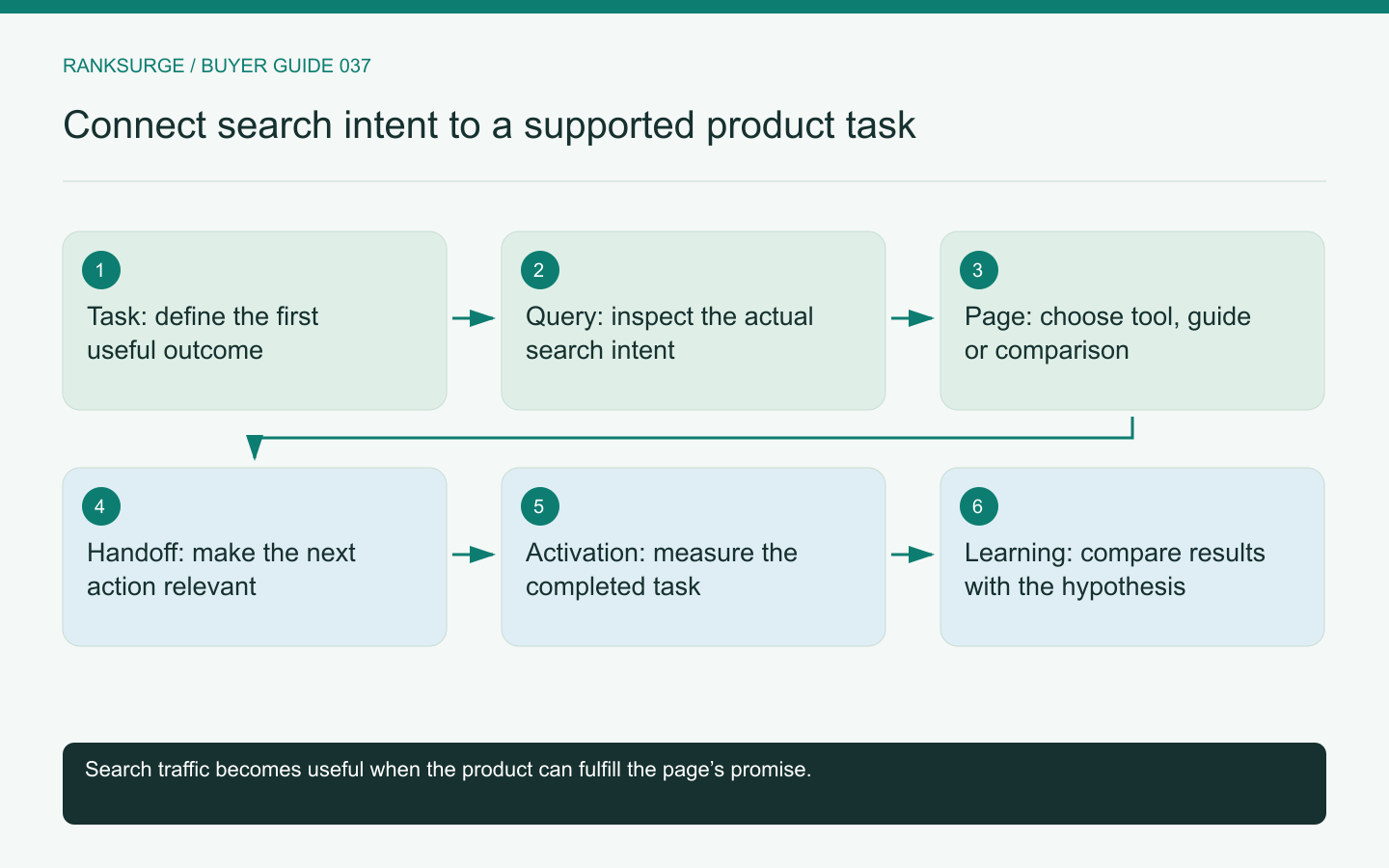
Choose SEO tools for product-led growth by connecting search opportunities to supported product tasks, activation evidence and honest page decisions.
TL;DR
- Prefer SEO tools that connect discoverable questions to useful product experiences by defining the product action before targeting keywords; begin the trial with one supported product task to judge fit.
- Evaluate candidates by comparing query intent and drafting a page-to-product handoff: research observed search results, then describe what the visitor learns, the next task, and the product state on arrival.
- Require measurable activation and realistic readiness checks: define a product event that proves the intended first task, and join Search Console exposure with product analytics rather than equating traffic to users.
Define the product action before the keyword target
SEO tools for product-led growth should help a team connect discoverable questions with useful product experiences. More traffic is not automatically more product adoption. A query can attract curious readers who have no reason to use the software, while a smaller task-specific query can lead to a meaningful first action.
Begin the trial with one supported product task. For example, a scheduling product might help a team coordinate availability across several participants. Define what a successful first use looks like before asking the SEO tool for related opportunities.
This does not mean every article must push a signup. It means the team should understand how the reader's problem relates to the product and where the product is not the right answer.
Compare query intent with the actual experience
Ask each candidate to research the task and show the observed search results. Determine whether people appear to want a free utility, a buying comparison, a conceptual explanation or implementation instructions. These intentions can share vocabulary while requiring different pages.
For an illustrative query about comparing meeting availability, a useful interactive tool may serve the need better than a long article. A query about selecting enterprise scheduling software may require a careful buyer guide. The SEO platform should support that distinction rather than convert every opportunity into the same blog assignment.
RankSurge's keyword research feature can supply query and SERP context. The product team still needs to decide which supported experience can satisfy the reader honestly.
Related reading: The Best Open Source SEO Tools in 2026.
Related reading: SEO for Startups: A Founder’s Handbook.
Inspect the transition from page to product
Use the trial to draft a page-to-product handoff. Describe what the visitor learns on the page, what they need to try next and what state the product should present when they arrive.
A generic homepage link may be sufficient for a broad comparison. A task guide may benefit from a relevant setup screen or documented example. Do not promise a preconfigured experience unless the application actually provides it.
Ask a colleague unfamiliar with the proposed page to follow the handoff. If they cannot tell why the product is relevant or what to do after signup, the keyword opportunity is not yet a complete growth plan. More traffic would amplify that confusion rather than fix it.
Choose meaningful activation evidence
Define a product event that indicates the visitor completed the intended first task. Account creation alone may be too weak when the real value occurs only after configuration or collaboration.
Then identify what measurement is available. Search Console can describe search exposure and clicks, while product analytics can describe in-app events. Joining those views requires an intentional measurement design and does not automatically establish causation.
The buying trial should include a report with both stages clearly labeled. Avoid a vendor presentation that silently treats estimated search traffic as active users or labels every organic signup as proof of a particular page's incremental impact.
Review opportunities against capability and readiness
A commercially attractive query may imply features your product does not have. Record that mismatch instead of writing an article that stretches the product description. A transparent comparison can still be useful, but the recommendation must follow the reader's requirements.
Readiness also matters. If the relevant product flow is confusing or incomplete, improving that flow may be a better first investment than commissioning a large content cluster. SEO software should inform prioritization, not create pressure to publish regardless of product quality.
Google's people-first content guidance provides a useful general standard: the page should help its intended audience accomplish something. Apply that standard even when a keyword has attractive commercial metrics.
Compare small experiments with broad publishing plans
Select a limited set of opportunities that represent different intent types. Publish or improve only the pages your team can support with a clear product experience and a reviewable measurement plan.
Ask the SEO tool to preserve the original hypothesis, target page and research context. Later, compare what happened with what the team expected. If a page attracts the wrong audience, the response may be to narrow its promise rather than add more calls to action.
A platform that saves decision history can be more useful than one that repeatedly generates new opportunities without helping you learn from earlier choices. Growth depends on those feedback loops, not only on research throughput.
Buy for the connection between evidence and product work
A research platform, product analytics system and engineering workflow may each own part of the process. Do not assume one SEO subscription replaces all three. Choose integrations only when they preserve useful context and reduce a real handoff problem.
The strongest candidate helps your team explain why a query fits, which page should serve it and which product action would demonstrate value. It also leaves room to reject a high-volume topic or delay publication when the product cannot yet fulfill the promise. That discipline makes SEO part of product growth rather than a separate traffic target.