
SEO Tools for Product Launch Research: Compare Market Evidence Before Building Pages
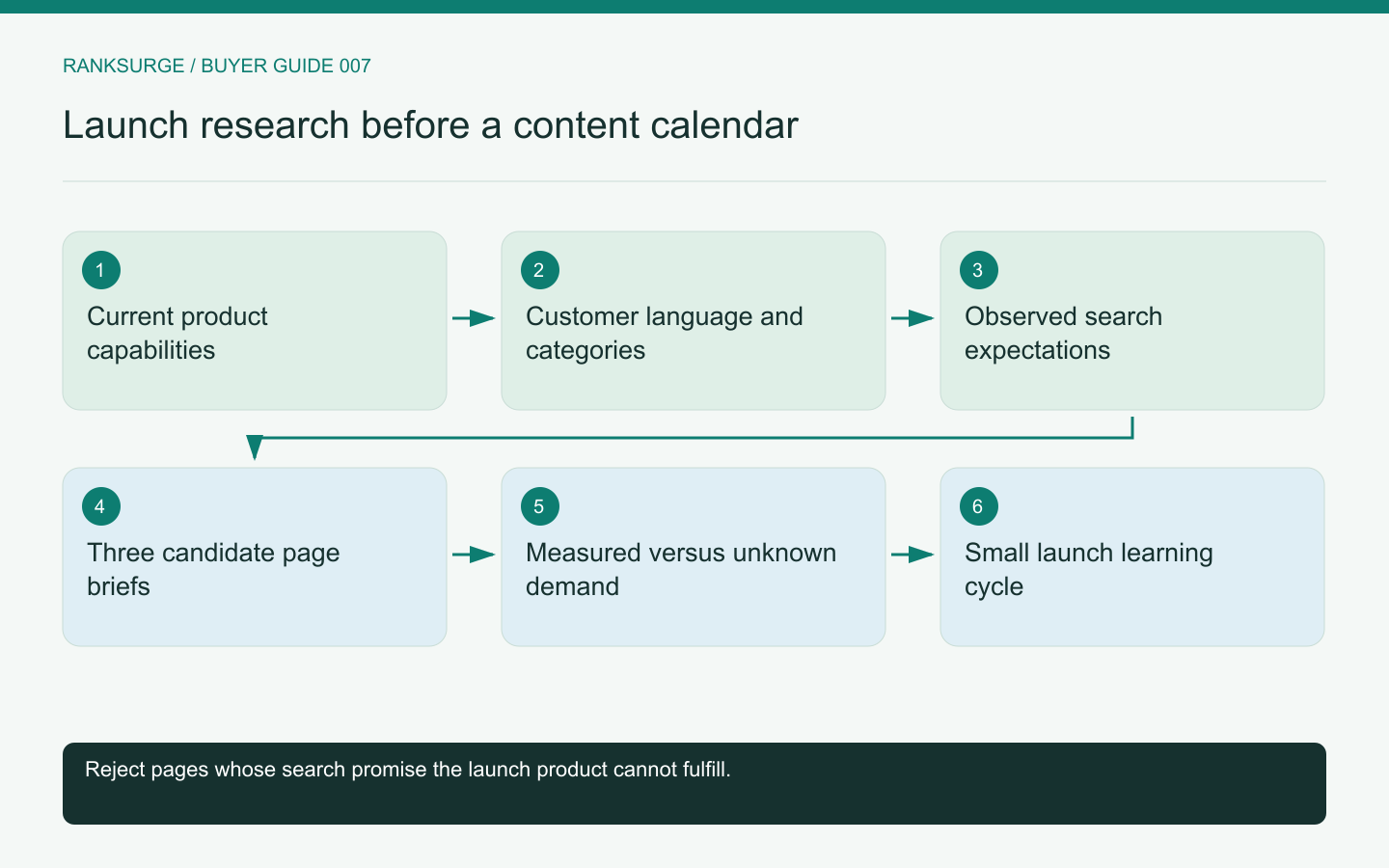
Evaluate SEO tools for a product launch by testing category demand, searcher fit and landing-page decisions before committing to a content plan.
TL;DR
- Main decision: buy a launch-focused SEO tool only if it helps pick a credible initial market and a few useful pages, surfacing uncertainty so the team can revise assumptions before committing.
- Useful method: test one category by having the tool inspect representative searches and dominant page types, then evaluate three candidate pages (category, use-case, implementation) for fit.
- Meaningful limit and success check: plan a small learning cycle with explicit hypotheses, save a baseline and the date of meaningful changes, then measure whether queries, visitor actions and conversations align.
Research the market before filling the calendar
A product launch creates pressure to publish quickly. An SEO tool can help you choose useful pages, but it can also make an untested content plan look precise. Hundreds of keywords are not evidence that the new product serves hundreds of distinct search needs.
For a launch, the buying decision should focus on market investigation. Can the tool help you understand how potential customers describe the problem, which page types appear in search and where your product has a credible answer? Choose that workflow before paying for extensive ongoing monitoring you may not yet need.
Write down what is actually available at launch. Include supported use cases, integrations, audiences and limitations. Research based on a future roadmap can lead to pages that attract customers the current product cannot serve.
Test one category and its adjacent meanings
Suppose you are launching software that collects client documents. Candidate phrases might refer to secure portals, form builders, file requests or document management. Each category can imply a different buyer expectation. A generic keyword list may mix them together because the terms share vocabulary.
Ask each candidate tool to inspect representative searches and identify the dominant page types. Are results product pages, templates, tutorials or enterprise procurement guides? Open a few relevant pages and note the task they promise to complete. Then compare that promise with the launch product.
This is an illustrative research exercise, not a claim that any particular category has a known volume or difficulty. The purpose is to test whether the platform helps you distinguish adjacent markets before committing to one.
Evaluate evidence for the first three pages
Choose three possible launch pages with different purposes: a category landing page, a specific use-case page and an implementation guide. Ask the tool to produce a compact evidence packet for each. It should include the audience, search context, product fit, existing alternatives and the question the page must answer.
The tool should also help you reject a page. If an apparent opportunity mostly attracts users seeking a free downloadable form, it may be a poor fit for a paid workflow product. That rejection is valuable even if the keyword has an attractive demand estimate.
Compare the packets with your sales conversations and support knowledge. Search data is one source of market evidence. It should not erase direct knowledge that a phrase means something different to your intended customers.
Preserve unknowns instead of manufacturing certainty
A new category or niche integration may have incomplete keyword data. Record unavailable volume or difficulty as unknown. A tool that shows a blank value is not necessarily failing; a tool that encourages a confident conclusion from missing evidence is more concerning.
Use additional signals carefully: relevant search results, repeated customer language, competitor page coverage and the existence of a real product task. These can justify an editorial experiment, but they do not turn an unmeasured keyword into a validated demand forecast.
During the trial, ask for one measured opportunity and one unmeasured hypothesis to be saved separately. Check whether your team can still distinguish them when reviewing the plan later.
Inspect how the platform supports this work
RankSurge's keyword research feature combines keyword metrics, search-result inspection and saved opportunities. For launch research, evaluate whether that combination helps you move from broad category language to a defensible page choice. Do not judge success by the maximum number of returned suggestions.
Ask a researcher to save the market, evidence links and reason for selection alongside the keyword. Then hand the plan to the person responsible for product positioning. If they discover unsupported promises, revise the brief before any article is commissioned.
Keep research and publishing permissions separate. Approving an investigation should not silently authorize a tool or agent to publish claims about an unreleased capability.
Related reading: SEO for Startups: A Founder’s Handbook.
Related reading: The Best Open Source SEO Tools in 2026.
Plan a small learning cycle
The first release of pages should answer a small number of well-supported questions. Define what you will learn after launch: whether relevant queries appear, whether visitors reach the appropriate product action and whether customer conversations match the page's framing. Avoid setting a ranking deadline the research cannot justify.
Save a baseline and the date of meaningful page changes. When results arrive, distinguish a wrong market assumption from weak execution or insufficient evidence. A low-traffic page may still be too new to judge; a page attracting the wrong audience may require a positioning change rather than more paragraphs.
Your tool evaluation should include this return visit. Can you reopen the original reasoning and compare it with what happened, or does the plan become a disconnected list of completed articles?
Buy for the next decision, with room to change
A launch team may need intensive discovery for a short period and modest monitoring afterward. Compare that workload with the available billing options and export requirements. Keep the research portable so a later change in tooling does not erase the learning.
The best launch research tool is the one that helps you choose a credible initial market and a few useful pages. It should make uncertainty visible and allow your team to revise its assumptions. A larger content calendar is an output; a clearer product-to-search fit is the decision worth buying.