
SEO Tools for Multilingual Sites: Compare Market Coverage and Language Context
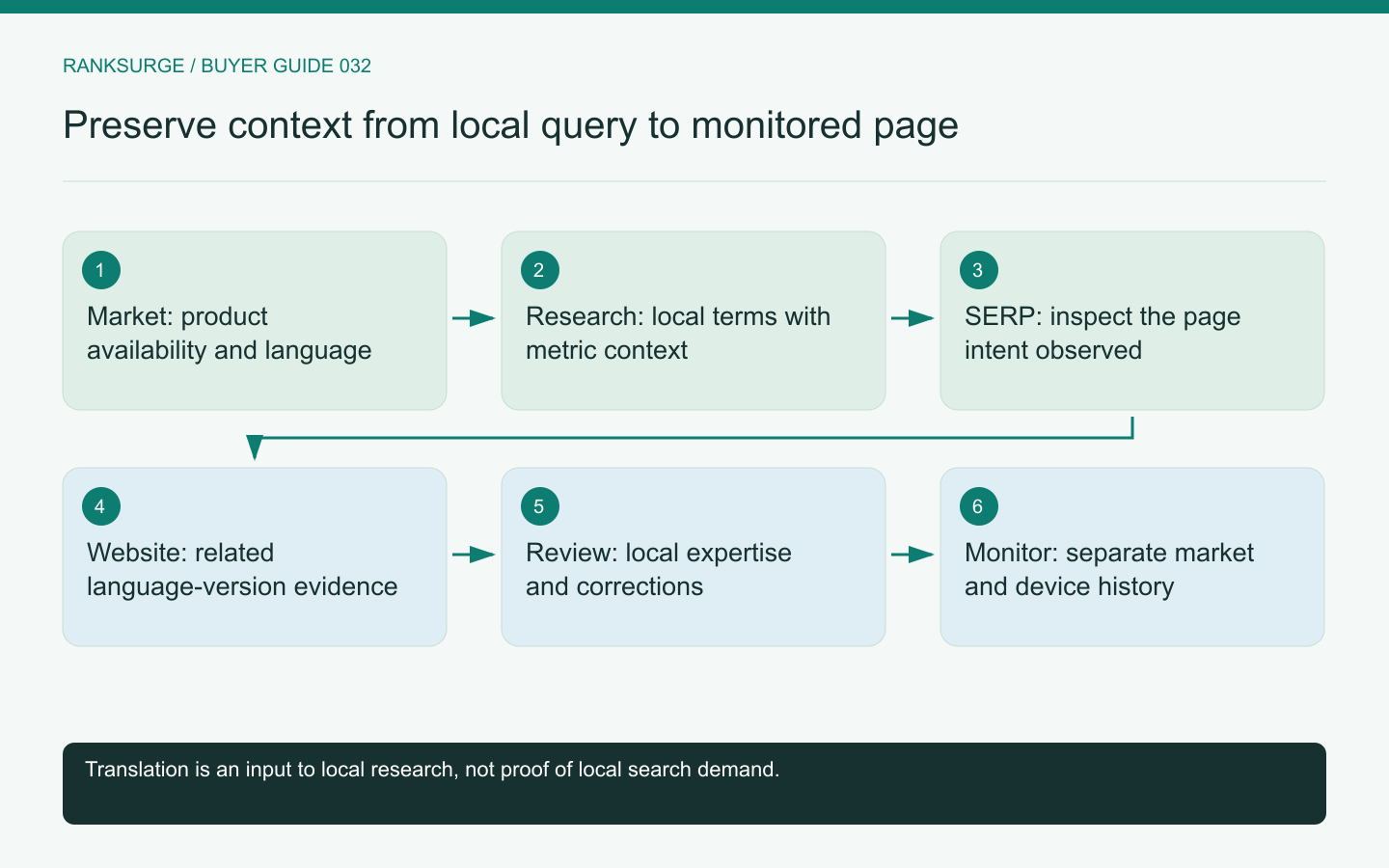
Compare SEO tools for multilingual sites using explicit language, country, URL and search-result contexts instead of translating one keyword list.
TL;DR
- Prefer tools and trials that match the markets the team can actually serve: aim for a small set of locally valid page decisions, clear technical inspection scope, and separate monitoring baselines.
- Evaluate candidates with concrete, market-specific tests: map supported market×language combinations, then ask each tool to research one product category in two genuine target markets for comparable evidence.
- Require explicit context and preserved evidence: tools must show location, language and collection context for metrics, keep unavailable local metrics unknown, and keep market histories separate.
Separate language from market
SEO tools for multilingual sites must preserve both the language people use and the market in which they search. A translated keyword list is not automatically a local demand model. The same language can appear in several countries with different products, competitors and buying expectations.
Begin with a matrix of supported markets and languages. For each combination, record whether the product is actually available, which site version serves it and who can review local terminology. This keeps the purchasing trial connected to real customer coverage rather than a long list of theoretically supported locations.
Related reading: The Best Open Source SEO Tools in 2026.
Use a market-specific research fixture
Choose one product category and ask each candidate to research it in two genuine target markets. Keep the seed idea consistent while allowing the local terms to differ. Inspect the resulting queries and search pages with someone who understands the language.
The tool should expose the location, language setting and collection context behind its metrics. A volume figure without those dimensions is difficult to compare. An attractive global total can hide a weak fit for the market your team is about to launch.
Keep unavailable local metrics explicitly unknown rather than substituting a global number.
Do not require identical keyword counts across markets. The useful result is a defensible set of local customer questions, including cases where a direct translation is not the phrase people normally use.
Compare page intent before assigning translations
Search results can reveal whether a query is served by category pages, product pages, guides or local service listings. Ask the tool to preserve the observed result URLs and the context of the lookup so reviewers can inspect the evidence.
An illustrative software product may find that one market uses a category term while another commonly searches for a specific workflow. Those findings can justify different page emphasis. They do not justify inventing local demand that the research did not establish.
RankSurge's keyword research workflow can support query and SERP investigation. The buying test is whether its available coverage and saved evidence match your target markets, not whether a single English-language demo looks comprehensive.
Related reading: SEO for Startups: A Founder’s Handbook.
Inspect the website's language relationships
Google's multilingual and regional site guidance discusses language versions and regional targeting. Use those concepts to create a technical fixture that includes related pages across site versions.
Ask the candidate to show which URL was inspected and what language or alternate-page signals it actually observed. Distinguish a tool that reports raw page evidence from one that validates a complete network of relationships. Both can be useful, but the second claim requires a broader demonstration.
Include a missing counterpart and a page whose translated navigation points back to the wrong market. These cases test whether the tool helps identify actionable inconsistencies rather than merely confirming that a language code appears somewhere in the HTML.
Test rank tracking with explicit context
Configure a small set of priority queries in the actual markets and devices you care about. Record the tracked URL and the observed ranking URL. A translated page ranking where you expected a different version is a useful investigation signal, not automatically proof that the language configuration is broken.
Keep market histories separate. Combining positions from different countries into one average can make a launch look better or worse without showing which customers experienced the change. Require a report that can preserve each configured context.
Also ask how new language versions enter monitoring. The team should be able to add a market deliberately and retain its start date, rather than quietly changing an existing tracker and losing a comparable baseline.
Evaluate collaboration with local reviewers
Give a regional marketer a sample research export. Can they see the original query, market, source context and proposed page decision? Can they reject a term as unnatural without losing the evidence that led to its selection?
A useful workflow preserves both machine-derived metrics and human language judgment. The reviewer should not have to choose between accepting every suggestion and replacing the entire dataset with an untraceable personal spreadsheet.
Measure the cost of repeated research as well. Expanding one query across several markets can multiply requests, so compare plans using the actual lookup pattern your team needs. Do not assume a project count is equivalent to market coverage.
Buy for the markets you can serve well
A specialist local or multilingual tool may be necessary for a particular search engine or region. A broader platform may be sufficient when it exposes the right context and your team supplies knowledgeable review. Verify coverage before committing to a long-term workflow.
The strongest trial produces a small set of locally valid page decisions, a clear technical inspection scope and separate monitoring baselines. Prefer that outcome over a large translated keyword export whose numbers and language choices nobody can confidently explain.