
SEO Tools for In-House Teams: Evaluate the Handoff to Engineering
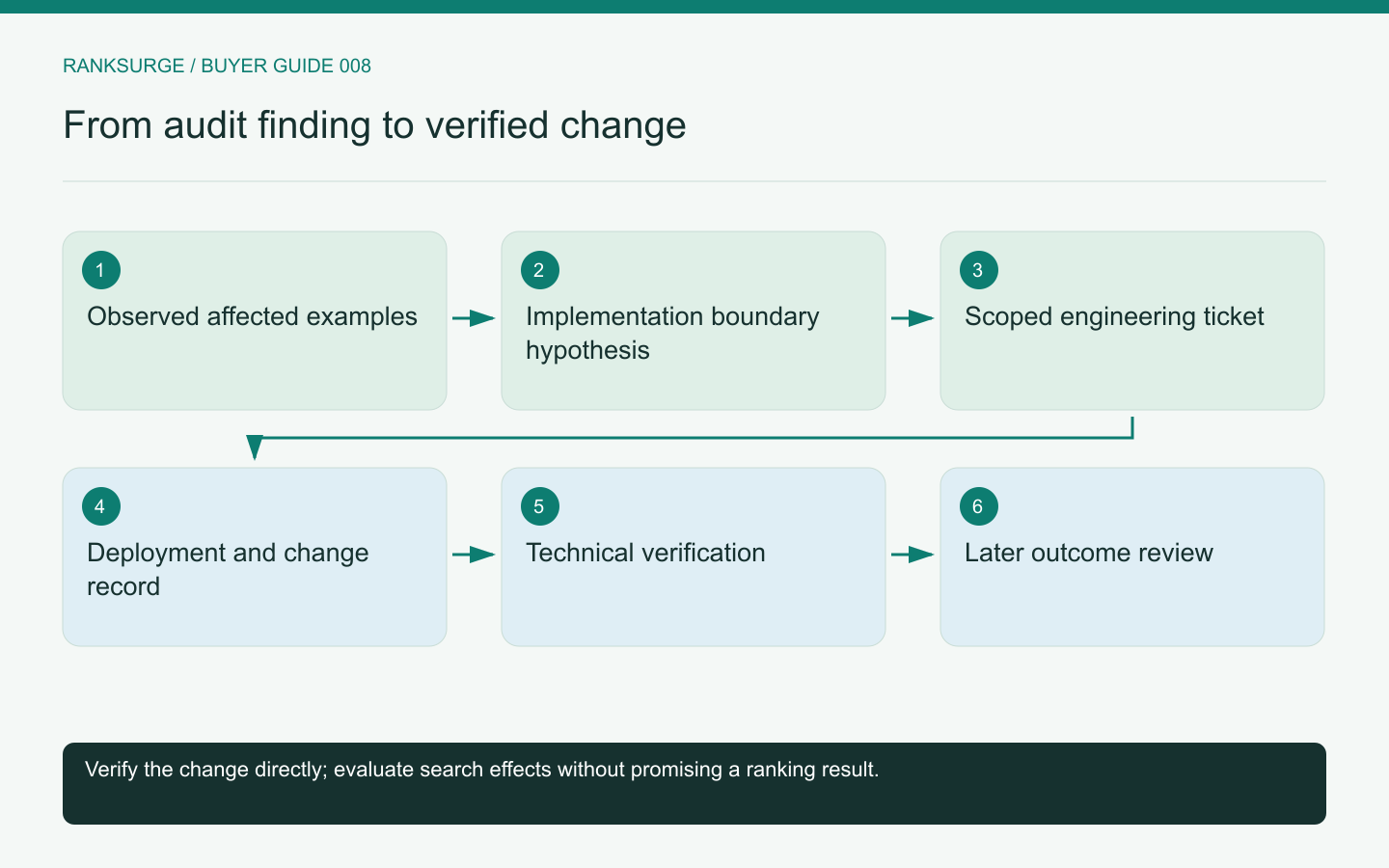
Choose an SEO tool for an in-house team by testing whether research becomes an engineering task with scope, evidence and a verification step.
TL;DR
- Make buying decisions on whether a platform improves the cross-team handoff, not just analysis output: run trials that deliver an understandable work item rather than screenshots of warnings.
- Evaluate with a representative issue: inspect a small sample, preserve source and destination, group evidence by likely implementation boundary, and treat root causes as hypotheses until verified.
- Use implementation-quality acceptance tests and clear verification: require recorded deployment details and that an engineer can start investigation without asking what the ticket means.
Buy the handoff as well as the analysis
An in-house SEO team can identify useful work and still struggle to get it implemented. Engineers receive vague tickets, product managers cannot compare the request with other priorities, and analysts lose track of what changed. Another dashboard will not solve those coordination problems unless it improves the handoff.
Evaluate an SEO platform using a task that crosses team boundaries. Choose a real page family and a change that could plausibly require engineering. Your trial should end with an understandable work item, not merely a screenshot of a warning. This makes the product comparison relevant to the way your organization actually ships changes.
Select a representative issue
Imagine a documentation site whose older pages link through unnecessary redirects. An audit may identify many affected URLs. Engineering needs to know whether the issue comes from a shared component, generated navigation or individual article content. Those possibilities imply different owners and different fixes.
During the trial, inspect a small sample of affected pages and preserve the observed source and destination. Group the evidence by the likely implementation boundary. Label the cause as a hypothesis until someone verifies it in the code or content system.
A platform that makes the affected examples easy to inspect can reduce investigation time. It does not remove the need to understand the application. Avoid turning a tool's severity label directly into an engineering priority without checking scope and user impact.
Define the minimum useful ticket
A useful ticket names the problem, affected page family, evidence, proposed action and verification method. Include the date of observation and any crawl limitations. Add what is not yet known so the implementer does not mistake a hypothesis for a confirmed root cause.
For the redirect example, the verification might be that selected internal links point directly to the intended canonical destination after deployment. It should not promise a specific ranking improvement. The team can verify the technical change immediately while observing search effects over a longer period.
Attach a few representative URLs and a way to retrieve the full affected set. A thousand-row attachment without a summary shifts all prioritization work onto engineering; a summary without examples makes the finding difficult to trust.
Evaluate reporting against the team's planning process
Ask a product manager to compare the SEO ticket with ordinary product work. Can they understand the expected benefit, effort uncertainty and consequences of delaying it? If the answer is no, identify whether the missing context is business judgment or unavailable tool evidence.
Use clear categories: access or discovery problems, misleading page signals, broken user journeys and opportunities to improve the answer. These categories can help a team reason about work without treating every audit flag as equally urgent.
RankSurge's site audit documentation describes crawl signals, affected URLs and optional Lighthouse findings. Evaluate those as inputs to your planning process. A performance sample and a site-wide crawl do not necessarily cover the same pages, so keep their scope explicit in the ticket.
Related reading: The Best Open Source SEO Tools in 2026.
Related reading: SEO for Startups: A Founder’s Handbook.
Check how changes return to the analyst
Implementation is not the end of the workflow. The analyst needs the deployment date, the actual change and any deviation from the proposed fix. Without that record, a later traffic change may be incorrectly attributed to the original recommendation.
During the trial, simulate a completed task. Update the ticket with a release note, run the relevant verification and save the new observation beside the old one. Check whether the platform's history or your accompanying workflow makes this comparison straightforward.
If another system will remain the source of truth for engineering work, that can be a good choice. Evaluate the linking and export process rather than demanding that the SEO product replace your issue tracker. The buying question is whether the boundary is reliable, not whether one tool owns everything.
Test access and ownership with real roles
An analyst, engineer and manager may need different views of the same evidence. Verify which access patterns the product supports in your intended plan. Do not assume that a read-only report link, a project member and an account administrator have equivalent permissions.
Ask who retains access if the person who created the project leaves. Confirm who manages connected properties and billing. Use test data when checking these scenarios so the evaluation does not expose customer or internal information unnecessarily.
The best permissions model is one your team understands and can operate. If a workflow requires broad access for every reviewer, record that limitation before adopting the product widely.
Make implementation quality the acceptance test
Choose the platform that helps your team move a finding into an appropriately scoped change and verify the result. Keep a short purchase note listing the demonstrated handoff, manual steps and unresolved limitations.
A useful acceptance test is that an engineer who missed the research meeting can start the investigation without asking what the ticket means. A second test is that the analyst can later explain what actually shipped. When both pass, the platform is supporting the whole improvement cycle rather than merely producing another list of issues.