
SEO Tools for Ecommerce Catalogs: Evaluate URL Discovery and Product-Level Evidence
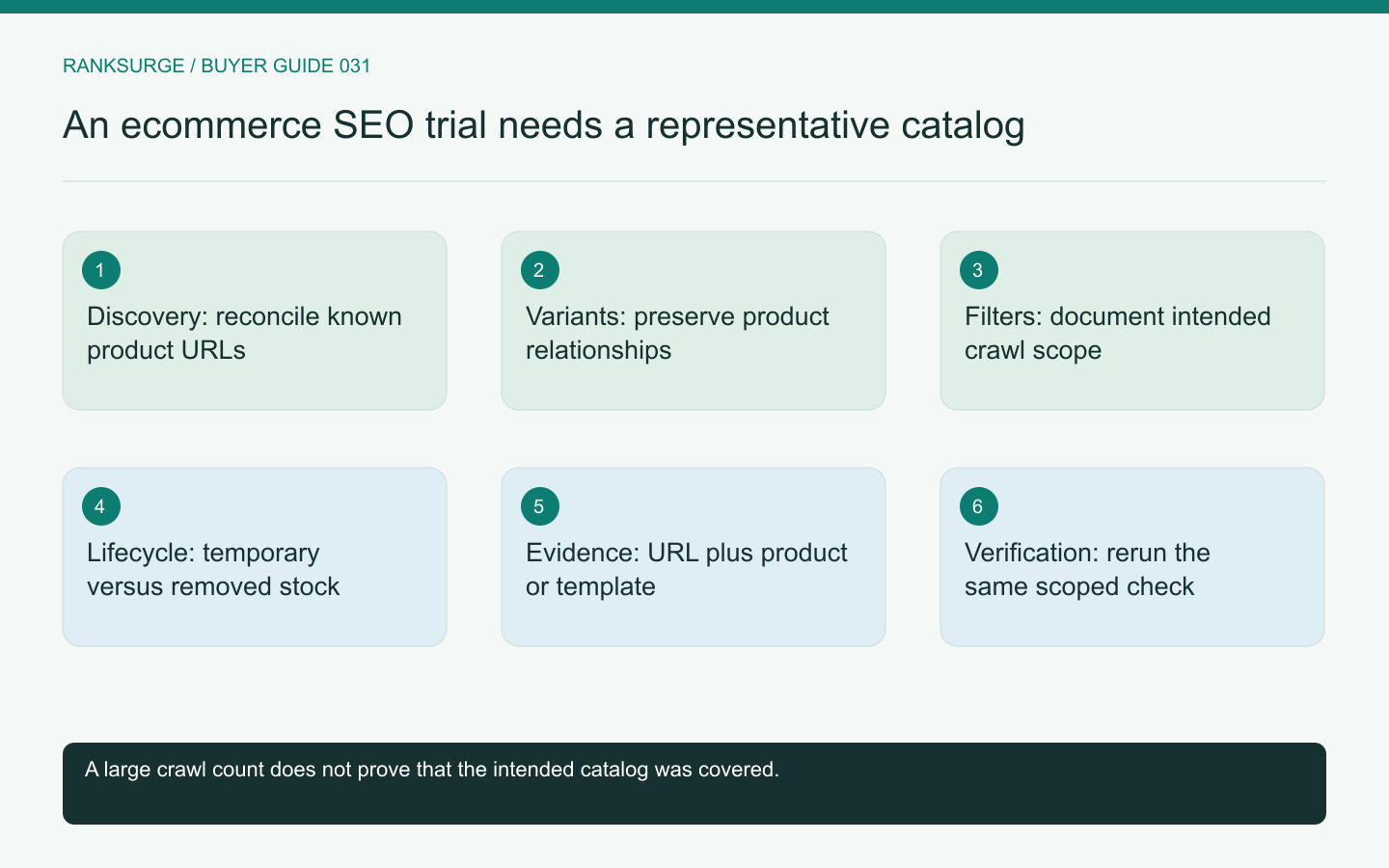
Choose SEO tools for ecommerce catalogs by testing product discovery, variant URLs, stock changes and evidence that can be handed to catalog engineers.
TL;DR
- Base the buying decision on a catalog-level evaluation: sample representative product states, confirm the tool preserves context for variants and lifecycle, and prefer platforms that deliver actionable handoffs.
- Use a reconciliation method: compare the tool's discovered URLs to your commerce product list, ask how pages were discovered, and demand a coverage explanation identifying missed and checked pages.
- Validate limits and reproducibility by testing filters, lifecycle states, and a simple fix cycle so scope is controlled and a repeat run confirms whether observed conditions changed.
Evaluate a catalog, not a handful of landing pages
An ecommerce catalog can contain products, variants, categories, filters and temporary states that look similar to a crawler but serve different customer needs. Buying an SEO tool for that environment requires more than confirming that it can find a missing title on the homepage.
Select a representative sample before starting a trial. Include a product with variants, a category with pagination, a filtered collection, a temporarily unavailable product and a permanently removed item. Your goal is to see whether the tool preserves enough context to distinguish these cases and recommend the right investigation.
Compare discovered URLs with known inventory
Start with a product list from your commerce system and compare it with the tool's discovered pages. A crawl can only report on the URLs it reaches or is explicitly given. A clean result for a partial crawl does not establish that the entire catalog is healthy.
Ask how the candidate discovers pages: internal links, sitemaps, supplied URL lists or another mechanism. Record page limits and exclusions. A catalog with many parameter combinations may consume a crawl budget differently from a site with the same number of products and simple URLs.
The useful purchasing output is a coverage explanation. You should be able to identify which intended product pages were checked, which were missed and why. A large total URL count is not a substitute for that reconciliation.
Inspect product and variant identity
Google's ecommerce URL guidance explains how URL design can create duplicate retrieval or missed content. Use that guidance to frame your tests, while keeping your store's intended product relationships explicit.
For an illustrative shoe catalog, one product may have several sizes and colors. Ask the tool to show the observed URL, canonical reference and linking context for a selected variant. The report should not automatically treat every similar page as a mistake without considering how the store represents variants.
Compare the SEO record with the product identifier used by merchandising. Engineers can act more reliably on a finding connected to a known product or template than on a spreadsheet of unexplained URLs.
Test filters without rewarding endless crawling
Faceted navigation can create many combinations. A useful tool should let you inspect representative paths and understand its crawl configuration rather than simply celebrate how many pages it fetched.
Choose a category with two filters and inspect the unfiltered page, each single-filter state and a combined state. Record which pages are intended to be discoverable and useful in search. The tool's job is to supply evidence about the observed implementation; your catalog strategy determines the intended behavior.
Ask whether configuration changes can be saved for a repeat run. If one analyst excludes parameters and another does not, their issue totals may differ for reasons unrelated to a website improvement. Reproducible scope is essential for comparing results over time.
Include stock and lifecycle changes
Temporarily unavailable products and permanently removed products deserve separate evaluation fixtures. A report that labels both as an identical problem may encourage the team to implement an overly broad fix.
Have the tool inspect the observed status, page content and internal links for each fixture. Then ask a merchandiser to explain the intended customer experience. The buying decision should favor a workflow that connects those two perspectives without assuming every product change is an SEO emergency.
Keep historical comparisons contextual. If a catalog deliberately removed a discontinued line, fewer indexed or crawled product URLs may be expected. A dashboard should let the team annotate or explain that change rather than presenting every reduction as unexplained decline.
Compare specialist crawling with broader research
A dedicated crawler may be appropriate when your catalog depends on detailed rendering, extraction or crawl controls. A broader research platform may be valuable for connecting category opportunities, competitor visibility and technical observations.
RankSurge's site-audit feature provides page-level SEO signals. Evaluate those against your representative catalog rather than assuming the audit replaces every specialist ecommerce diagnostic. Pair tools only when the additional evidence changes a real decision.
For example, category keyword research can help decide which collection deserves attention, while a focused crawl explains whether its product links are discoverable. These are complementary jobs with different acceptance criteria.
Related reading: The Best Open Source SEO Tools in 2026.
Related reading: SEO for Startups: A Founder’s Handbook.
Require an actionable catalog handoff
Ask each candidate to produce a small issue packet containing the affected URL, observed condition, product or template context, example evidence and suggested verification after a fix. A report of thousands of warnings is less useful than a prioritized set tied to changes the team can safely make.
Have an engineer implement one harmless test correction and rerun the same scoped check. The tool should make it clear whether the observed condition changed. Choose the platform whose coverage and evidence your merchandising and engineering teams can both understand, not the one that produces the largest raw issue count.