
SEO Tools for Cursor: Keep Research Context Separate From Code Changes
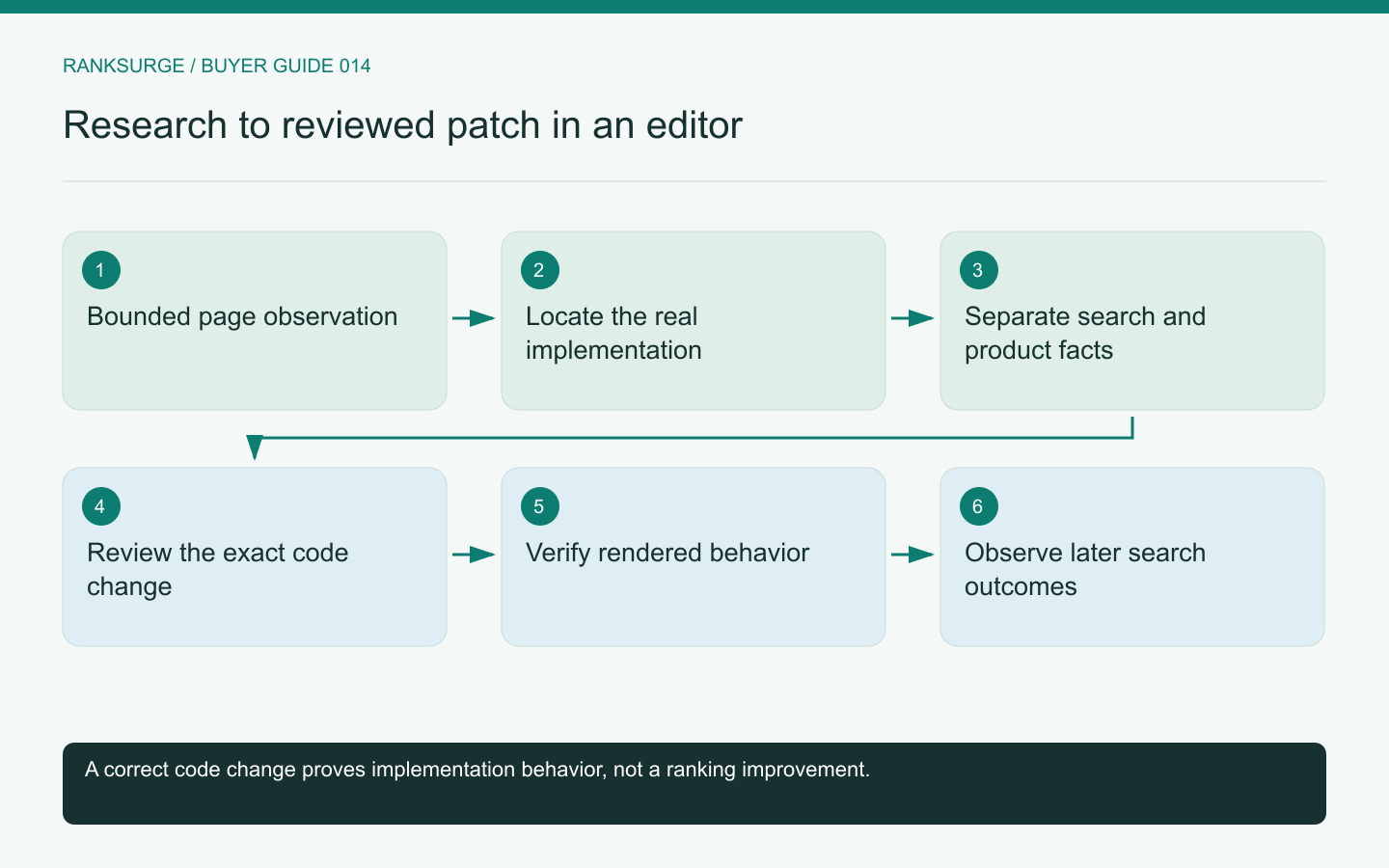
Evaluate SEO tools in a Cursor workflow through the handoff from research to a reviewed code change, with explicit boundaries for source facts and deployment.
TL;DR
- Prefer SEO tooling that preserves the review boundary: it must support a clear path from observation to a reviewed change while leaving deployment under the team's normal authority.
- Evaluate tools with a bounded page-level task: ask the research tool for context, then require the editor agent to locate the implementation without changing unrelated files.
- Judge success by a completed review cycle and engineering verification: the workflow should yield a small, understandable change, then verify rendered output and metadata in the right environment.
Evaluate the boundary between research and editing
An editor-based agent can move quickly from a search insight to a code change. That makes an SEO connection useful for developers, but it also makes the review boundary important. A recommendation about a title, route or internal link should remain traceable to evidence after it becomes a patch.
When choosing SEO tooling for a Cursor workflow, test a small code-adjacent problem. Avoid using a broad “optimize the whole site” request as the first evaluation. It creates too many simultaneous changes to understand whether the research improved the implementation.
The purchase should support a clear path from observation to reviewed change, while leaving deployment under your team's normal authority.
Pick a bounded page-level task
Use a page with a specific problem such as an unclear title or an internal link that sends users through an obsolete route. Ask the research tool for the relevant search context or audit evidence. Then ask the editor agent to locate the implementation without changing unrelated files.
The resulting proposal should name the affected component or content file and explain why the proposed change addresses the observation. If the title is generated from shared data, the agent should identify that boundary rather than editing a rendered artifact that will be overwritten.
This tests the connection between research and code understanding. The SEO tool is not expected to know your entire application; the workflow should combine its evidence with the repository's actual structure.
Keep three kinds of evidence distinct
Search evidence describes observed results, queries or page signals. Product evidence describes what your application actually offers. Implementation evidence describes how the current code produces the page. A useful proposal cites the relevant source for each.
For example, a competitor's result may emphasize an integration your product does not support. That is not permission to add the same claim to your title. Likewise, an audit finding about a missing field does not prove the field is absent from every rendered state of a dynamic page.
Ask the agent to identify what it has inspected and what it is assuming. If the result depends on a browser-rendered state, include that verification in the plan rather than pretending a source-file read is sufficient.
Review the patch as a product change
Inspect the exact diff. Check that the change preserves meaning, accessibility and routing behavior. A keyword inserted into a button label may make the interface worse even if it looks relevant in a research table. A renamed URL can create migration work far beyond the original SEO question.
Keep changes proportional to the evidence. If the task concerns one page title, a broad navigation rewrite should require its own rationale. The trial should reveal whether the workflow can stay scoped when the agent discovers adjacent opportunities.
Record rejected edits too. A useful evaluation may conclude that the current wording is clearer or that more evidence is needed before changing a route.
Verify the result in the right environment
After an authorized change, inspect the rendered page and relevant metadata using your normal development checks. Confirm that the intended output changed and unrelated behavior remained intact. For a link correction, follow the link; for metadata, inspect the generated value rather than only the source string.
Search outcomes require a separate observation period. A passing build or a correct browser render establishes implementation behavior, not a ranking improvement. Keep those claims separate in the final report.
This is why an editor workflow needs both engineering verification and SEO evidence. Neither replaces the other, and the tool comparison should include the effort required to complete both.
Check connection scope and persistence
Verify the SEO connection in the actual Cursor environment your team uses. Follow current provider and client documentation rather than relying on a remembered configuration format. RankSurge's MCP setup guide includes a Cursor connection path, which you should confirm against the installed client.
Decide whether the configuration belongs to an individual or a shared project and how credentials are supplied. Avoid committing personal secrets. Make sure a teammate can understand the required setup without inheriting another person's account authority.
Save the research artifact alongside the issue or review, not solely in an editor chat. The next developer should be able to see why the change was made after the original session is gone.
Related reading: How to Prompt Claude Code for SEO.
Related reading: The Best Open Source SEO Tools in 2026.
Choose based on a completed review cycle
Compare candidate tools using the same bounded task and include research cost, implementation review and verification effort. Note whether the result preserved source context and whether the agent stayed within the intended files and actions.
A successful workflow produces a small, understandable change with a clear reason and appropriate checks. It does not need to automate deployment to be valuable. In many teams, the best improvement is reducing the gap between a vague SEO request and a patch an engineer can review confidently.
Buy the connection that supports that complete cycle. Keep research permission, code-edit permission and production-release permission explicit so convenience in the editor does not blur who is responsible for the final product behavior.