
SEO Tools for Consultants: Evaluate Evidence, Reuse and Client Explanations
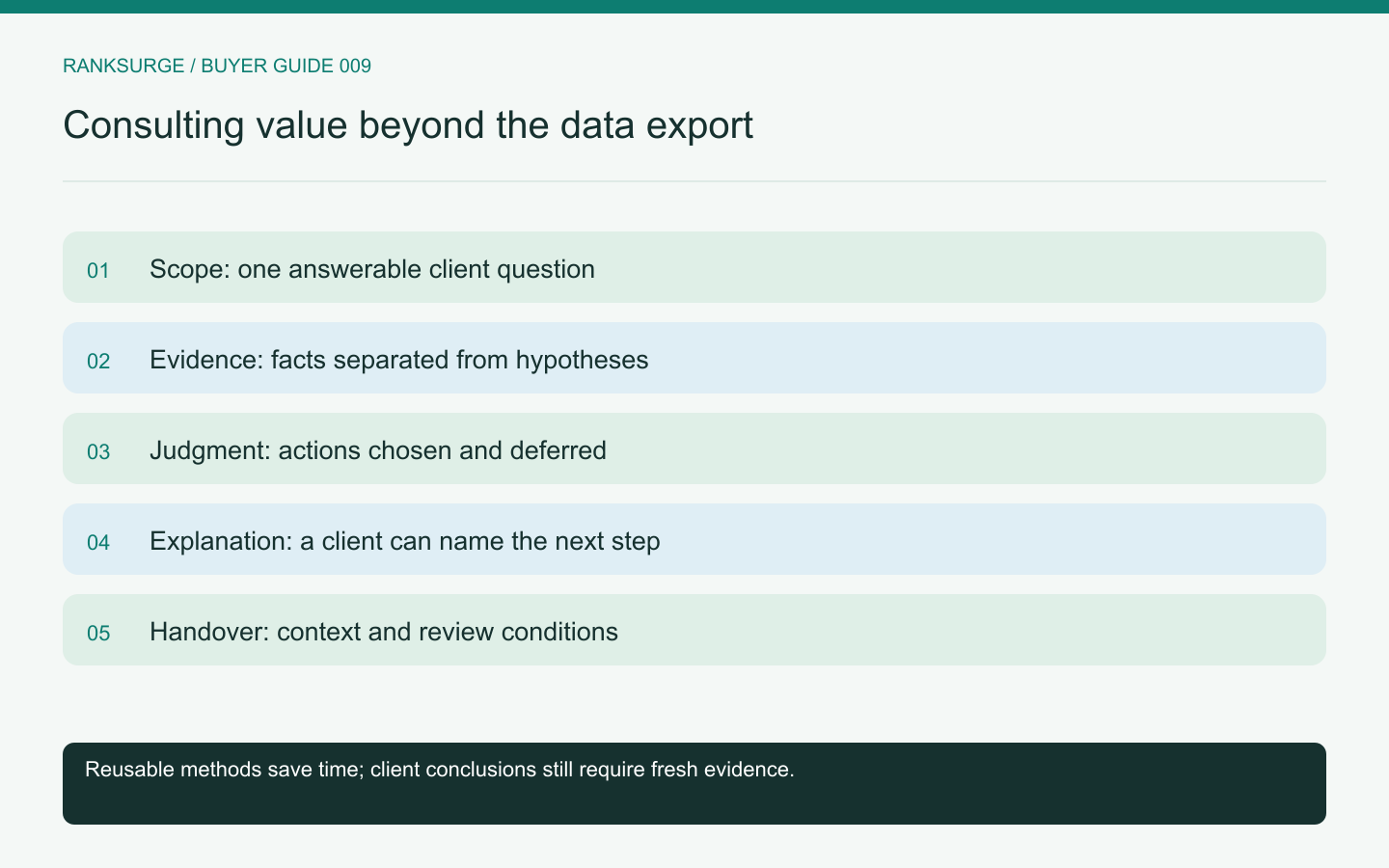
Evaluate SEO tools for consulting work through evidence quality, client explanations, research reuse and a clear boundary around the engagement.
TL;DR
- Select the SEO platform that supports your independent judgment and lets you deliver a defensible recommendation and practical next move, not merely access to large data sets or flashy charts.
- Use a deliberately constrained, fictional brief to test whether a tool helps you prioritize evidence and stop at a clear recommendation instead of encouraging an expanding, never‑ending investigation.
- Treat tool evaluation as successful only when you can explain why you chose final actions, defer others, and supply a completed sample deliverable or exportable evidence that makes the decision auditable.
Choose a tool that supports your judgment
An independent SEO consultant sells a useful diagnosis and a practical next move. The client is not buying your access to a large keyword database. When evaluating software, focus on whether it helps you reach a defensible recommendation and explain it to someone who may know little about search.
Start with the kind of engagement you actually sell: a one-time review, a content strategy, a technical investigation or continuing advisory work. Each creates different data and reporting needs. A platform that fits a monitoring retainer may be excessive for occasional research, while a lightweight lookup tool may leave a technical consultant assembling too much evidence manually.
Test a deliberately constrained engagement
Use a fictional brief such as “Explain why this service page is not attracting relevant search visits, and recommend the next two actions.” Set a research limit and a delivery deadline. The constraint reveals whether the tool helps you prioritize or encourages an expanding investigation without a stopping point.
Inspect the page, its search context and the available first-party or third-party evidence. Keep observed facts separate from explanations that still need testing. If the page is inaccessible, that may be the immediate recommendation; a broad keyword export should not distract from a basic access failure.
The evaluation succeeds when you can explain why you chose the final actions and why other plausible actions were deferred. That reasoning is the consultant's contribution, even when software gathers much of the evidence.
Evaluate the client explanation
Turn one finding into a paragraph a client can act on. Name the page or page family, explain the problem in ordinary language and describe the proposed change. Add evidence the client can inspect without needing to understand every metric in the research interface.
For example, “The comparison page answers feature questions but does not explain the migration effort buyers ask about” is more useful than “increase topical relevance.” The first statement can be checked against the page and customer questions. The second may sound authoritative while leaving the client unsure what to do.
Ask someone outside SEO to read the deliverable. If they cannot identify the next action, revise the explanation. Do not assume a branded PDF or a health score makes a report understandable.
Keep reusable methods without recycling conclusions
Consultants can save time by reusing research checklists, report structures and qualification criteria. Client-specific conclusions need fresh evidence. A competitor that matters to one business may be irrelevant to another, even in the same broad industry.
During the trial, repeat the same method for two distinct businesses. Check how easily you can preserve different goals, markets and rejected ideas. A good workflow makes reuse visible at the method level while keeping the factual context separate.
RankSurge offers a keyword research workflow with metrics, search-result inspection and saved opportunities. If that fits your service, test whether you can retain the reasoning behind a shortlist as well as the shortlist itself. The saved result should help the next engagement, not become an unexplained collection of attractive numbers.
Related reading: The Best Open Source SEO Tools in 2026.
Related reading: How to Prompt Claude Code for SEO.
Price the whole delivery process
Record the time spent collecting data, checking it, writing the recommendation and preparing the handoff. A cheaper subscription can cost more overall if it repeatedly requires manual reconciliation. An expensive suite can also be wasteful if most of its capabilities do not support the work you sell.
Distinguish recurring commitments from project-specific usage. A one-off competitor investigation should not quietly consume capacity promised to a monitoring client. If the product uses credits or operation limits, test a representative engagement and record actual usage before estimating your margin.
Also account for review. AI-assisted summaries can accelerate a draft, but verifying claims and removing irrelevant recommendations remains part of the service. Do not quote a delivery time based only on how quickly a tool generates text.
Plan the handover before the engagement ends
A client should understand what you examined, what you recommend and what remains uncertain. Decide which underlying data and configuration you will provide under the engagement terms. Then verify that you can export or share those materials appropriately.
Keep access boundaries clear. A client may need a report without receiving administrative control over your research account. A contractor may need temporary access without inheriting billing authority. Check the actual product behavior instead of assuming the account structure fits consulting work.
For a one-time engagement, add a review condition. “Reassess after the new product pages are indexed and sufficient performance evidence exists” is more useful than implying the report will remain current indefinitely.
Make the purchase answerable to the service
Your final comparison should identify which tool best supports the engagement, where manual work remains and what would trigger a different choice. Include one completed sample deliverable as evidence.
The right platform helps you be specific, restrained and clear. It should make it easier to tell a client that a tempting action is not yet justified, as well as to recommend a change confidently. That is a stronger basis for buying software than the number of charts you can include in a presentation.