
SEO Tools for Codex: Evaluate a Research Workflow Before Automating It
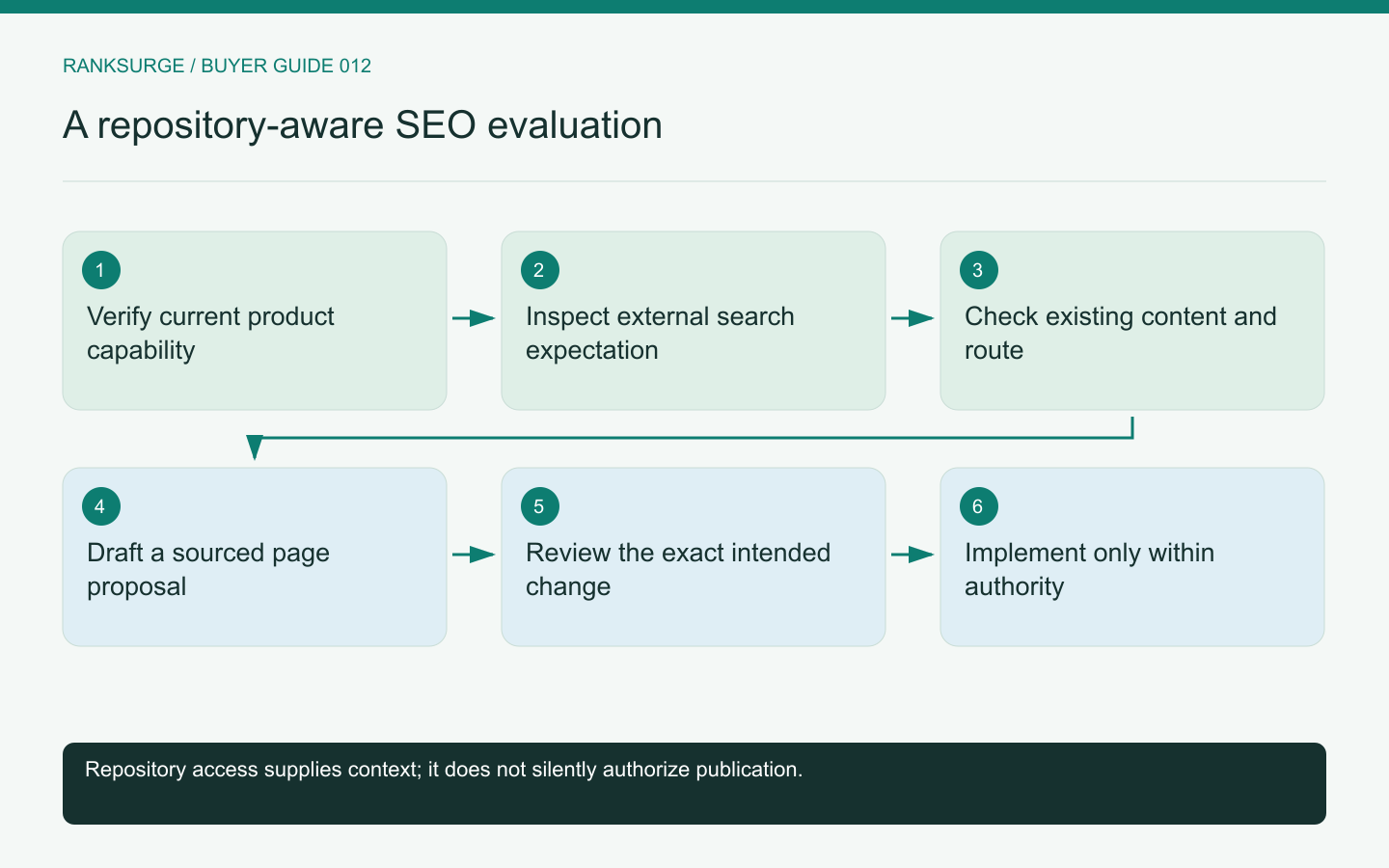
Evaluate SEO tooling for Codex with a repository-aware research exercise that keeps product facts, search evidence and code changes under separate review.
TL;DR
- Main decision: treat Codex as a bridge between product implementation and SEO research, buying only when proposals remain traceable, bounded, and reviewable rather than when agents make unchecked changes.
- Useful method: require each SEO-tool connection to produce a brief tying query, market evidence, observed results, product fit and a proposed page, then have Codex locate the relevant content file without editing it.
- Meaningful limit and success check: run a narrow, reviewable trial that tracks time, product-fact checking, duplicate-content review and human corrections to confirm the integration saves useful work.
Choose a research connection that respects the repository
A team using Codex may already have access to the product's code, documentation and content files. Adding an SEO research tool can connect that internal context with external search evidence. The buying opportunity is useful: the agent can compare what the product actually does with what people search for. The risk is treating repository access as automatic permission to change or publish everything it finds.
Evaluate the workflow with a clear boundary. Authorize research and a proposed change first. Require an inspectable artifact before implementation. This makes the trial about evidence quality and integration usefulness rather than about how quickly an agent can create files.
Use a product fact that affects keyword fit
Select a real capability with an important limitation. For example, an application might export reports but not provide live dashboards. Ask the research workflow to investigate queries related to both, using the repository documentation as product context and external search data as market context.
A successful result should reject or qualify terms that imply unsupported behavior. It should identify which source established the product fact and which source established the searcher's expectation. The distinction matters because a high-volume keyword does not authorize a new product claim.
Use a small repository scope and avoid sharing secrets or irrelevant customer data with external services. The research tool needs a useful description of the product, not every file the agent can access.
Compare the proposed artifact
Ask each candidate tool connection to support a brief containing the query, market, observed result types, product fit and proposed page. Require a note about existing content that may already answer the question. The output should also identify what remains uncertain.
Then ask Codex to locate the relevant content file or route without editing it. This tests whether the research can be connected to the actual application. A generic recommendation to “add a landing page” is less useful than a proposal that understands the existing documentation structure and avoids a duplicate page.
The platform should provide evidence; the agent's repository work should provide implementation context. Do not let either source silently stand in for the other.
Test the review boundary
Use a harmless proposed metadata or content change as the final trial artifact. Have the agent explain the problem, the exact file it would change and how the result would be verified. Keep the change uncommitted or in a reviewable branch according to your team's normal process.
The important observation is whether the agent preserves the reasoning when moving from research to code. A search result suggesting a comparison page does not justify deleting an existing guide, changing navigation broadly or publishing unsupported competitor claims.
Evaluate the amount of human correction required. Record concrete errors such as a wrong route, missing source date or unsupported feature statement. Avoid assigning a vague productivity score based only on the speed of the first draft.
Inspect connection and credential ownership
Determine who owns the SEO account and how Codex is authorized to access it. Ask whether the workflow uses interactive authorization or a credential intended for automation, and how access can be revoked. Use current setup documentation for the installed client and provider rather than copying an old command from a blog.
RankSurge documents Codex-compatible access through its MCP setup guide. In a buying evaluation, confirm the connection in your actual environment and inspect the tools available there. Do not assume a plugin, a direct MCP connection and a headless integration have identical setup or permissions.
Keep credentials outside committed repository files. A successful trial should leave a reproducible setup record without leaving an active secret in the report.
Related reading: How to Prompt Claude Code for SEO.
Related reading: The Best Open Source SEO Tools in 2026.
Measure a completed research-to-review cycle
Track the time and usage required to reach a reviewable proposal, not merely to receive keyword suggestions. Include product-fact checking, duplicate-content review, source inspection and correction of the generated recommendation. These steps determine whether the integration saves useful work.
Compare the result with your current process using the same task. If the connected workflow produces better evidence but requires more setup, decide whether repeated use justifies the investment. If it produces fast prose that reviewers repeatedly rewrite, the apparent speed may not translate into a shorter cycle.
Keep the sample narrow enough to inspect thoroughly. One completed task can reveal integration gaps that ten unfinished demonstrations conceal.
Adopt with explicit operating rules
The final purchase note should state which research tasks the connection supports, which repository actions require review and where evidence is saved. Define who refreshes product context when capabilities change and who checks current competitor facts before publication.
Codex can be a useful bridge between product implementation and SEO research when each side remains traceable. Choose tooling that strengthens that bridge with source context, bounded authority and portable results. The acceptance condition is a proposal your team can confidently review and implement, not an agent that makes the most changes before anyone reads them.