
SEO Tools for Claude: Check Evidence Quality Before Trusting the Summary
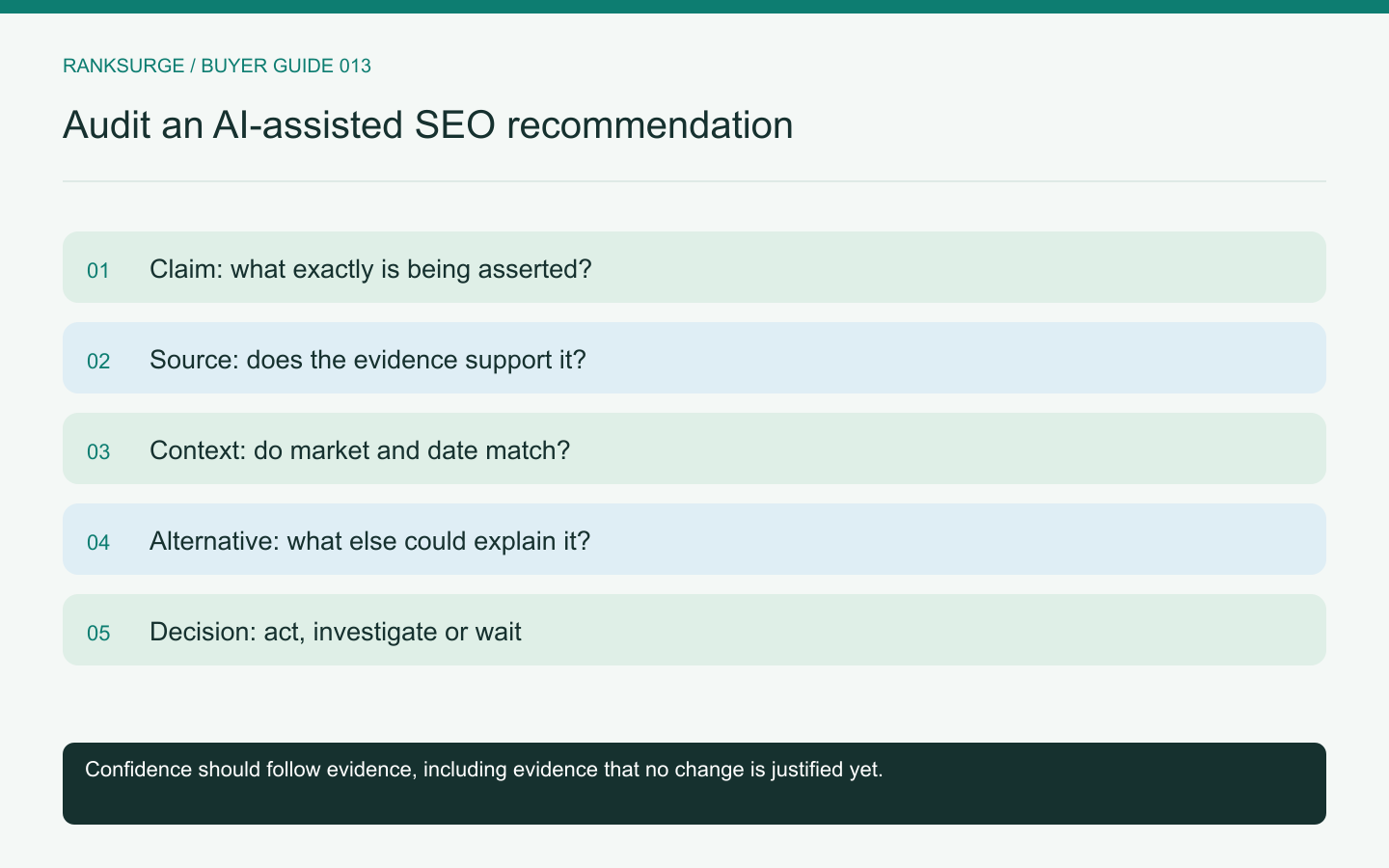
Choose SEO data tools for Claude by testing source traceability, uncertainty handling and whether a non-specialist can audit the resulting recommendation.
TL;DR
- Select SEO tooling for Claude that prioritizes inspectable evidence over fluent summaries: prefer workflows whose stated confidence matches available evidence and whose next steps remain understandable after the conversation ends.
- Compare candidate connections with the same bounded task and require outputs that label facts, hypotheses and missing information; trace three claims to their sources to reveal server, prompt or model failures.
- Include a meaningful success check: ask the workflow for the strongest reason not to act, set a research budget and stopping condition, and weigh tool cost against the reviewer effort needed to verify conclusions.
Evaluate the evidence behind a confident answer
A polished SEO explanation can be persuasive even when its underlying data is incomplete. When selecting tools for a Claude-based research workflow, evaluate whether the connection makes evidence easier to inspect, not merely whether it produces a fluent summary.
Use a task with an uncertain answer. A page may have weak traffic because its topic is poorly matched, because users want a different format or because a technical issue limits discovery. Ask the workflow to compare those explanations and identify what evidence would distinguish them. This is more revealing than asking it to generate a list of obvious SEO tips.
Related reading: The Best Open Source SEO Tools in 2026.
Give the same question to each candidate connection
Choose one page and a defined market. Supply the page's purpose and a small set of known facts. Ask for a recommendation supported by observed search results, available performance evidence and direct inspection of the page.
Require the response to label facts, hypotheses and missing information. For example, “the page does not explain setup prerequisites” can be checked directly. “That omission caused the traffic decline” is a causal hypothesis requiring more evidence. A useful tool workflow should preserve that distinction rather than smoothing it away in the final prose.
Keep the question bounded so you can inspect the underlying records. A broad site-wide request can make it difficult to notice unsupported reasoning among dozens of recommendations.
Inspect source-to-claim alignment
Pick three statements from the response and trace each to its source. Does the linked result support the statement as written? Does the date and market match the question? Is an estimated competitor metric being described as though it were first-party measurement?
This exercise evaluates the combined workflow: the data tool, the instructions and the model's interpretation. If a claim fails, identify which part failed. The server may return insufficient context, the prompt may be too vague or the final response may overstate what the data proves.
Do not discard a useful product merely because the first prompt was poor. Improve the task once, repeat the comparison and record the change. Equally, do not excuse a missing data contract as a prompting problem indefinitely.
Test whether the workflow can recommend no action
Ask for the strongest reason not to make the proposed change. This helps reveal whether the system is investigating a decision or simply trying to satisfy an assumed demand for more work. A page with limited evidence may deserve monitoring rather than immediate rewriting.
For a concrete example, compare a recommendation to replace a title with the possibility that the observed change comes from a different query mix. The workflow should identify which additional evidence would make one explanation more credible.
A justified pause can be a valuable consulting result. The tool's purpose is to improve decisions, not to keep a content or engineering queue permanently full.
Evaluate the client experience without assuming identical features
Different Claude clients and account configurations can expose different connection or review experiences. Verify the intended setup directly rather than assuming a demonstration in one environment applies to every member of your team.
RankSurge's MCP documentation describes compatible research access. Use the current instructions to establish the connection, then inspect what the actual client makes available. The buying test remains the same: can a reviewer follow the evidence from the tool result to the recommendation?
Keep credentials and connected-account authority out of shared prompt examples. A reusable research brief should describe the task and project context without containing secrets.
Related reading: How to Prompt Claude Code for SEO.
Preserve a reviewable report
Ask the workflow to produce a short report with the decision, supporting observations, alternatives considered and unresolved questions. Include source dates and links. Save it outside the conversation in the location your team uses for project decisions.
Give the report to a teammate who did not watch the research. Ask them to identify the proposed action, the main uncertainty and the evidence that would change the recommendation. If they cannot, revise the output structure before increasing automation.
This test is especially important for client-facing work. A client may reasonably ask why a particular page was selected. The answer should not depend on replaying an opaque sequence of agent calls.
Compare cost with review effort
Observe both tool usage and the time required to verify the report. A cheaper data connection may create more manual reconciliation; a richer connection may return unnecessary material that makes review slower. Compare the completed, reviewed decision rather than the first response.
Set a research budget and a stopping condition. If a new lookup is unlikely to change the decision, save it for a later question. If evidence is genuinely insufficient, the workflow should say so instead of filling the gap with generic advice.
Choose the SEO tooling that helps Claude produce recommendations your team can inspect and challenge. The strongest result is not the most confident answer. It is an answer whose confidence matches the evidence and whose next step remains understandable after the conversation ends.