
SEO Tool Data Residency: Map Customer Data Separately From Public Search Data
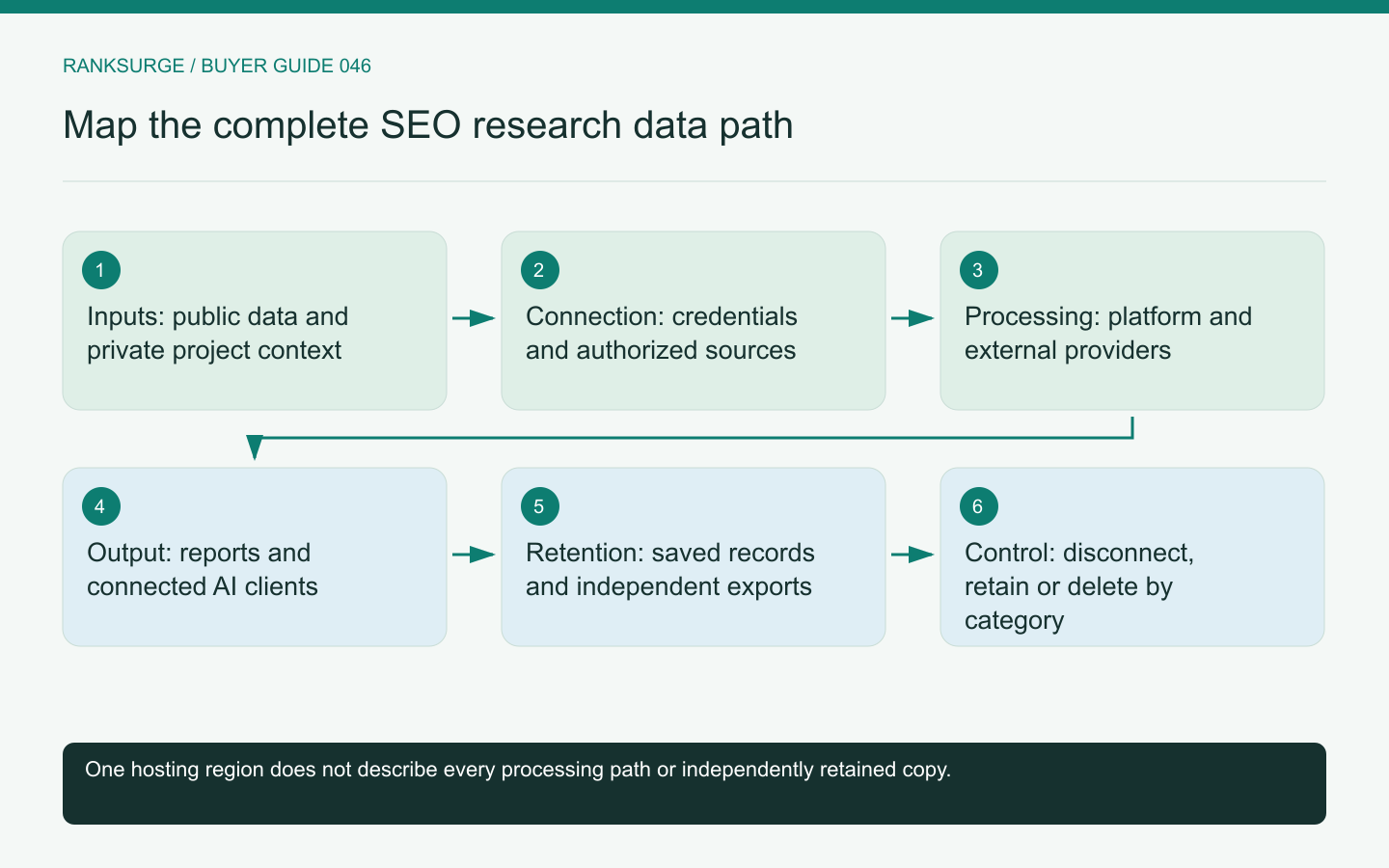
Evaluate SEO tool data residency by mapping public research, connected account data, saved reports, AI-client transfers and independently retained exports.
TL;DR
- Main decision: pick the SEO tool whose documented data paths match the work you intend to perform; prefer a clear map of what enters, where it goes, what remains and who controls it.
- Useful method: begin procurement with a data inventory and trace an ordinary research workflow—identify where processing occurs, what is stored, which services receive results, and use synthetic notes in trials.
- Limit/success check: verify retention boundaries and connected clients, request precise commitments for named data categories, and ask for evidence covering relevant storage and processing paths.
Separate the data categories before asking for a region
SEO tools handle more than public search results. An account can contain customer identities, unpublished business plans, connected analytics access, private project notes and reports assembled from several sources. A single question about where the server runs does not describe all of those paths.
Start the buying review with a data inventory. List public research inputs, account information, connected-service credentials, retrieved first-party reports, saved project content and exports. For each category, identify why it is used and whether your team actually needs to provide it.
Trace one ordinary research workflow
Choose a realistic task, such as reviewing a client's Search Console performance and saving a report. Draw the path from the original service through the SEO platform to the final reader. Include any AI assistant or external reporting destination involved.
Ask where processing occurs, what is stored and which service receives the result. Do not assume that a product's hosting location describes every connected vendor, support system or AI client used in the workflow.
RankSurge's privacy policy distinguishes its hosted service from independently operated self-hosted deployments and describes connected Google data handling. Use the current policy as a source for questions, while seeking explicit answers for any residency requirement it does not address.
Related reading: The Best Open Source SEO Tools in 2026.
Distinguish processing from retention
A tool can retrieve information for a request without retaining the complete source report in its primary database. It can also create a saved summary or export that contains some of that information. Those are different records with potentially different lifecycles.
For the trial, identify what remains after the research task ends. Inspect saved reports, project notes, downloaded files and any conversation history in a connected assistant. A statement about one database does not automatically cover copies your team creates elsewhere.
Ask the vendor to describe the retention boundary for each category. Avoid converting a narrow statement about on-demand retrieval into a broad claim that no customer-related information is ever retained.
Evaluate connected AI clients separately
If your workflow sends research to an AI client through MCP or another integration, that client becomes part of the data path. The SEO tool's own policy is not the only policy relevant to the resulting conversation or saved output.
RankSurge's policy explicitly discusses returning requested data to connected clients. The purchasing question is whether your organisation approves the specific client, configuration and material involved. A compatible protocol does not by itself establish an acceptable data-handling arrangement.
Use synthetic project notes in the trial. Verify which fields the requested tool returns and avoid sending unrelated private context merely because it is available in the account. Minimized inputs make the workflow easier to understand and review.
Related reading: SEO for Startups: A Founder’s Handbook.
Compare hosted and self-hosted responsibility
Self-hosting can give an organisation control over parts of its infrastructure, but it does not automatically eliminate external data providers or operational obligations. List the services a self-hosted deployment still calls and who maintains them.
The operator may own backups, access controls, monitoring and updates. The hosted provider may handle some of those tasks under its service terms. Compare those responsibilities explicitly rather than treating self-hosted as a synonym for local-only processing.
If a geographic requirement is important, ask for evidence covering the relevant storage and processing paths. Do not infer a guarantee from a company's office address, a domain suffix or a general statement about cloud hosting.
Test disconnection and exported copies
Disconnect a harmless test integration and inspect what happens to the connection record and access. Then identify which reports or files your team independently retained before disconnection.
The platform may correctly remove its connection while a downloaded spreadsheet remains on an analyst's laptop. That is an organisational responsibility the software cannot automatically solve. The buying review should account for both provider behavior and your own handling process.
Use a simple register listing the record, owner, purpose and deletion or retention rule. This makes follow-up questions concrete and prevents several different categories from being hidden under the word data.
Ask for precise commitments where needed
Some teams have contractual or organisational requirements that need a specific written commitment. Translate those requirements into questions about named data categories and operations. A vague request for full compliance is difficult for a vendor to answer meaningfully.
Have the appropriate internal owner review the answers and unresolved gaps. This article is a procurement framework, not a substitute for interpreting your organisation's legal obligations or a vendor's contract.
Choose the SEO tool whose documented data paths fit the work you intend to perform. The useful outcome is a clear map of what enters, where it goes, what remains and who controls it. That is stronger evidence than a single region label displayed on a sales page.