
SEO Research Budgets: Spend the Next Lookup Where It Can Change the Plan
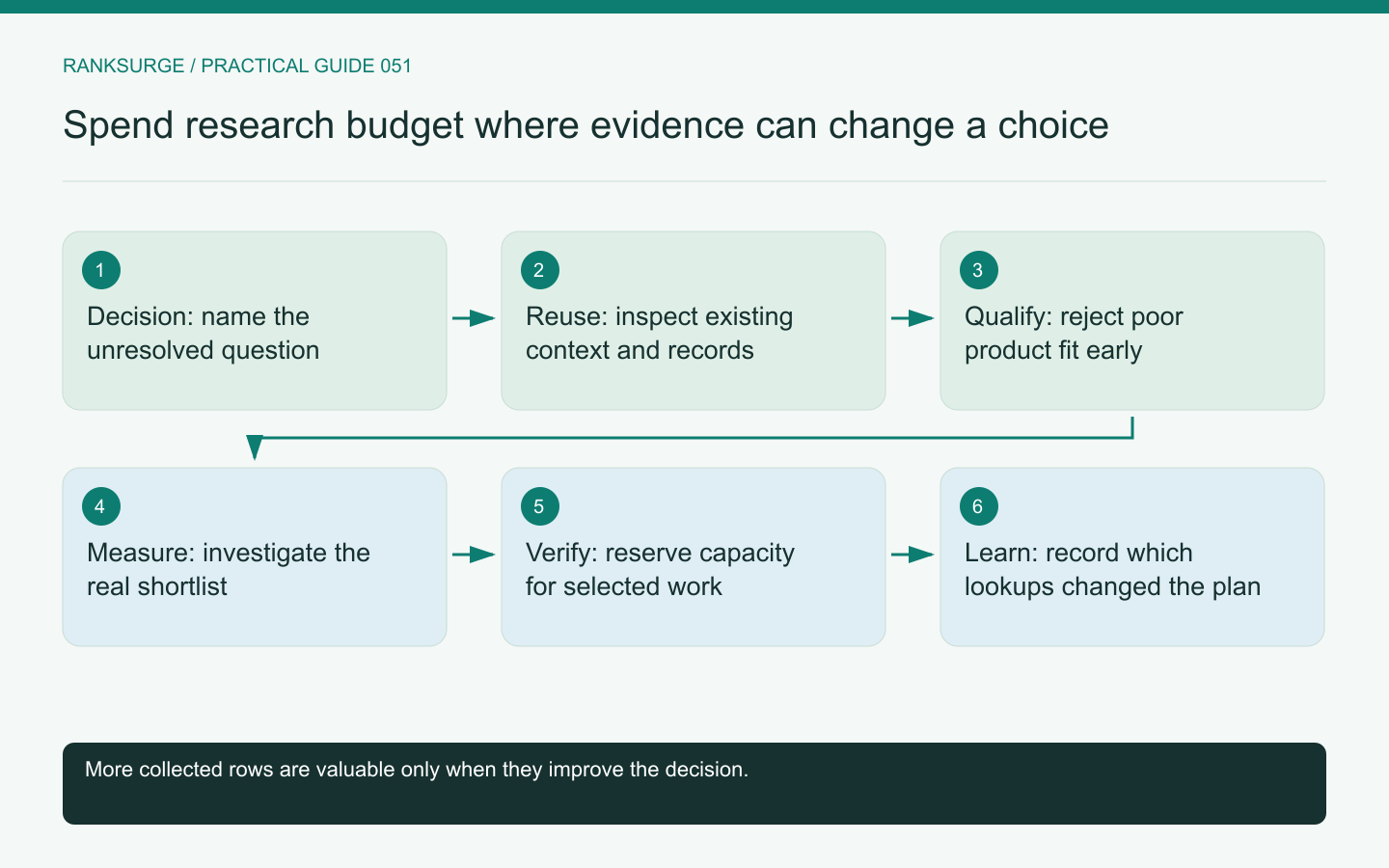
Allocate an SEO research budget by identifying the next decision, reusing valid evidence and spending paid lookups only where they can change the plan.
TL;DR
- Prefer paid lookups only when their possible result could change a specific decision; start by stating the decision, available evidence and the uncertainty blocking action so lookups add actionable value.
- Use a compact, shareable process: keep a four-field evidence ledger, reuse existing project context before buying data, and advance candidates in staged, documented steps.
- Set clear success checks and limits: decide a stopping rule before expanding seeds, reserve capacity for verification, and after the cycle review which lookups actually changed decisions.
Start with the decision that is still uncertain
An SEO research budget is easiest to waste when the task is simply to collect more keywords. A more useful starting point is a decision: which commercial page should be improved next, whether a proposed topic fits the product or which market deserves a focused trial.
Write the decision and the evidence already available. Then identify the uncertainty that prevents action. A paid lookup is worthwhile when its possible result could change that decision. If every plausible result leads to the same next step, the lookup may add detail without adding value.
Create a small evidence ledger
Use a record with four fields: question, existing evidence, missing evidence and next action. For an illustrative software team, the question might be whether a comparison page deserves an update. Existing evidence could include customer questions and the current page's first-party performance. Missing evidence might be the present search-result format for the target query.
This structure keeps research bounded. It also helps another analyst understand why a request was made and whether the result has already been collected.
Do not treat every older record as unusable. Some business facts remain stable, while current search results or competitor pricing can change. Decide what needs refreshing based on the claim, not only the age of the file.
Reuse context before purchasing more data
Review the project's goals, supported capabilities, target markets and existing pages. These facts can eliminate unsuitable keywords before a paid metric lookup is necessary.
RankSurge's MCP documentation includes shared project context and saved research workflows. Use those records to avoid repeatedly rediscovering the same product boundaries. The benefit comes from maintaining useful context, not from asking an agent to run a larger search every time.
For example, a hosted-only product can reject an unsupported installation tutorial before measuring dozens of related phrases. A transparent comparison might still be worthwhile, but that is a different brief with a different research need.
Spend in stages
Begin with broad but inexpensive qualification using information you already possess. Then measure the shortlisted queries in the relevant market. Finally, inspect current results for the candidates that could become real page decisions.
This staged approach does not require a rigid universal percentage for each activity. The right distribution depends on your backlog and the quality of existing evidence. A new product may need more market discovery, while an established site may benefit more from page-level diagnosis.
Record why an item advances to the next stage. That makes the process reviewable and prevents a high volume number from becoming the only reason a weak topic survives.
Use a hypothetical budget example carefully
Imagine a team has an illustrative allowance of 100 research units for a review cycle. It first reserves enough for the required monitoring and client commitments, then uses the remaining allowance to resolve a few uncertain page decisions.
The units in this example are planning placeholders, not a claim about a provider's task price. The team should replace them with the documented consumption of its actual operations.
RankSurge's pricing page states that usage varies by operation. That means ten keyword requests and ten larger research tasks should not automatically be treated as equivalent cost. Build the worksheet around the work you intend to perform.
Related reading: SEO for Startups: A Founder’s Handbook.
Related reading: The Best Open Source SEO Tools in 2026.
Define a stopping rule for exploration
Before expanding a seed list, decide what would count as enough evidence to proceed. You might need several clearly distinct reader tasks, a representative result review and a check against existing coverage.
Stop when additional variations no longer change the proposed page plan. Collecting fifty phrasings of the same question can make the spreadsheet look substantial while leaving the editorial decision unchanged.
Keep rejected ideas with short reasons. This saves future cycles from spending the same budget on the same unsupported or duplicate opportunities.
Reserve capacity for verification
Do not spend the entire allowance on discovery if the team still needs to verify the selected work. A final SERP inspection, a refreshed source or a post-change observation can be more valuable than another broad keyword export.
For agent-assisted research, bound the requested scope and ask for a proposed next lookup when uncertainty remains. Unlimited exploration can consume shared capacity without producing a clearer decision.
If a budget limit prevents further measurement, preserve unknowns explicitly. The team can make a qualitative decision or defer the topic. It should not fill missing fields with invented values to make the plan look complete.
Review the value of the research afterward
At the end of the cycle, identify which lookups changed a decision and which were redundant. Use that review to adjust the next cycle's process, not to punish reasonable exploration that returned an unhelpful result.
The goal is not the lowest possible research spend. It is a disciplined connection between cost and learning. A good budget leaves the team with fewer important uncertainties, a clear page plan and enough retained context that the next review starts from what is already known.