
SEO Reporting Tools for Executives: Compare Decisions, Attribution and Caveats
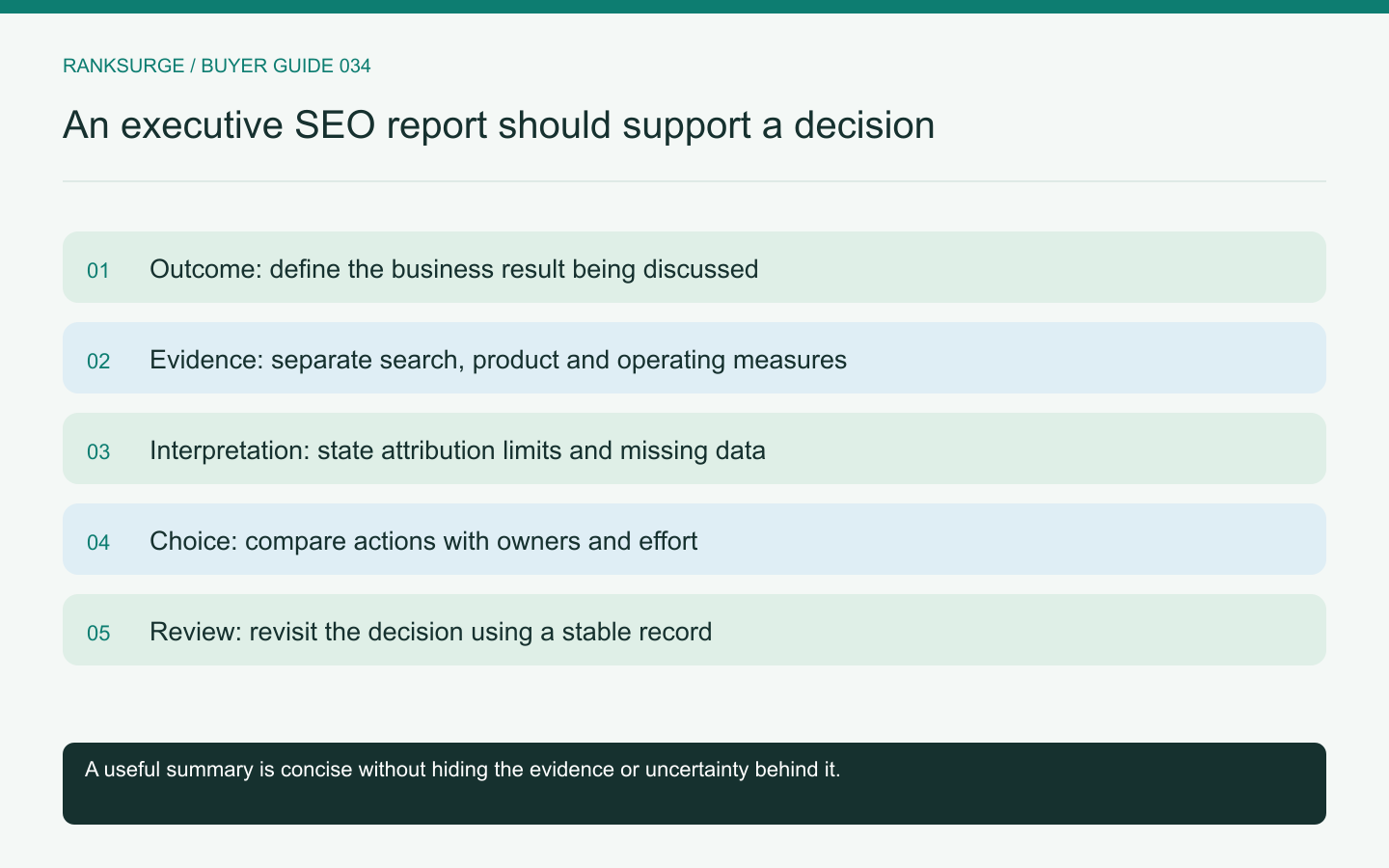
Choose executive SEO reporting tools by testing whether they connect search evidence to decisions, investment choices and clearly stated uncertainty.
TL;DR
- Main decision: Executive SEO reporting tools should help leaders decide where to invest, what to stop and which uncertainty needs more evidence, so buying starts from leadership decisions not raw rankings.
- Useful method: Require a path from summary to evidence—an executive reads a concise conclusion and an analyst inspects the records; ask vendors to show activity increases that did not produce business outcomes and explain why.
- Limit / success check: Test reports with missing or conflicting data using a trial dataset and an unfamiliar leader; the purchase succeeds when leadership can explain why the SEO team is doing its next piece of work.
Begin with the decision on the meeting agenda
Executive SEO reporting tools should help leaders decide where to invest, what to stop and which uncertainty needs more evidence. A report full of rankings and technical warnings can be accurate yet fail that purpose. Start the buying process with the actual decisions the leadership team makes.
For example, the team may need to choose between improving existing commercial pages, entering a new topic area or repairing a technical discovery problem. Each option has a different owner, cost and expected observation period. The report should connect evidence to those choices without pretending search performance is fully controllable.
Separate outcomes from operating measures
Business outcomes may include qualified enquiries or product activations. Search measures may include clicks, impressions and observed positions. Operating measures may include reviewed pages or completed fixes. These categories can inform each other, but they should not be presented as interchangeable proof of success.
Ask each candidate to show a report where activity increased but business outcomes did not. Can the report explain the difference without hiding behind a large total of completed tasks? A useful tool should make disappointing results understandable as well as make positive results attractive.
Define the conversion event with the product or analytics owner. If the organisation has no reliable qualified-lead measure, label that gap directly rather than using all form submissions as a convenient substitute.
Inspect attribution language
A report can show that organic search visitors completed an action. That does not automatically prove a particular content change caused the result. Other campaigns, product releases and seasonal demand may have changed at the same time.
Use an illustrative quarter in which branded searches increase after a product launch. Ask the vendor to separate that context from non-branded discovery and explain what remains uncertain. The goal is not to eliminate interpretation, but to make the interpretation visible.
Google's Search Console performance documentation describes the dimensions and measures available in search reporting. Use those definitions as the basis for the search portion of the report, while keeping downstream product outcomes in their own evidence layer.
Require a path from summary to evidence
An executive should be able to read a concise conclusion without navigating a complex application. An analyst should be able to inspect the records behind that conclusion. Compare tools on both experiences.
For a claim such as commercial-page visibility improved, ask for the exact page set, date comparison, market context and metric definition. A saved filter or export should make the claim reproducible. A screenshot of a chart is not enough if the underlying segment changes silently next month.
RankSurge can support research and project-level evidence, including saved reports described in its MCP documentation. Evaluate the report workflow your team will actually use; do not infer a complete revenue-attribution system from the availability of SEO data.
Related reading: SEO for Startups: A Founder’s Handbook.
Related reading: The Best Open Source SEO Tools in 2026.
Compare decisions with owners and review dates
A strong report ends each major finding with an action or an explicit decision to wait. The action needs an owner and a reason it should change the situation. A list of generic recommendations does not help leadership allocate scarce engineering or content capacity.
For example, a set of valuable pages with inconsistent internal discovery may justify a navigation investigation. A weakly measured keyword opportunity may justify a small research task before a large content investment. Those are different commitment levels and should look different in the report.
Ask the candidate to preserve the earlier recommendation and its follow-up. Without that history, each monthly meeting can become a new presentation disconnected from the decisions made in the previous one.
Test a report with missing or conflicting data
Provide a trial dataset with an unavailable conversion feed and a change in tracking configuration. The report should explain the limits clearly instead of filling the gap with a confident estimate or a zero.
Conflicting systems also deserve a visible explanation. A third-party traffic estimate and first-party click data measure different things. A useful executive report does not average them into a fictional compromise number merely to make the slide simpler.
Ask a leader unfamiliar with the tool to describe what can and cannot be concluded. Their answer is a practical test of whether the interface communicates uncertainty well.
Buy for a repeatable decision rhythm
A polished dashboard may be useful for frequent monitoring, while a short narrative report may be better for monthly resource decisions. Many teams need both, connected by consistent definitions and a stable evidence trail.
Choose the tool that helps your organisation revisit prior decisions, understand current limits and commit to a small number of justified next steps. The purchase succeeds when leadership can explain why the SEO team is doing its next piece of work, not when every chart on the screen happens to point upward.