
SEO Report Template Tools: Compare Reuse Without Hiding Project Differences
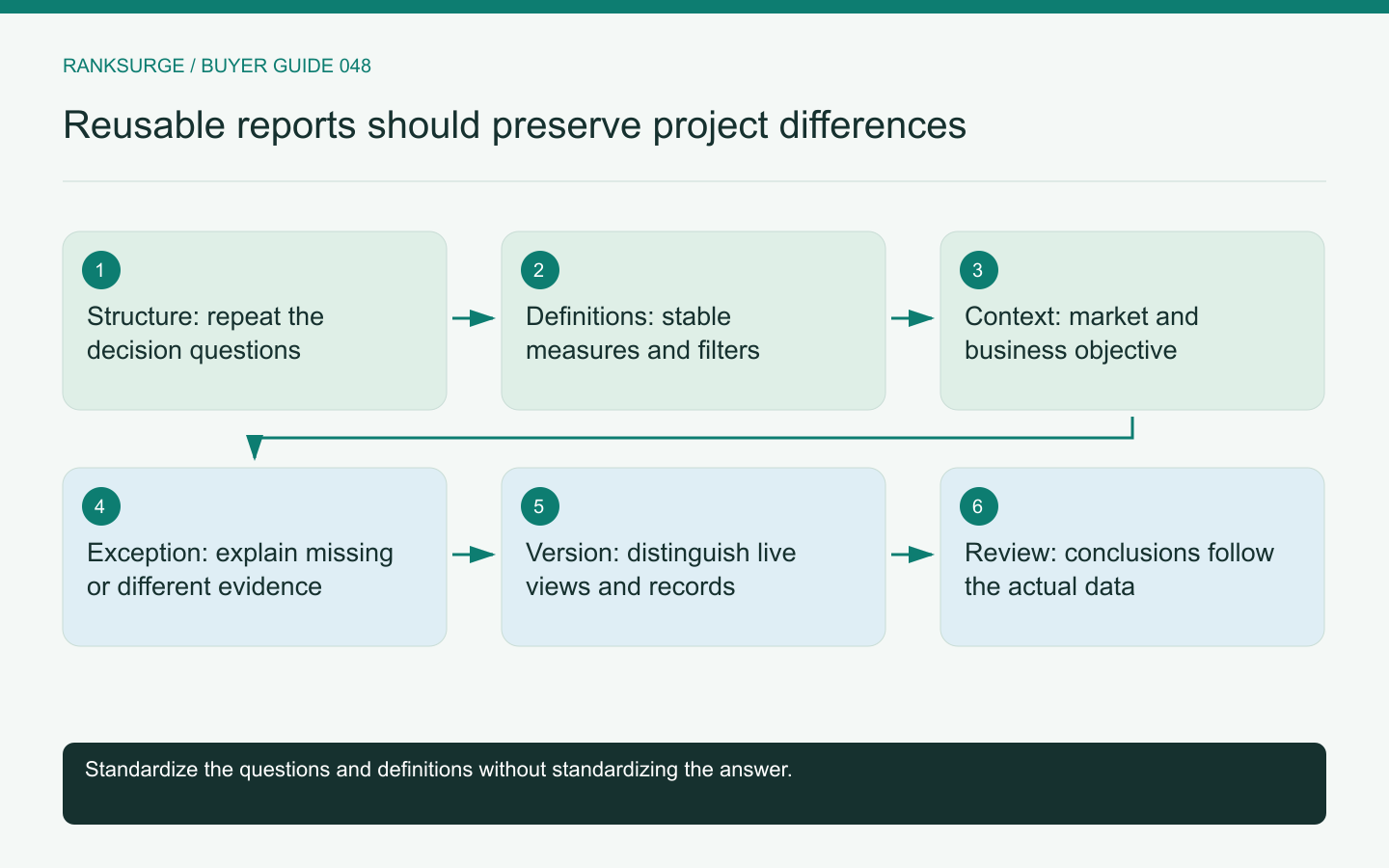
Evaluate SEO report template tools by testing reusable definitions, legitimate project differences, missing data and versioned changes to the report structure.
TL;DR
- Main decision: pick a reporting template that preserves honest differences—standardize the structure while letting evidence drive distinct conclusions rather than forcing uniform answers across projects.
- Useful method: test templates by running the same report structure on two contrasting sites (established and new), and record which fields are mandatory, optional, or unavailable so differences remain visible.
- Meaningful limit / success check: evaluate generated narratives and exceptions by supplying contradictory evidence; require the narrative to preserve uncertainty and let an analyst trace sentences back to underlying evidence.
Reuse the reasoning structure, not the conclusion
SEO report template tools can reduce repetitive preparation and improve consistency. They become unhelpful when a copied layout hides meaningful differences between projects or encourages the same conclusion regardless of the evidence.
Start with the decisions a recurring report should support. A useful structure might include the current question, relevant evidence, interpretation, proposed action and follow-up from the previous review. Those sections can be reused across clients while their contents remain specific to each project.
Related reading: The Best Open Source SEO Tools in 2026.
Compare templates with two different projects
Use an established site with reliable first-party data and a new site with limited history. Ask each candidate to generate or assemble the same report structure for both.
The new site's report should not manufacture trend claims from an inadequate baseline. The established site's report should not omit meaningful segmentation merely because the template was designed for a simpler project. A strong tool can preserve the structure while making these differences visible.
Record which fields are mandatory, optional or unavailable. A missing source should produce an explicit limitation or omitted section, not a chart filled with zeros that looks like a measured decline.
Keep metric definitions attached
A reusable template needs stable definitions for its measures. Search clicks, estimated traffic, average position and conversions should not share vague labels that change meaning from one client to another.
Google's Search Console performance documentation provides definitions and dimensions for that source. If the report uses another provider's estimate, preserve its separate identity rather than presenting the numbers as directly interchangeable.
Ask how a template stores date ranges, comparison periods and filters. A report that looks consistent but silently changes those settings can mislead readers more than a visibly different report with a clear explanation.
Test a legitimate exception
Create a fictional client that serves only one region and another that serves several markets. The template should allow relevant market context without duplicating every section unnecessarily.
Then test a client whose primary objective is qualified enquiries rather than ecommerce revenue. The report should support the agreed business measure instead of forcing a revenue chart that the source data cannot substantiate.
These exceptions are not flaws in standardization. They are the conditions under which a reusable structure remains honest. Compare how easily the tool records the reason for an exception so the next analyst does not remove it while trying to make reports look uniform.
Inspect template changes over time
Change a metric definition or add a new evidence section in the trial template. Ask what happens to previously issued reports. Historical records should remain understandable in their original context, even if future reports use an improved structure.
A live report that updates automatically may be useful for monitoring. A monthly decision record may need a dated snapshot. The tool should make the distinction clear rather than silently rewriting the basis of an earlier meeting.
RankSurge's MCP documentation includes reusable report briefs and saved reports. Evaluate how those capabilities fit your review process, while checking the specific versioning and sharing behavior you need instead of assuming it from the word template.
Related reading: SEO for Startups: A Founder’s Handbook.
Evaluate generated narrative with a contradictory fixture
If a reporting product drafts commentary, give it evidence that does not fit a simple success story. For example, impressions may rise while qualified enquiries remain unchanged, or an important source may be unavailable for part of the period.
The narrative should preserve the contradiction and uncertainty. A template that always finds a positive trend may produce attractive presentations but weak decisions. Human review remains necessary for conclusions about business impact and recommended investment.
Ask an analyst to trace one sentence to the underlying evidence. If that cannot be done, the sentence should be revised or removed rather than retained because it sounds plausible.
Compare maintenance across a reporting cycle
Measure the work needed to prepare, review, share and later revisit the report. A tool that saves layout time but adds hours of correction may not improve the overall process.
Include the cost of updating shared definitions and handling client-specific exceptions. The team should know who owns the base template and who can approve local changes. Otherwise, copied versions can drift until consistency becomes only visual.
Export a completed trial report with its important context. Another analyst should be able to understand the period, sources, exceptions and decisions without access to the original preparer's private notes.
Choose a template that makes differences visible
A good reporting template reduces repeated formatting and makes important questions harder to forget. It does not eliminate the need to understand the project.
Select the product that supports consistent definitions, honest missing-data handling and explicit exceptions. The successful trial produces two reports that share a clear structure while reaching different conclusions when the evidence differs. That is useful standardization: a repeatable way to think, not a repeated answer.