
SEO Platform Billing Controls: Evaluate Shared Budgets and Account Ownership
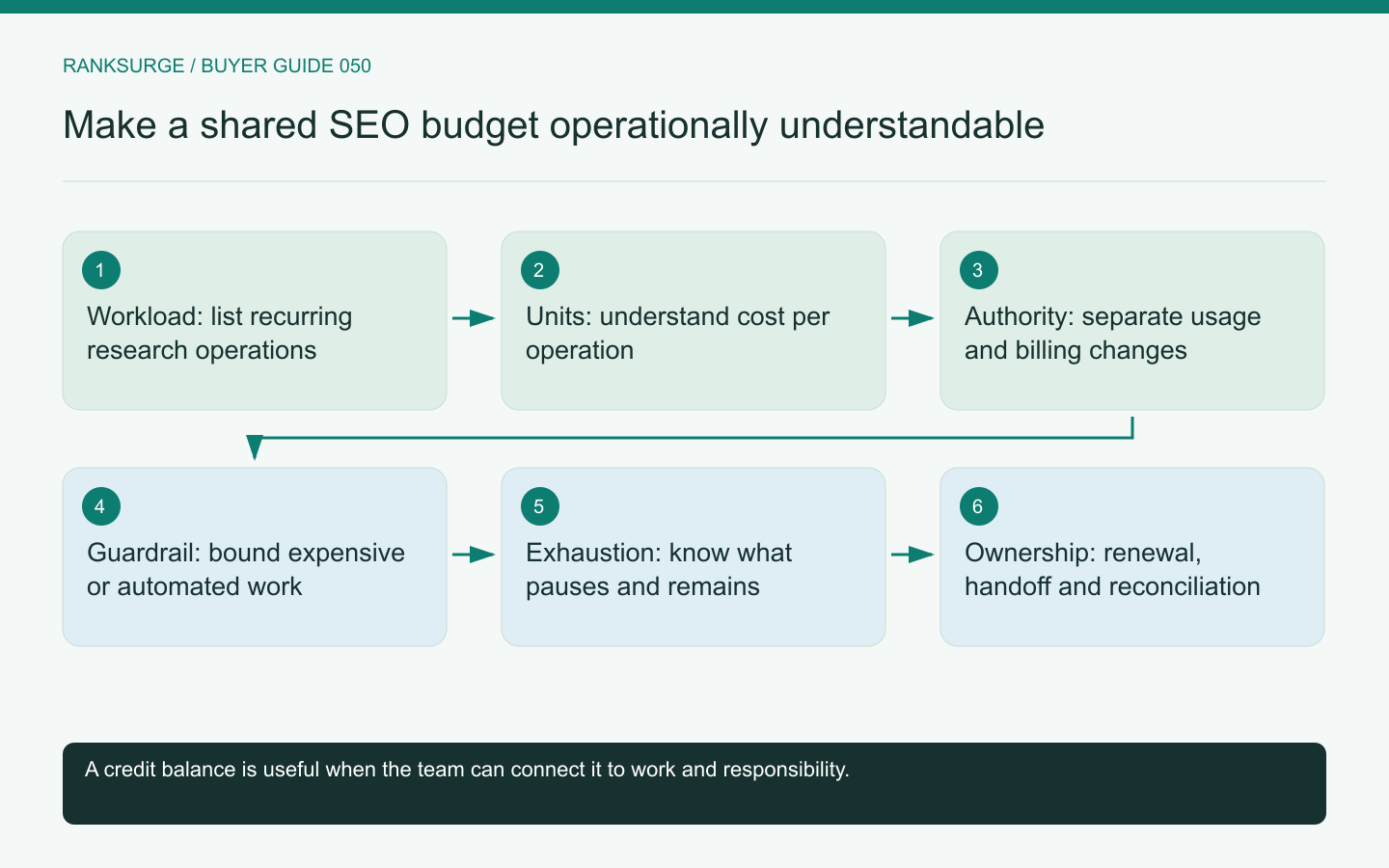
Evaluate SEO platform billing controls with shared usage, operation costs, owner responsibilities and a controlled exhaustion-and-renewal scenario.
TL;DR
- Prefer an account model that makes spending deliberate and explainable: pick controls that let the team predict ordinary usage, recognize spikes, and respond to exhaustion without losing context.
- Evaluate plans by modelling real work: list a normal week's keyword research, audits and AI tasks, estimate their frequency, then compare plans and controls against that workload.
- Validate limits and failure modes: rehearse allowance exhaustion and test an expensive operation so the interface/API makes cost understandable and the team knows what stops or continues.
Budget for the work, not just the plan name
SEO platform billing controls should help a team understand which activities consume its allowance and who can change the commitment. A plan name or a monthly credit total is not enough to predict cost. Different research operations can consume different amounts, and several people may share the same pool.
Start with a normal week of work. List keyword research, competitor lookups, tracking, audits and any AI-assisted tasks your team actually intends to run. Then estimate how frequently each occurs. This workload is the basis for comparing plans and controls.
Inspect the unit of consumption
Ask the vendor to explain what a credit or billable unit represents for each operation. A keyword idea request, a detailed SERP lookup and a larger site audit may have different cost structures. Avoid dividing the subscription price by the headline credit count and treating the result as a universal task price.
RankSurge's pricing page states that credit consumption varies by operation. It also describes monthly renewal behavior and what happens when credits are exhausted. Use the current plan terms as dated inputs to your evaluation rather than assuming every SEO platform follows the same model.
Run a small controlled workflow and compare the displayed usage before and after. The purpose is to verify that your team can reconcile its activity, not to generate unnecessary paid calls during a demonstration.
Related reading: The Best Open Source SEO Tools in 2026.
Related reading: What Broke the $99 Ceiling?.
Compare shared budgets with individual authority
Determine whether usage is pooled across an organisation, separated by project or governed by another model. Then identify who can consume the allowance and who can change billing settings.
A junior analyst may need to run ordinary research without being able to upgrade the subscription. A project lead may need visibility into usage without owning payment details. Compare the available roles with those responsibilities instead of assuming billing authority follows every administrative label.
If the product cannot enforce per-project budgets, your team may need a planning convention or external report. Record that limitation clearly. A shared total can be acceptable when everyone understands how work is prioritized.
Test the expensive-operation decision
Choose a representative operation that could consume a meaningful share of the budget. Ask whether the interface or API makes the expected cost understandable before execution and whether repeated requests are easy to trigger accidentally.
For an agent-assisted workflow, define which operations may run automatically and which need a bounded request plan. An agent's ability to call a tool does not mean unlimited exploration is appropriate for a shared paid account.
RankSurge's MCP documentation distinguishes research operations from certain free project-context and reporting actions. Verify the current behavior you rely on and keep any budget rule explicit in the workflow using those tools.
Rehearse allowance exhaustion
Ask what stops when the allowance is used, what remains accessible and how the team is informed. A paused data operation differs from a deleted project or an automatically purchased overage. The distinction matters to both planning and incident response.
Use documentation or a safe trial scenario rather than deliberately wasting a production budget. Have the operator explain what a customer-facing report would show if its refresh could not run. It should not quietly present stale data as newly collected.
Also identify which work is most important to preserve near the limit. A team may defer exploratory research while reserving capacity for a scheduled client review, if the platform's model allows that planning.
Inspect renewal and cancellation ownership
Record the renewal date, billing currency and the person responsible for reviewing the subscription. A team should not depend on a departing employee's memory to prevent an unwanted renewal or maintain an important service.
Test the supported owner handoff or document the vendor-assisted process if a direct transfer is unavailable. Payment control, organisation ownership and project access may be separate responsibilities.
Cancellation should be understood as a specific action: stopping future renewal may not immediately end access or remove data. Read the current terms for the selected plan and preserve the confirmation rather than inferring the outcome from a button label.
Compare reporting with the finance workflow
Export or record a small usage period and ask the account owner to explain the main drivers. A bill that can only be interpreted by the engineer who configured the integration creates avoidable dependence.
Separate subscription cost from any external provider or self-hosting cost your architecture adds. A self-hosted deployment can shift responsibility rather than eliminate expense. Your comparison should include infrastructure and maintenance when those are part of the selected option.
Choose controls that make spending deliberate
A simple plan can work well when operations are understandable and the team has clear ownership. More granular controls become valuable as projects, staff and automated workflows multiply.
Buy the model that lets your team predict ordinary usage, recognize an unusual spike and respond to exhaustion without losing context. The goal is not merely a low starting price. It is a subscription whose consumption and commitments remain explainable throughout the way your team actually works.