
SEO Monitoring Integrations: Evaluate Alert Delivery and Investigation Context
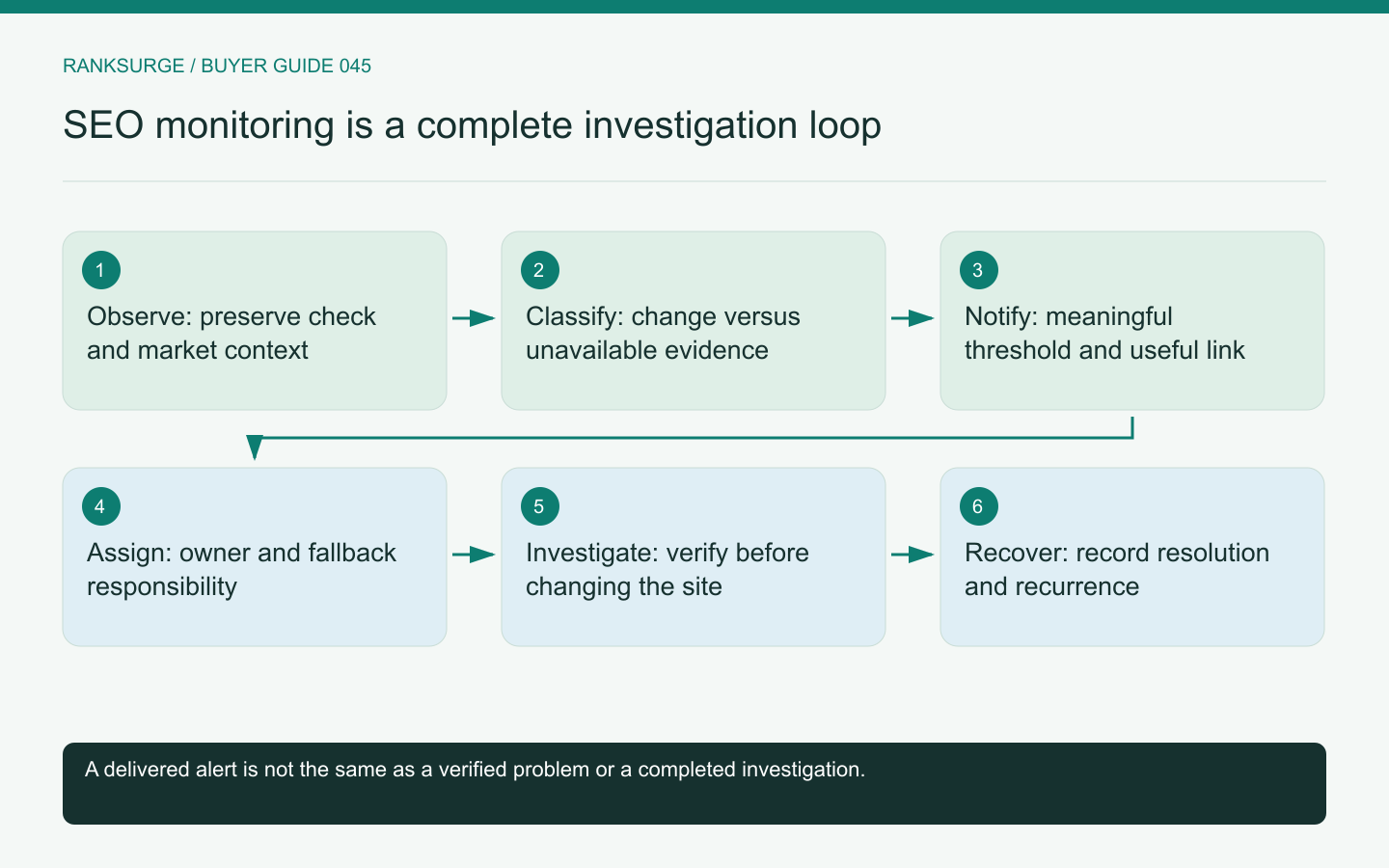
Evaluate SEO monitoring integrations with actionable alert context, missed-data detection, ownership and recovery after notification failures.
TL;DR
- Prefer integrations whose alerts describe meaningful change, preserve enough context to reproduce the observation, and explicitly reach someone with a clear next step rather than merely increasing notification volume.
- Validate integrations with controlled tests that distinguish collection failures from true site changes and confirm notifications retain query, location, URL and device dimensions needed to reproduce the lookup.
- Measure success by sensible thresholds, reliable delivery and clear recovery handling: ensure the system reports notification failures, avoids noisy low-value alerts, and shows whether incidents were resolved or reoccurred.
Define the action an alert should trigger
SEO monitoring integrations connect observations to the people who can investigate them. Their value is not the number of notifications delivered to a chat channel. A useful alert describes a meaningful change, preserves enough context to inspect it and reaches someone with a clear next step.
Choose a small set of conditions for the purchasing trial. Examples include an important page returning an unexpected status, a tracked query showing a different landing page or a scheduled data collection failing. These conditions require different responses and should not arrive as indistinguishable red badges.
Separate website changes from collection failures
A missing observation can mean the page disappeared, the data provider failed or the monitoring job never ran. Ask the candidate to distinguish those cases. Treating every absence as a website problem wastes investigation time and can trigger unnecessary changes.
Use a controlled test in which the collection step fails without changing the website. The alert should state that evidence is unavailable, not claim that rankings collapsed or pages were removed.
Then test a genuine harmless page change in a non-production fixture. The operator should see the observed condition and collection time clearly enough to distinguish it from the earlier monitoring failure.
Preserve the monitored context
A rank observation depends on the configured query, location, language and device. A page observation depends on the inspected URL and the check performed. An alert should retain the dimensions needed to reproduce the relevant lookup.
RankSurge's rank-tracking feature describes tracking configured keywords and observed pages. When evaluating an integration around that data, inspect how much of the configuration survives in the notification and linked record.
A message saying position changed is not enough if the recipient cannot tell which market or URL was involved. The notification can stay concise while linking to a complete observation record.
Compare thresholds with actual investigation value
A small ranking movement may not require immediate action. A critical public page becoming inaccessible may deserve prompt review. Ask how the tool lets your team define different thresholds or review cadences for different conditions.
Use historical or synthetic fixtures with routine fluctuations and a clearly important change. The system should not bury the important event under a stream of low-value updates. More sensitivity is not automatically better monitoring.
Avoid treating a single observation as proof of a durable trend. The alert can request verification and preserve uncertainty. That is often a more useful instruction than a confident diagnosis generated before anyone has inspected the page.
Test grouping and ownership
Several alerts can arise from one underlying change, such as a template deployment affecting many pages. Ask whether the integration can group related observations or at least provide enough shared context for the receiving team to recognize the relationship.
Assign a responsible role for each alert type. Technical page failures may belong to engineering, while an unexpected landing page may require SEO review. A shared channel with no owner can become an archive of ignored notifications.
During the trial, have the primary owner be unavailable. Confirm that the team knows the fallback process. This can be an operational convention rather than a native product feature, but it should be deliberate.
Inspect the notification failure path
Pause the test destination or use a controlled invalid endpoint. Ask what the integration records and whether it retries, reports failure or silently drops the notification. Monitoring that cannot report its own delivery failure may create false confidence.
Separate the observation record from the notification attempt. If a message fails to reach chat, the underlying evidence should still be available for later review. Conversely, a successfully posted alert does not mean someone has investigated it.
Do not assume RankSurge offers every notification destination or retry policy described here. Verify the actual integration path you plan to use and identify any application-owned delivery step.
Related reading: SEO for Startups: A Founder’s Handbook.
Related reading: The Best Open Source SEO Tools in 2026.
Evaluate resolution and repeated alerts
After correcting the trial condition, inspect how the tool represents recovery. Does it send a recovery notice, close an issue or simply stop alerting? The operator should be able to understand that behavior before depending on it.
Then reintroduce the condition in the test environment. Determine whether the system recognizes a new occurrence or hides it as an already acknowledged old alert. Repeated incidents and repeated observations are not the same thing.
Keep a record of the investigation outcome. Over time, the team can adjust noisy thresholds and improve instructions based on actual usefulness rather than the number of alerts generated.
Choose a monitoring loop the team can sustain
A simple scheduled review may be enough for lower-priority keyword changes. Important technical conditions may justify more immediate integration. Match the response cadence to the decision, the cost of delay and the confidence of the signal.
The strongest trial demonstrates observation, notification, investigation and recovery as distinct steps. Buy the tool or integration that keeps those steps connected and understandable. An alert becomes valuable when it leads to an appropriate action, not merely when it reaches another inbox.