
SEO MCP Servers: Compare Data Access, Permissions and Research Costs
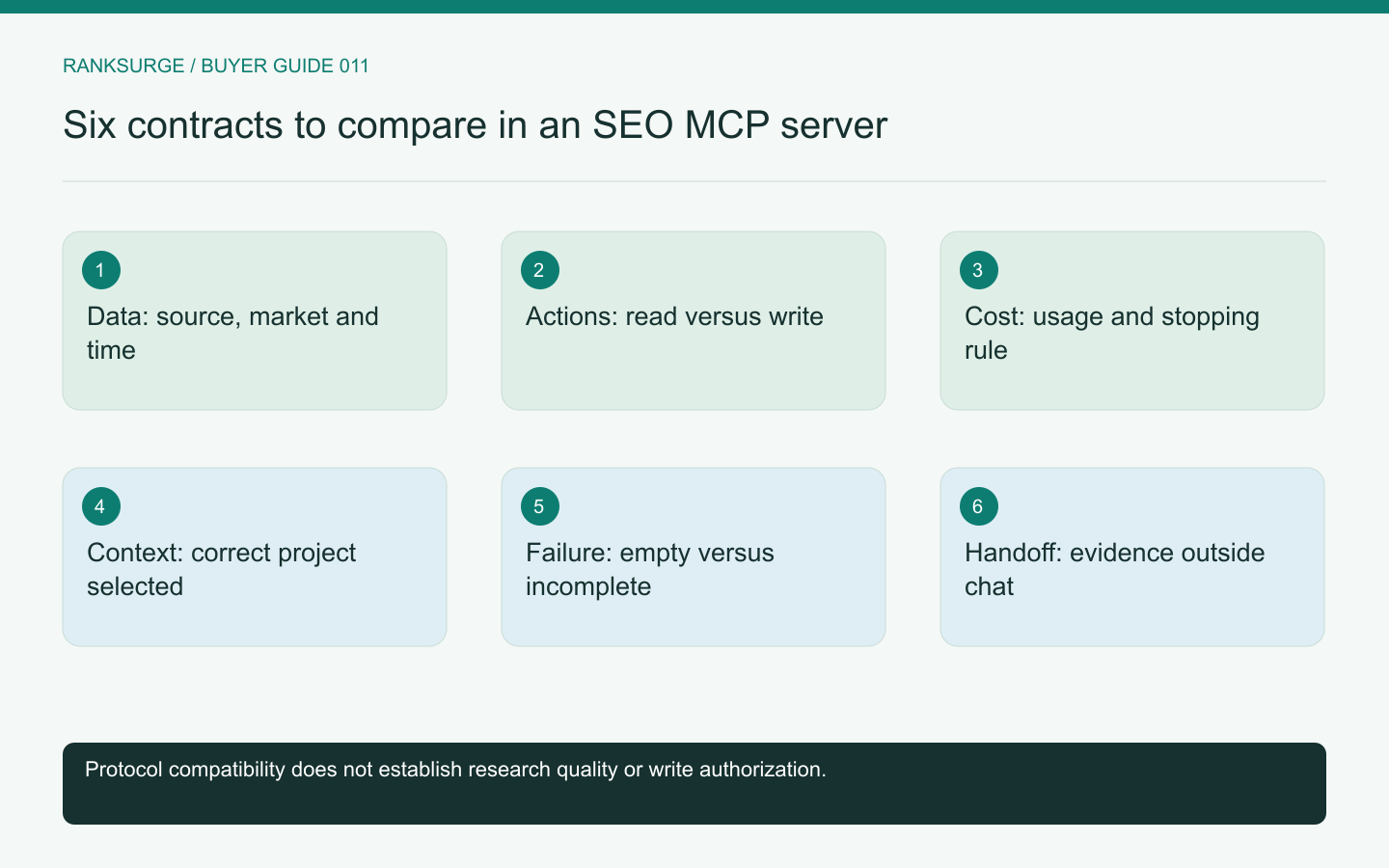
Compare SEO MCP servers by their data contracts, write permissions, cost visibility and ability to preserve evidence outside an agent conversation.
TL;DR
- Prefer the SEO MCP server whose capabilities, permissions and data meaning fit the workflow you intend to operate; connection success alone is insufficient to rely on for recurring decisions.
- Evaluate servers by defining one clear data contract and using small, inspectable samples so agents reason from coherent schemas and researchers can compare returned evidence rather than prose.
- Treat cost, writes and project selection as explicit success checks: run bounded tasks, verify no unintended saves, record operations and confirm saved evidence is readable outside the chat.
Compare the server behind the conversation
An SEO MCP server connects an AI client to research capabilities, but the quality of the result depends on more than whether the connection succeeds. Two servers can expose similarly named tools while returning different evidence, using different data sources or granting different write authority. Evaluate those differences before building a recurring workflow around either one.
The MCP architecture documentation describes a client-server protocol for exchanging context and exposing capabilities. The protocol does not decide whether a keyword is commercially relevant or whether an agent's recommendation is sound. Those judgments still require useful inputs and a reviewable research method.
Start with one data contract
Pick a task such as retrieving the current search results for a keyword in a specified market. Ask each server what input identifies the market, what output identifies the observed pages and what timestamp or source context accompanies the result. Compare the returned evidence, not just the prose the agent writes afterward.
Then choose a task that uses historical or estimated data. Determine whether the response distinguishes estimates from live observations and missing fields from numeric zero. A coherent schema helps an agent reason correctly, but it does not replace accurate source definitions.
Use a small sample that your researcher can inspect manually. A tool that returns an enormous response may consume attention and model context without improving the decision.
Separate reading from saving
Inventory read operations and state-changing operations independently. Reading competitor keywords is different from saving a shortlist, editing shared project context or changing a monitoring configuration. The server's tool names should make those effects clear enough for your team to set appropriate permissions.
During a trial, ask the agent to research without saving, then inspect the project to confirm nothing changed. Next, authorize one small save and verify exactly what appeared. This exercise tests the boundary your workflow depends on without requiring broad administrative access.
Do not assume that a read-oriented prompt removes write capability from the credential. A prompt is an instruction to the agent; server-side authorization is a separate control. Evaluate both when the distinction matters to your organization.
Examine cost before open-ended research
A request such as “analyze all competitors” can fan out into many paid operations. Ask how the server exposes cost, quotas or usage evidence and how failed or repeated requests are treated. Determine whether the client can see enough information to respect a research budget.
Set a bounded task: investigate three candidate pages and stop once the evidence supports a choice. Record the operations performed and the resulting usage. A useful comparison includes both the quality of the decision and the cost of obtaining it.
Avoid comparing raw credit numbers across providers as though their units were equivalent. Compare completed tasks, necessary follow-up work and total spending under your expected workload.
Test context and project selection
A server connected to several projects needs a reliable way to select the intended one. Ask the agent to identify the project before reading or writing data. Supply deliberately different project goals in a test environment and inspect whether the resulting research respects those differences.
RankSurge's MCP documentation describes research, saved keywords and shared project context. That combination can support repeatable work, but the buyer should still test how the intended client identifies the project and handles updates. A fluent answer is not evidence that the correct project was used.
Preserve the project identifier and research scope in the final artifact. Another teammate should be able to tell which business the recommendation concerns without reading the whole conversation.
Related reading: How to Prompt Claude Code for SEO.
Related reading: How to Use Vellum and OpenSEO for Your SEO Engine - RankSurge Blog.
Evaluate failure and recovery behavior
Disconnect a test client or use a documented invalid input and observe how the server reports the failure. Does the agent receive a clear error, a partial result or an ambiguous empty response? Can the researcher distinguish no matching data from a request that did not complete?
For writes, ask how the workflow prevents accidental repeated saves after an uncertain response. Do not assume the agent remembers every operation perfectly. Prefer evidence that can be checked in the destination project.
Keep tests within the provider's supported behavior and your authorized account. The goal is integration confidence, not stress testing or probing security boundaries without permission.
Keep the evidence outside the chat
The final recommendation should include source context, selected and rejected candidates, unresolved questions and the next action. Save it in a form another person can read without reproducing the entire agent session. A conversational interface is useful, but it should not become the only repository of research reasoning.
Test this handoff with a teammate who did not watch the agent work. If they cannot identify the evidence behind the conclusion, improve the output contract before automating more tasks.
Choose the SEO MCP server whose capabilities, permissions and data meaning fit the workflow you intend to operate. A successful connection is the beginning of the evaluation. A reproducible decision with bounded cost and clear authority is the result worth buying.