
SEO Data API Vendors: Evaluate Coverage, Provenance and Retry Costs
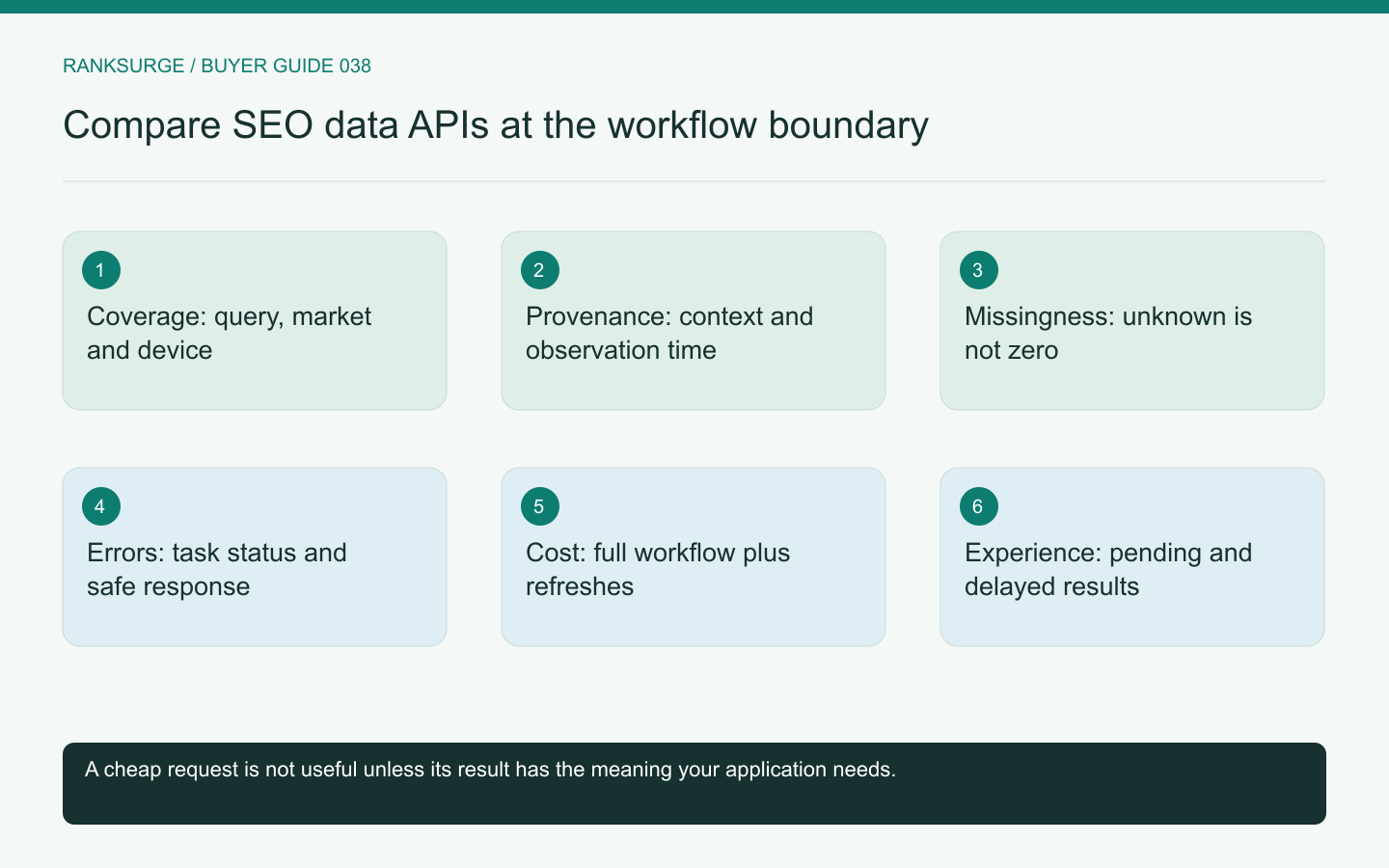
Evaluate SEO data API vendors with a fixed query fixture, provenance fields, endpoint-level errors and a realistic cost model for retries and refreshes.
TL;DR
- Select the vendor or platform that meets declared coverage and exposes enough evidence to debug and explain results; prioritize data your application can interpret, recover from, and present without inventing certainty.
- Evaluate providers with a small, representative fixed query set and keep raw responses; pair that with task-level error tests to verify how partial failures, queued work, and validation errors are reported.
- Treat cost, retries and latency as system-level constraints: model full workflow costs including retry allowances, test slow paths deliberately, and confirm permitted storage, caching and redistribution rights before committing.
Compare the data product your application needs
SEO data API vendors sell access to several different kinds of evidence: search results, keyword estimates, backlink records and other datasets. A low price per request does not make two endpoints equivalent. Start by defining the exact record your application needs and how fresh it must be.
For a rank-monitoring feature, the required record might include query, location, language, device, observation time and result URLs. For keyword planning, it might include a reported volume with its market and collection context. Write these requirements before comparing pricing tables.
Build a fixed evaluation set
Create a small query set that represents your actual customers. Include a common commercial query, a narrow technical phrase, a local query and a term with ambiguous meaning. Run the same configured tasks through each candidate where their documented coverage permits it.
Do not rank vendors by whether one lookup matches a personal browser search exactly. Search context and observation time can differ. Instead, inspect whether the response includes enough information to understand what was requested and what was returned.
Keep raw responses for the evaluation with credentials removed. A normalized comparison table is helpful, but the original response is necessary when your parser or interpretation is later questioned.
Inspect provenance and missingness
Ask which fields identify the requested market, language and device, and whether the response reports the actual collection context. A dataset should not lose those dimensions when your application stores it.
Distinguish an unavailable metric from a measured zero. A response that omits difficulty should remain unknown in your product unless the provider explicitly defines another meaning. Inventing a default value makes sorting convenient and undermines the evidence customers see.
DataForSEO's organic SERP API overview documents its endpoint model and collection options. Use a vendor's own endpoint documentation to understand the product you are buying rather than assuming every SEO API offers the same freshness and execution behavior.
Test errors at the task level
A successful HTTP response does not necessarily mean every requested task produced usable data. Ask how the provider represents validation errors, queued work, partial failures and unavailable results. Your integration should inspect the documented status fields at the appropriate level.
DataForSEO's error reference is an example of the detail a production integration needs. Compare candidates on the clarity of their error contracts and the actions your application should take for each class.
Use a harmless invalid parameter in the trial. The goal is to see whether the failure is explicit and whether the operator can identify the mistake without searching through an unexplained generic error. Do not repeatedly submit expensive tasks just to test a retry loop.
Model the full cost of a workflow
Estimate a normal customer workflow rather than a single request. A keyword report may require discovery, metrics, SERP inspection and later refreshes. A monitoring feature may repeat tasks across locations and devices.
Add a bounded allowance for legitimate retries and failed-task investigation. Determine which unsuccessful requests are billable under the current contract. Do not assume a retry is free or that repeated polling has no operational cost.
An illustrative cost worksheet can list the number of tasks per report, the documented unit price and the refresh frequency. Keep the prices as dated inputs from the vendor rather than hard-coding them into product assumptions that nobody revisits.
Compare latency with your user experience
A synchronous lookup may suit an interactive feature, while queued work may suit a scheduled report. The right choice depends on what your interface promises and how it handles pending results.
Test the slow path deliberately. A user should see that work is queued or incomplete rather than an empty chart interpreted as no opportunity. If a task finishes later, define how the result is associated with the original request and whether the user needs to refresh manually.
Measure your own trial if latency matters, and label those observations narrowly. Do not turn one successful response into a universal performance claim about the vendor.
Before committing, confirm the permitted storage, caching and redistribution of each dataset. Internal research and displaying records to paying customers can have different contractual requirements. Have the purchasing owner resolve those terms explicitly; technical access to an endpoint does not establish every intended usage right.
Decide whether an API or a platform is the better purchase
A direct API gives your team control over ingestion, storage and presentation. It also makes your team responsible for schema changes, retries, budgeting and the customer-facing meaning of the data. A platform such as RankSurge can provide a research workflow around underlying data, but should be evaluated on the application work it actually removes.
Choose the vendor or platform that meets your coverage requirements and exposes enough evidence to debug a surprising result. The strongest contract is not merely inexpensive data; it is data your application can interpret, recover and explain without inventing certainty.
Related reading: The Best Open Source SEO Tools in 2026.
Related reading: How to Use Vellum and OpenSEO for Your SEO Engine.