
SEO APIs vs SEO Software: Decide Who Will Build the Research Workflow
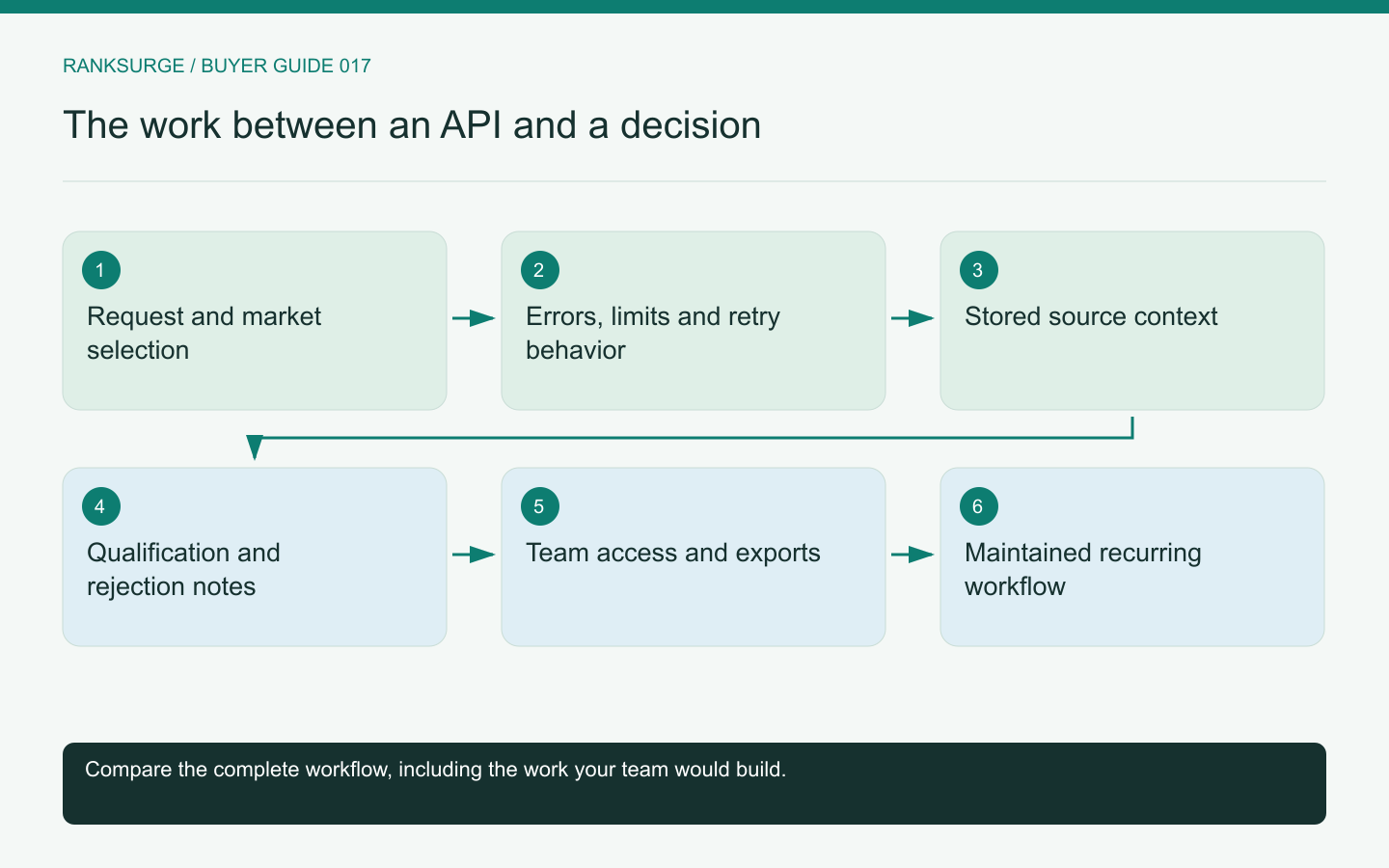
Decide between an SEO API and a research platform by accounting for the interface, persistence, retries and analyst workflow your team would need to build.
TL;DR
- Decide method by who will build and operate the application layer: choose direct APIs when the custom workflow is valuable to own, or a platform when its existing workflow covers the task with less maintenance.
- Validate the choice by prototyping a concrete task: build or demonstrate a small shortlist workflow with both approaches and prefer the option that yields correct, repeatable decisions at acceptable total cost.
- Treat operational limits as part of the comparison: compare total implementation and maintenance, test the workflow twice, and include monitoring for data-contract changes and incomplete responses.
An API returns data; a workflow turns it into work
Buying direct access to SEO data can be attractive when your team wants flexibility. A research platform can be attractive when analysts need a usable process immediately. The right choice depends on which parts of that process your organization is willing to build and maintain.
Start by describing the complete task. “Fetch keyword volume” is an operation. “Qualify a shortlist, preserve the market and evidence, and hand the selected pages to a writer” is a workflow. An API may support the operation perfectly while leaving most of the workflow to your team.
Compare the total implementation, not just the first successful response.
Map the missing application layer
A custom API integration may need input validation, market selection, credentials, request limits, retries, storage, exports and access control. It may also need a way to distinguish incomplete results from no data. None of these is necessarily difficult in isolation, but together they form a product your team must operate.
Ask who will use it. Engineers may be comfortable with scripts and structured files; nontechnical researchers may need saved views, clear errors and project context. A prototype built for one developer can become an unsupported internal dependency when the whole marketing team adopts it.
Write these requirements before estimating development cost. Otherwise the comparison tends to include only the code that calls the endpoint.
Use a shortlist task as the trial
Suppose an analyst wants to evaluate twenty candidate queries in two markets. The workflow must preserve which metric belongs to which market, identify missing values and record why some terms were rejected. It should also avoid charging for repeated lookups unnecessarily when appropriate saved evidence already exists.
Build or demonstrate this small workflow with both approaches. For the API option, measure the work needed to produce a usable artifact. For the platform option, inspect whether the built-in workflow preserves the context you need or forces awkward manual steps.
The winner is not necessarily the approach that returns data fastest. It is the one that supports a correct, repeatable decision at an acceptable total cost.
Evaluate flexibility with a concrete requirement
Direct APIs are useful when you need custom joins, specialized reporting or integration into an existing internal system. Make that requirement specific. For example, you might need to combine search observations with a product catalog's category identifiers and refresh only selected segments.
A platform may already provide exports or integration access sufficient for that task. RankSurge's feature overview presents research and monitoring in a shared product, while its MCP documentation describes agent-accessible capabilities. Evaluate the actual interface against your requirement rather than assuming a platform is closed or an API is automatically more suitable.
Avoid building a custom system solely to reproduce a standard table unless the resulting control has a clear benefit.
Related reading: The Best Open Source SEO Tools in 2026.
Related reading: SEO for Startups: A Founder’s Handbook.
Account for data-contract changes
An API integration depends on field meanings, pagination, error behavior and provider updates. Decide who monitors changes and how downstream reports are checked. A field that remains present while its interpretation changes can be more dangerous than an obvious request failure.
Preserve source context with stored observations. Include the market, date, query and provider definition where relevant. Do not flatten every result into a single number that later users cannot interpret.
A platform moves some maintenance responsibility to its operator, but it does not remove the need to understand the output. Your team still needs to know whether a metric is estimated, historical or first-party before using it in a decision.
Compare operating costs after the prototype
For the API option, include provider usage, infrastructure, maintenance, user support and the time spent repairing reports. For the platform option, include subscription costs, manual workarounds and any additional services required. Keep setup cost separate from recurring cost.
Run the same representative task twice. The second run reveals whether the workflow is reusable or depends on the original developer remembering undocumented steps. Have another teammate perform it if possible.
If the custom integration is intended for a recurring process, test an incomplete response and a temporary failure using supported methods. Determine whether the system resumes safely and explains what remains unknown instead of silently producing an empty report.
Consider a staged choice
You do not need to choose one approach for every task. A platform can support exploratory analysis while an API powers a narrow recurring report. A custom integration can start small and expand only after the team understands the data and workload.
Keep ownership clear when combining approaches. Decide which system holds project decisions and which holds raw observations. Otherwise analysts may compare different snapshots without realizing they came from different queries or dates.
Choose direct APIs when the custom workflow is valuable enough to own. Choose a platform when its existing workflow covers the task with less maintenance and acceptable flexibility. The useful buying question is who should build and operate the application layer between raw SEO data and a decision the team can trust.