
Semrush Alternatives for SEO Research: Scope the Work Before Comparing Suites
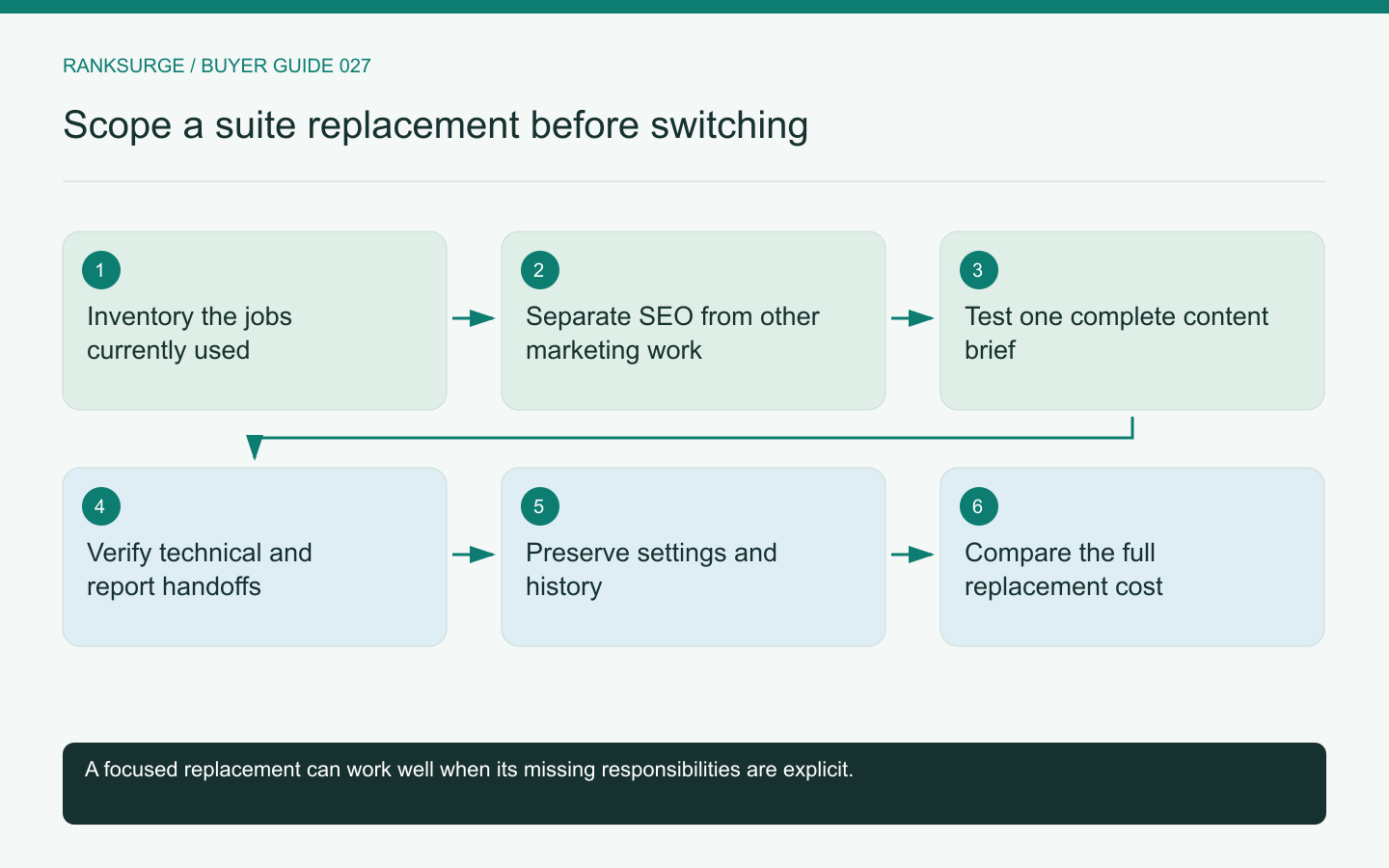
Compare Semrush alternatives by separating SEO research requirements from other marketing-suite work and testing the exact modules your team needs.
TL;DR
- Choose the Semrush alternative that completes the specific portion of workflow you actually need to replace; scope the replacement first to avoid gaps after cancellation and guide deliberate selection.
- Validate candidates with hands-on trials: run a complete content‑planning exercise and require identical evidence packets, then test a technical crawl handoff and a reporting recreation to confirm usability.
- Treat migration and purchasing as operational decisions: export and overlap data to compare definitions, and use a conditional decision statement comparing demonstrated tasks, budget, and review capacity.
Scope the replacement before choosing it
A search for a Semrush alternative can mean several different things. One team wants keyword and competitor research. Another needs technical audits, client reports and local monitoring. A third uses a broader marketing suite that extends beyond SEO. Replacing only one part while assuming the rest will follow can create gaps after cancellation.
Write down the jobs that must continue and identify which are actually SEO research. Separate them from advertising, social or other marketing workflows if your account uses those. The shortlist should reflect the intended replacement scope rather than the largest possible collection of features.
This guide compares documented product categories and proposes a trial, not a performance ranking.
Establish the current workflow
Semrush's SEO toolkit page describes competitor analysis, keyword discovery and other SEO work within its broader offering. Review the specific modules and plan your team currently uses, then identify the outputs that matter: a qualified content brief, an audit handoff, a monitoring report or a competitor investigation.
For each output, note the required market, source context, export format and reviewer. A report that exists only because one analyst manually combines three views is part of the workflow even if that combination is not documented.
This inventory prevents the team from choosing a cheaper product that appears similar but leaves important assembly work unaccounted for.
Related reading: The Best Open Source SEO Tools in 2026.
Consider alternatives by role
Ahrefs Site Explorer is a candidate for competitor and backlink research. Evaluate the exact evidence and history needed for your work rather than assuming it reproduces every Semrush module.
RankSurge is a candidate for teams that want keyword, domain, audit and monitoring work connected to agent-accessible research. Verify the depth and limits of each required workflow in the actual account.
A focused crawler or first-party reporting tool may be appropriate for a narrower job. That approach can be sensible, but it produces a tool combination rather than a one-for-one suite replacement. Include coordination and export work in the comparison.
Related reading: How to Prompt Claude Code for SEO.
Run a complete content-planning exercise
Choose a real product area with a few candidate queries. Ask each alternative to identify relevant searches, inspect result intent and recommend whether to create a page, update an existing page or reject the opportunity.
Require the same evidence packet: market, observations, available metrics, product fit and duplicate-content review. The trial should produce a brief a writer can use, not simply another keyword list.
Compare the manual corrections required. A tool that returns many irrelevant suggestions may still be useful to an experienced analyst, but the qualification effort belongs in the cost. A smaller, clearer output may fit a team with limited review capacity.
Test one technical and one reporting handoff
For the technical task, choose a representative page family and inspect crawl coverage before comparing issue counts. Ask a developer to use the exported evidence to investigate one finding. This reveals whether the alternative provides enough context for implementation.
For reporting, recreate one client or management question using the same date range and filters. Check whether the report distinguishes source metrics from interpretation and preserves the relevant limitations. A visually similar chart can still answer a different question if its aggregation changes.
Do not require every replacement to use the same interface. Require it to produce an equally understandable decision and handoff for the work you intend to keep.
Plan the data transition
Inventory saved keywords, competitor lists, reports and monitoring settings. Export what the team needs while the current account remains available. Preserve the meaning of historical metrics and explain any source change in future reports.
Run a small overlap period if practical. Use it to compare configuration and understand differences, not to declare one provider inaccurate whenever values disagree. Different definitions and collection methods can legitimately produce different observations.
Assign an owner to reconnect properties, update report links and retire unused integrations. A subscription change is also an operational change, especially when automated reports or client access depend on the old account.
Compare the full commercial arrangement
Check current pricing, plan boundaries, user access, usage limits and cancellation terms directly with each provider. Avoid assuming all features on a marketing website are included in the first paid tier.
Include separate tools required by the replacement and the time spent maintaining the combined workflow. A smaller subscription can still be the better choice if it covers the essential work, but the saving should survive this broader calculation.
Use a conditional decision statement: choose the alternative if it completes the demonstrated research and reporting tasks within the team's budget and review capacity. Keep unresolved requirements visible rather than filling them with optimistic assumptions.
The best Semrush alternative is the one that fits the portion of the workflow you truly need to replace. Scoping that work first lets you choose a focused tool, another suite or a combination deliberately, without discovering missing responsibilities only after the old account is gone.