
Self-Hosted SEO Tool Backups: Evaluate Restoreability Before Deploying
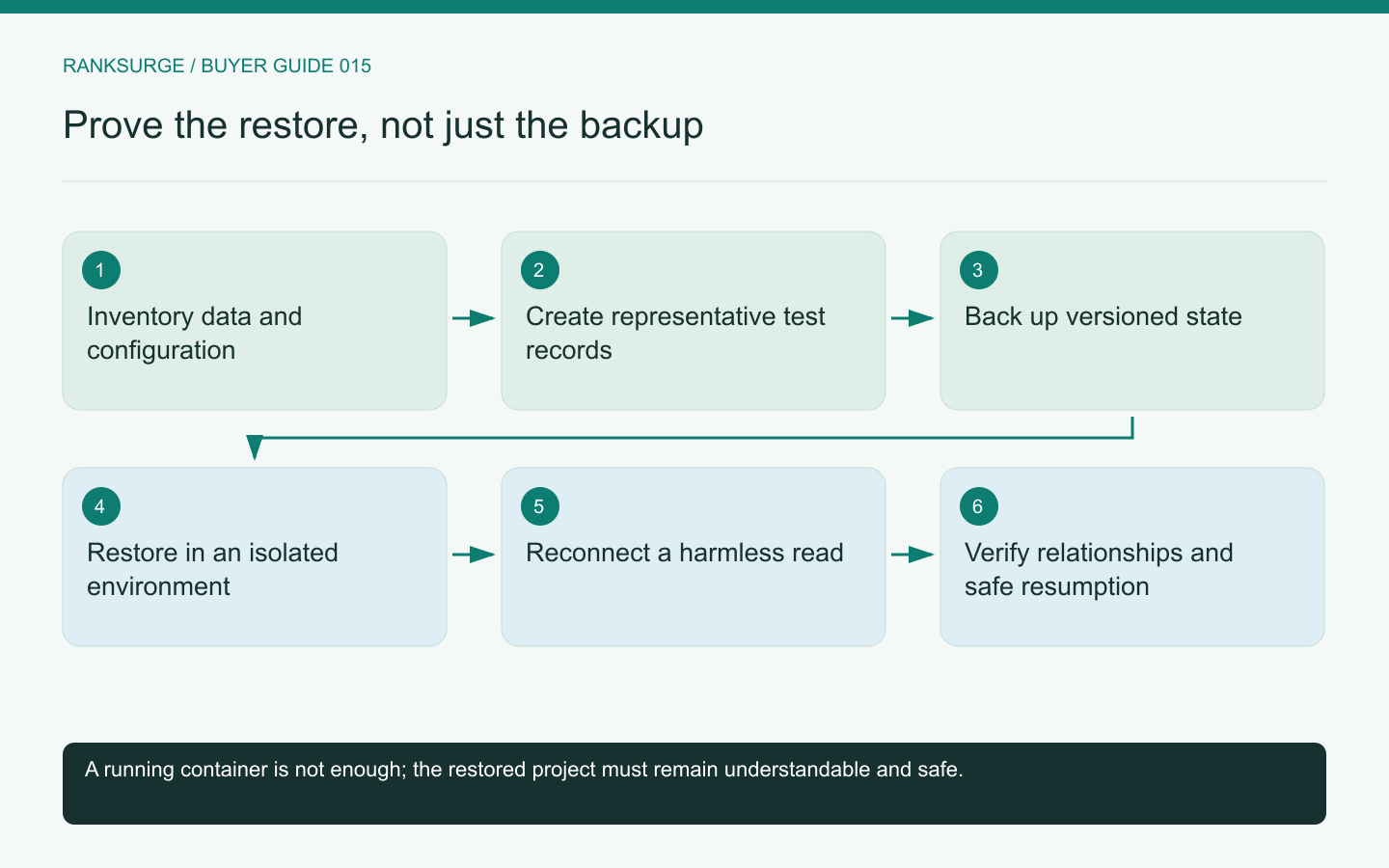
Evaluate self-hosted SEO tools by restoring project data, configuration and external connections before relying on the deployment for research history.
TL;DR
- Only deploy a self‑hosted SEO tool if the team can restore the application and its research state after a failure; backups alone are not proof of recoverability and carry operational ownership.
- Validate recoverability by inventorying every stateful component and performing an isolated restore using a representative recovery fixture that exercises relationships, not just record counts.
- Set concrete limits and a clear acceptance check: define acceptable loss and measure the full restore effort, with success being a teammate opening the restored project, understanding evidence and resuming work.
The backup requirement is a working restore
Self-hosting an SEO tool gives your team control over deployment, but it also makes the team responsible for preserving useful research. A backup file that exists is not the same as an application that can be restored with its projects, credentials and history intact.
Before choosing a self-hosted platform, define what you would need after losing the running environment. Include saved keywords, research notes, reports, monitoring configuration and the settings needed to reconnect external services. Then test a restore using harmless data in a separate environment.
This is a buying criterion because operational ownership consumes time and expertise. A lower software bill does not remove that responsibility.
Inventory state beyond the database
The database may contain projects and saved observations, but other state can live in object storage, mounted volumes, configuration files or an external identity system. Generated reports and uploaded assets may follow different storage paths from keyword rows.
List each component, its owner and its recovery method. Identify which secrets can be reissued and which encrypted records depend on a key you must preserve securely. Do not place live credentials in a general backup checklist or a public repository.
Also record the application version and deployment configuration. Restoring data into an incompatible version can fail even when the backup itself is complete. The recovery package needs enough context to recreate the intended environment.
Create a representative recovery fixture
Build a test project with a few saved keywords in different markets, a research note, a report and a monitoring configuration if supported. Include a record with an unavailable metric so you can verify that missing data survives accurately.
Take the documented backup, then restore it into an isolated environment. Ask a teammate to open the project and explain its state. Can they identify the market, read the report and see the intended monitoring scope? Can they distinguish historical evidence from a fresh lookup?
The fixture should exercise relationships, not just record counts. A report that exists but no longer belongs to the correct project is not a successful recovery.
Keep restored environments from acting unexpectedly
A restored application may contain schedules, webhooks or external credentials. Decide how those are disabled or isolated during testing so the recovery exercise does not duplicate live monitoring, spend provider credits or send notifications unintentionally.
Review authentication before exposing the restored service. Inspect the deployment's actual authentication mode and network boundary. A local convenience configuration should not be assumed safe for an internet-facing recovery environment. Container storage also needs explicit treatment: Docker's volume documentation describes volumes and backup-related workflows, which should be checked against the application's own data-consistency requirements.
Use the current deployment documentation for the exact version you run. Do not copy a production hostname or credential into a test environment simply because it makes startup easier.
Test external connections as separate dependencies
An SEO application may depend on data-provider accounts, search-property authorization or model-service credentials. A database restore does not guarantee those external relationships remain valid. Determine how each connection is reauthorized and who can perform that action.
Record the business owner of each account and the source of billing. If the only person who can restore a connection is unavailable, the recovery plan has a human dependency that deserves attention.
For the trial, verify a harmless read after restoration rather than launching a broad research job. The goal is to establish that the connection works without consuming an unpredictable budget or altering project state.
Related reading: The Best Open Source SEO Tools in 2026.
Define acceptable loss and recovery effort
Choose how much recent work the organization can afford to lose and how quickly the tool needs to return. Those requirements guide backup frequency and operational investment. A solo researcher may tolerate reconstructing a few notes; an agency with ongoing client monitoring may have a different threshold.
Measure the restore exercise honestly. Include finding the backup, provisioning the environment, restoring data, reconnecting services and verifying access. A storage system's restore command duration is only one part of the total.
Document failures and repeat the relevant step after correction. Do not call the plan tested merely because a container started or a health endpoint responded.
Compare self-hosting with managed responsibility
Use the exercise to estimate ongoing work: backups, updates, access management, provider billing and periodic restore tests. Compare that with the managed offering's documented responsibilities and limitations. Neither option removes the need to preserve your own research decisions in a usable form.
If your team lacks an owner for recovery, managed hosting may be the more practical choice even when self-hosting is technically possible. If control and customization matter enough, the restore test helps make the operating commitment explicit.
Choose a self-hosted SEO tool only when you can explain how its useful state returns after failure. The acceptance condition is a teammate opening a restored project, understanding the evidence and safely resuming work. Everything before that is preparation for recovery, not proof that recovery works.
Related reading: How to Prompt Claude Code for SEO.