
Seasonal Keyword Demand: Separate Planning Windows From Temporary Spikes
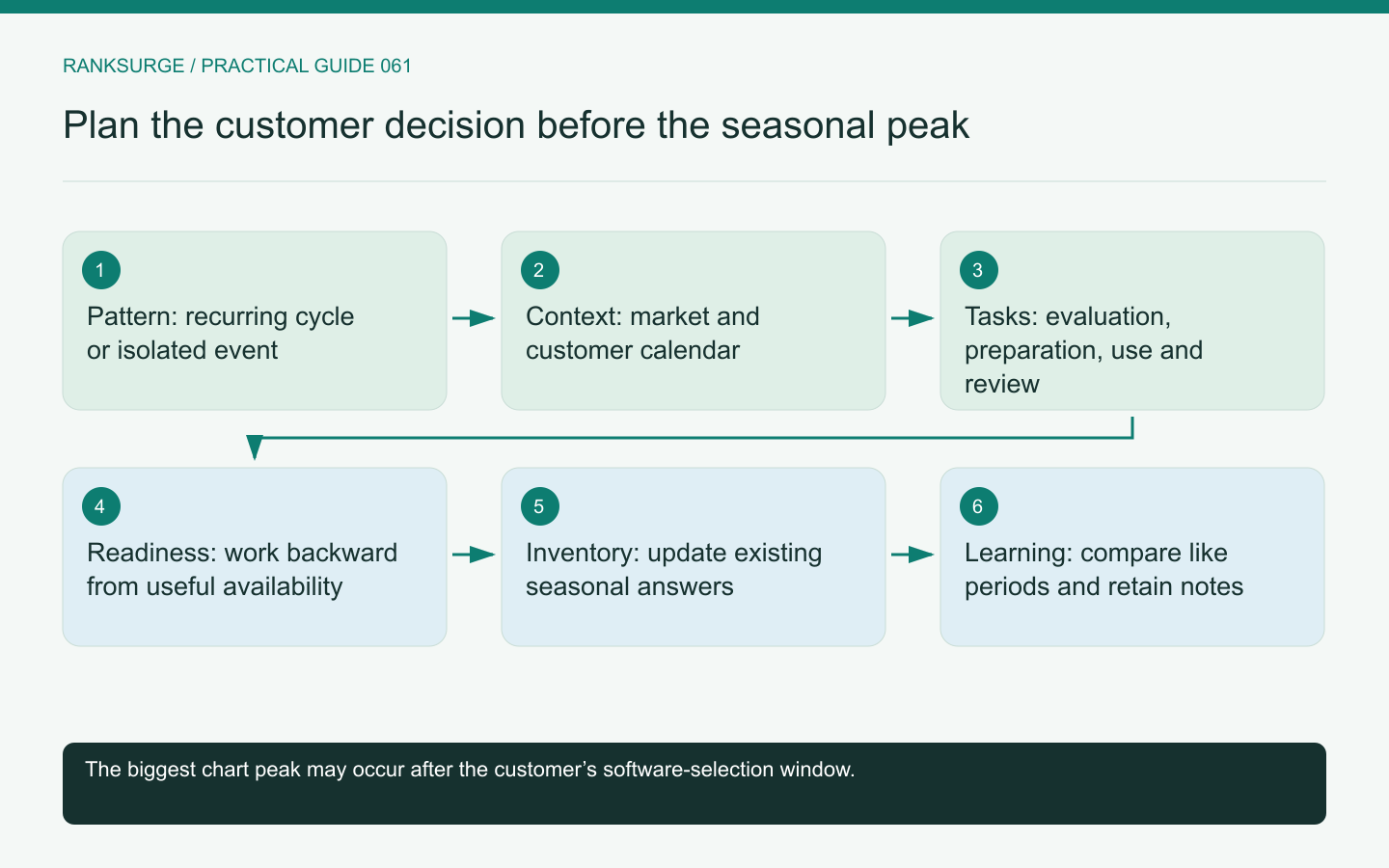
Plan seasonal keyword content by comparing recurring demand windows, customer preparation time and existing coverage rather than reacting to a single spike.
TL;DR
- Plan around the customer decision, not the biggest spike: treat seasonal keyword work as preparation for recurring customer decisions and avoid using the largest visible peak as the start date for writing.
- Use a task-driven, calendar-aware workflow: map seasons to reader tasks, record location and calendars, then choose a publication readiness date and work backward through required reviews and localization.
- Check success by comparing like periods and preserving evidence: measure against similar cycles, keep filters and dates, and record the planning window, supporting evidence and unresolved questions for the next cycle.
Research the planning window before the peak
Seasonal keyword research should help a team prepare useful content before a recurring customer decision. The largest visible peak is not necessarily the best date to begin writing. Readers may compare products, secure approval or arrange implementation well before the event that creates the demand.
Start with the customer workflow. For an illustrative appointment platform serving training providers, course enrollment may peak at a familiar time of year, but the organization may choose scheduling software months earlier. The editorial plan should distinguish those decisions instead of assigning every related keyword to the same week.
Separate recurrence from a one-time event
Compare several relevant periods where data is available and inspect the circumstances around unusual changes. A repeating pattern deserves a different planning response from a single product announcement, outage or news story.
Google Trends explains that its values are normalized relative interest, not absolute search counts. Keep that distinction visible when interpreting the chart. A peak at the top of the scale does not tell you how many potential customers exist.
Use other evidence, such as your own page performance and customer planning conversations, to understand what the pattern might mean for the business.
Keep geography and the calendar explicit
A season can occur at different times in different markets, and business calendars do not always follow weather seasons. Record the location, time range and query interpretation used in the analysis.
For the training example, academic intake dates, fiscal budgeting and local holidays may affect the buying process differently. Do not apply one market's pattern to every customer merely because the product is available internationally.
If the team cannot explain which customer calendar the keyword follows, label the seasonal interpretation tentative. It is better to preserve uncertainty than schedule a large campaign around an attractive but poorly understood curve.
Map the season to distinct reader tasks
Create a simple sequence: early evaluation, preparation, active use and follow-up. Then ask which tasks your product and expertise can address at each stage.
Early evaluation might need a tool-selection guide. Preparation could require an implementation checklist. Active use may call for support documentation rather than another broad blog post. Follow-up could involve reviewing results and preparing improvements for the next cycle.
These are editorial possibilities, not an instruction to create four pages for every keyword. Check existing coverage and combine tasks when one well-structured destination can satisfy them without losing focus.
Build a backward plan from readiness
Choose the date by which the content must be accurate and usable, then work backward through research, product review, writing, localization where needed and publication preparation. Allow time for dependencies that your team actually has.
Do not invent a universal lead time or promise that publishing a certain number of weeks before a peak will produce rankings. The plan should reflect the work required and the uncertainty of search visibility.
For the appointment platform, a comparison guide requiring current integration details may need product-owner review. Schedule that review before assigning a final publication date, rather than discovering the missing facts at the end.
Prefer maintenance when the page already serves the task
Read the previous season's content. A useful page may need updated dates, current availability or a stronger example rather than a new year-specific URL.
Keep stable material stable and revise facts that genuinely changed. If an older campaign page is no longer appropriate, decide its future deliberately: retain an archive, update the destination or handle removal according to the site's needs.
Avoid automatically cloning the same article with a new year in the title. The reader should gain current, relevant information, not another nearly identical result competing with the previous version.
Measure the outcome in the right comparison
After the cycle, compare similar periods and document changes in the product, site and market that could affect interpretation. A month-to-month decline after the seasonal peak may be expected rather than evidence that the content failed.
Google Search Console's performance report can help inspect first-party page and query behavior. Keep the filters and dates with the analysis so another person can understand the comparison.
Also review whether the content answered customer questions and remained accurate. Search exposure alone does not establish that a seasonal guide supported the intended decision.
Leave the next cycle a better brief
Record the observed planning window, the evidence supporting it, useful pages and unresolved questions. Include one thing the team would start earlier and one item that did not justify its maintenance cost, so the next cycle improves the process rather than repeating it. Assign an owner to refresh time-sensitive facts before the next cycle.
RankSurge can support the research process, but the seasonal plan should remain explainable without a chart screenshot. The deliverable is a reasoned schedule for useful answers tied to a real customer calendar, with enough context to revise it when the next season behaves differently.
Related reading: SEO for Startups: A Founder’s Handbook.
Related reading: The Dark Query Problem: Why Search Console Hides Most of Your Searches.