
Search Console Page–Query Analysis: Find the Searcher's Unanswered Task
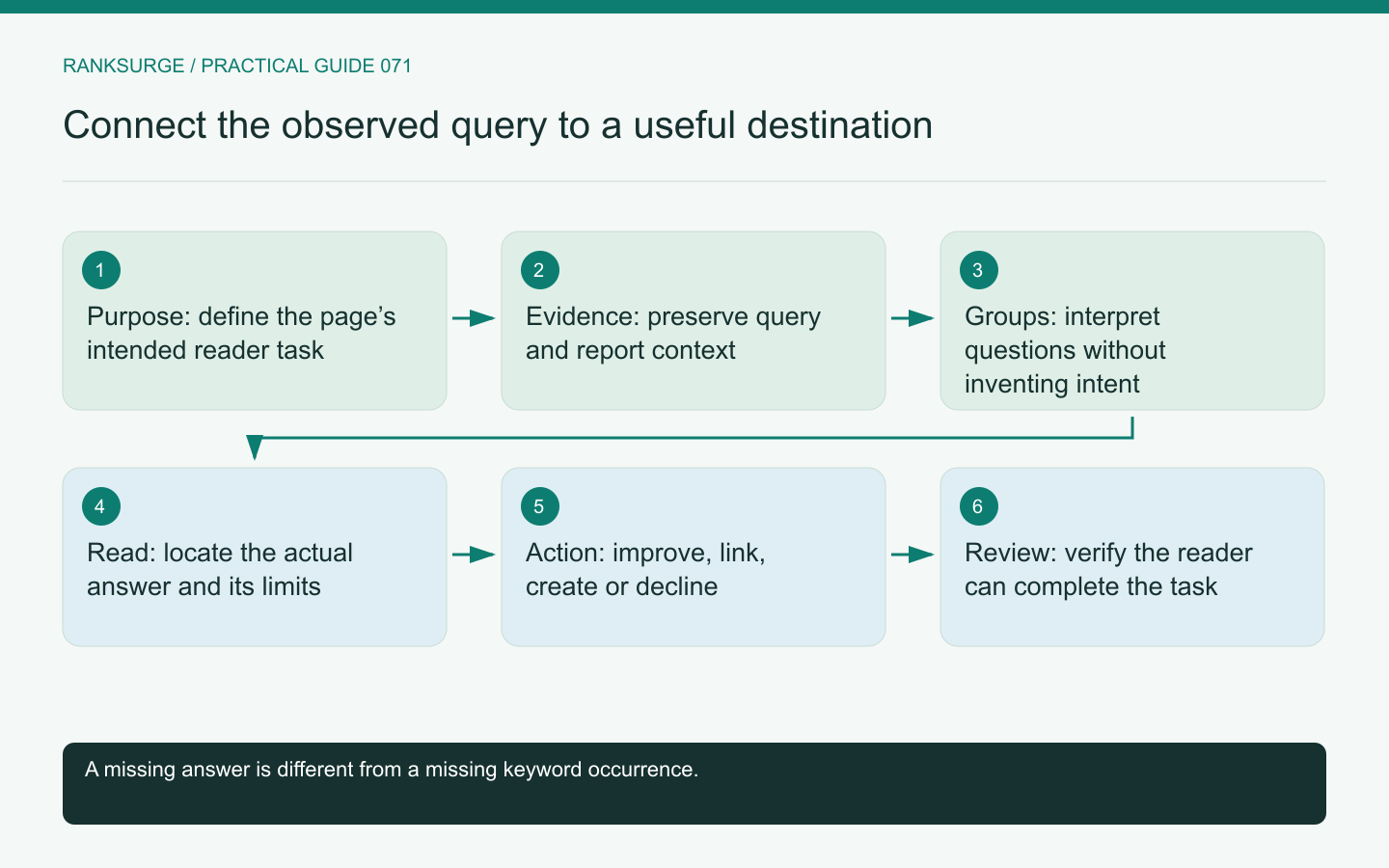
Use page–query analysis to compare the searcher’s task with the actual landing page, then choose a focused improvement instead of adding every phrase.
TL;DR
- Main decision: Page–query analysis reframes reporting toward the searcher's apparent need and which page served it; begin with one important page and define its intended audience and task before looking at queries.
- Useful method: Group representative queries by the question they imply, keep original queries beside task labels, and use a small decision worksheet to record implied task, current answer, missing evidence, destination action and owner.
- Meaningful limit and success check: Verify facts before expanding the page’s promise, then review the change by testing whether a reader with the selected question can find the answer and understand its limitations.
Join the query to the destination's actual purpose
Page–query analysis asks a more useful question than which keywords a site receives: what did the searcher appear to need, and which page did the site present for that need? The relationship can reveal an answer that is missing, buried or assigned to the wrong destination.
Start with one important page. Write its intended audience and task before looking at the query list. This gives the investigation a reference point and reduces the temptation to redefine the page around every phrase that happens to appear in a report.
Preserve the report context
Record the property, period, search type and relevant filters. Use the available page and query evidence consistently, and keep the source's coverage limitations in mind.
Google's Search Console performance report provides dimensions that support this investigation. The report is an observation of search performance, not a transcript of each visitor's intention.
If a query's meaning is ambiguous, preserve that uncertainty. Do not invent a detailed customer journey from a few words simply because the phrase would fit a convenient editorial story.
Related reading: The Dark Query Problem: Why Search Console Hides Most of Your Searches.
Group queries by the question they imply
Read a representative set and describe the tasks in plain language. For an illustrative appointment-software page, queries might ask about pricing, staff calendars, timezone behavior and getting started.
Those groups can imply different expectations. Pricing queries may need a current commercial destination, while timezone queries may need a precise workflow example. The broad product page can introduce both without necessarily being the best complete answer for either.
Include one query that does not comfortably fit each group and decide whether it belongs elsewhere. This counterexample helps expose a broad label that hides several different needs before it becomes a writing assignment.
Keep the original queries beside the task labels. A reviewer should be able to challenge the interpretation without reconstructing the export.
Read the landing page from each task's perspective
For each important group, inspect whether the page gives a direct, accurate answer. Note where the answer starts, what evidence it provides and what the reader should do next.
In the scheduling example, the page might mention “global teams” without explaining how appointment times are displayed. The gap is not necessarily a missing occurrence of the word timezone. It may be a missing explanation of the actual behavior.
Write the gap as an information need. This leads to a better edit than inserting query phrases into headings without improving the answer.
Distinguish the wrong page from an incomplete page
Sometimes the current destination should be improved. In other cases, a different existing page already serves the task more accurately.
If documentation explains timezone behavior in depth, the product page may need a clearer summary and a useful link. If no suitable destination exists, a new guide may be justified. If the query is outside the product's supported scope, the right decision may be to avoid expanding the page at all.
Do not redirect or consolidate pages solely because one query group appears unexpected. First understand the intended roles and the broader evidence for each destination.
Use a small decision worksheet
For every selected group, record the implied task, current answer, missing evidence, destination action and owner. Keep the action specific enough to review.
For example: “Add a verified explanation of which timezone appears in the booking confirmation, with a two-person example, and link to the existing configuration guide.” That is more actionable than “optimize for timezone keywords.”
The worksheet also prevents several writers from creating separate pages for closely related phrasings. They can see which destination owns the task and where a new article would duplicate planned work.
Verify facts before expanding the promise
A query can expose something customers want that the product does not yet support. Do not let the existence of the search become a reason to claim the capability.
Ask the product owner or inspect current documentation for the relevant behavior. If the answer is a limitation, explain it accurately where useful. If the behavior is unresolved, defer the claim or narrow the brief.
Google's helpful-content guidance is a useful quality reference, but the concrete responsibility remains with the team producing the answer.
Review the change as a task improvement
After the edit, check the published page and follow the intended route. Can a reader with the selected question find the answer and understand its limitations? That is the immediate acceptance test.
Later, examine comparable performance evidence and note changes in query mix or other context. Avoid claiming that one paragraph caused every subsequent movement in clicks.
RankSurge can support the research collection, while the editorial decision should remain explicit. Page–query analysis succeeds when it turns observed language into a clearer destination for a real reader task, rather than a list of additional phrases for the same page to repeat.
Related reading: SEO for Startups: A Founder’s Handbook.