
Search Console Average Position: Explain the Aggregate Before Reporting a Rank
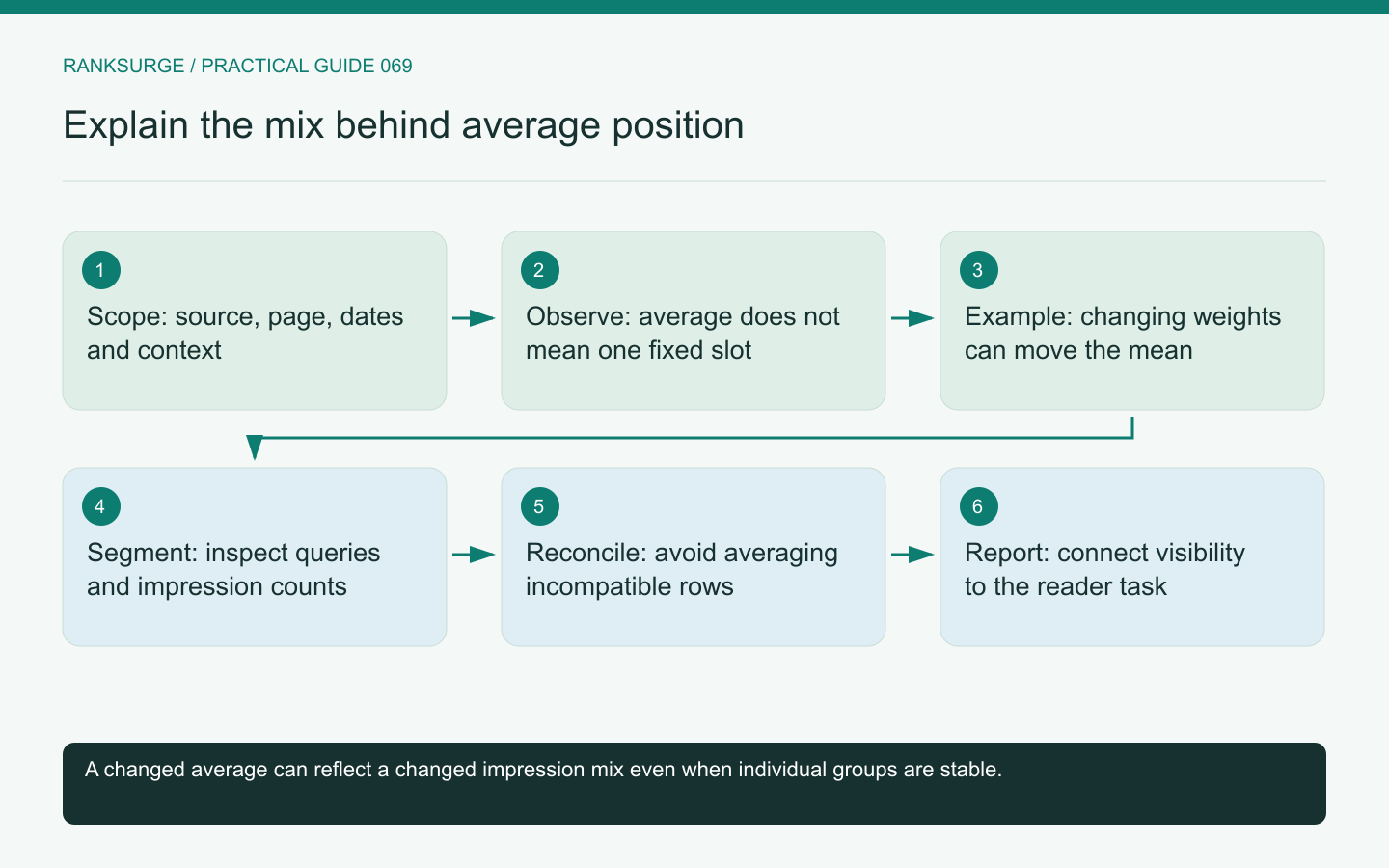
Explain Search Console average position through scope and impression mix, using weighted examples instead of presenting an aggregate as a single fixed rank.
TL;DR
- Treat Search Console average position as an aggregate observation tied to a clear reporting scope—name property, page, date range, search type and filters instead of declaring a single fixed rank for all searchers.
- Investigate changes by segmenting and weighting data: inspect query or page groups and impression counts, and use configured rank checks or the weighted example to explain mix-driven shifts.
- Limit conclusions by preserving context and reporting constraints: avoid casually averaging exported averages, keep a stable comparison view, and state what the available evidence cannot determine.
An average is not a single search result
Search Console average position summarizes observations within a selected reporting scope. It should not be reported as though every searcher saw the site in one fixed slot. Different queries, dates and contexts can contribute to the aggregate.
Start by naming the scope: property or page, date range, search type and any filters. “The average position for this page across the selected queries improved” is more informative than “we rank fourth” when the underlying record combines many different searches.
The point is not to avoid the metric. It is to explain what decision the summary can reasonably support.
Related reading: The Dark Query Problem: Why Search Console Hides Most of Your Searches.
Keep the observation context with the number
A reported position without context invites misleading comparisons. One export may cover a particular country and device, while another combines all available contexts. A third may come from a separate rank tracker with its own collection settings.
Do not treat those numbers as interchangeable simply because they all use the word position. Record the source and scope in the report, and decide which measurement fits the question.
A configured rank check can help inspect a particular query context. Search Console provides first-party performance evidence over its reporting scope. Each has a role, but one does not automatically invalidate the other when their summaries differ.
Use a weighted example to explain a changing mix
Consider a simplified illustrative dataset with 100 observations at position 2 and 100 at position 10. Their equally weighted mean is 6. If the next period contains 100 observations at position 2 and 900 at position 10, the mean becomes 9.2.
Neither group's position changed in this example; the mix changed. This is arithmetic for understanding aggregation, not a reconstruction of every detail of Google's reporting rules.
The example explains why a broader appearance for lower-position queries can make an aggregate look worse even while the site retains its stronger visibility for the original group.
Investigate the segment that changed
When the average moves, inspect relevant query or page groups and their impression counts. Ask whether the change comes from a shift within an existing group, a new set of queries or a different distribution of contexts.
For an illustrative documentation site, a page may start appearing for many broad research terms while remaining useful for its established specific query. That can change the overall average without proving that the existing answer deteriorated.
Keep the explanation tentative until the data supports it. A segment analysis helps narrow possibilities; it does not automatically establish the cause of a ranking change.
Do not average exported averages casually
If you combine rows, understand what each row represents and which weighting is appropriate. Taking a simple average of row-level averages can give equal influence to a tiny row and a very large one.
Even a weighted calculation needs compatible scope and coverage. If rows overlap or omit part of the dataset, the recomputed result may not match the source summary. Do not alter the numbers until they agree without understanding the difference.
The Search Analytics API reference documents grouping and aggregation behavior. Use the source definition when building a report, and retain the request configuration with the resulting table.
Pair position with the reader outcome
Review clicks, impressions and the role of the page alongside position. A movement in the average may be less important than whether relevant users can find and use a critical product explanation.
For a narrow implementation guide, the useful question might be whether it is visible for the specific supported workflow. A site-wide average dominated by unrelated broad queries would be a poor success criterion for that task.
Avoid translating position directly into revenue or customer value. The connection requires additional evidence about relevance and behavior after the visit.
Use a stable comparison for recurring reports
Choose the main scope deliberately and keep it consistent from one reporting period to the next. If the scope changes, annotate the change rather than presenting the series as seamless.
Preserve a small set of important query groups as a complementary view where appropriate. That can help the team distinguish broad discovery growth from movement in the terms that matter to a particular product decision.
Do not freeze the entire research strategy around a fixed keyword list forever. Use the stable view for comparison and a separate exploratory view for newly emerging questions.
Write the conclusion with its limits intact
A useful report might say that the overall average worsened while a larger share of impressions came from a newly visible query group, and that the core group remained broadly similar. It should also state what the available evidence cannot determine.
RankSurge can support rank and research workflows, but the analyst must preserve the difference between a configured observation and a broad average. Explain the aggregation clearly, and the metric becomes a useful investigative signal instead of a misleading declaration of one universal rank.
Related reading: SEO for Startups: A Founder’s Handbook.