
Robots Exclusions: Separate Crawl Access From Indexing Intent
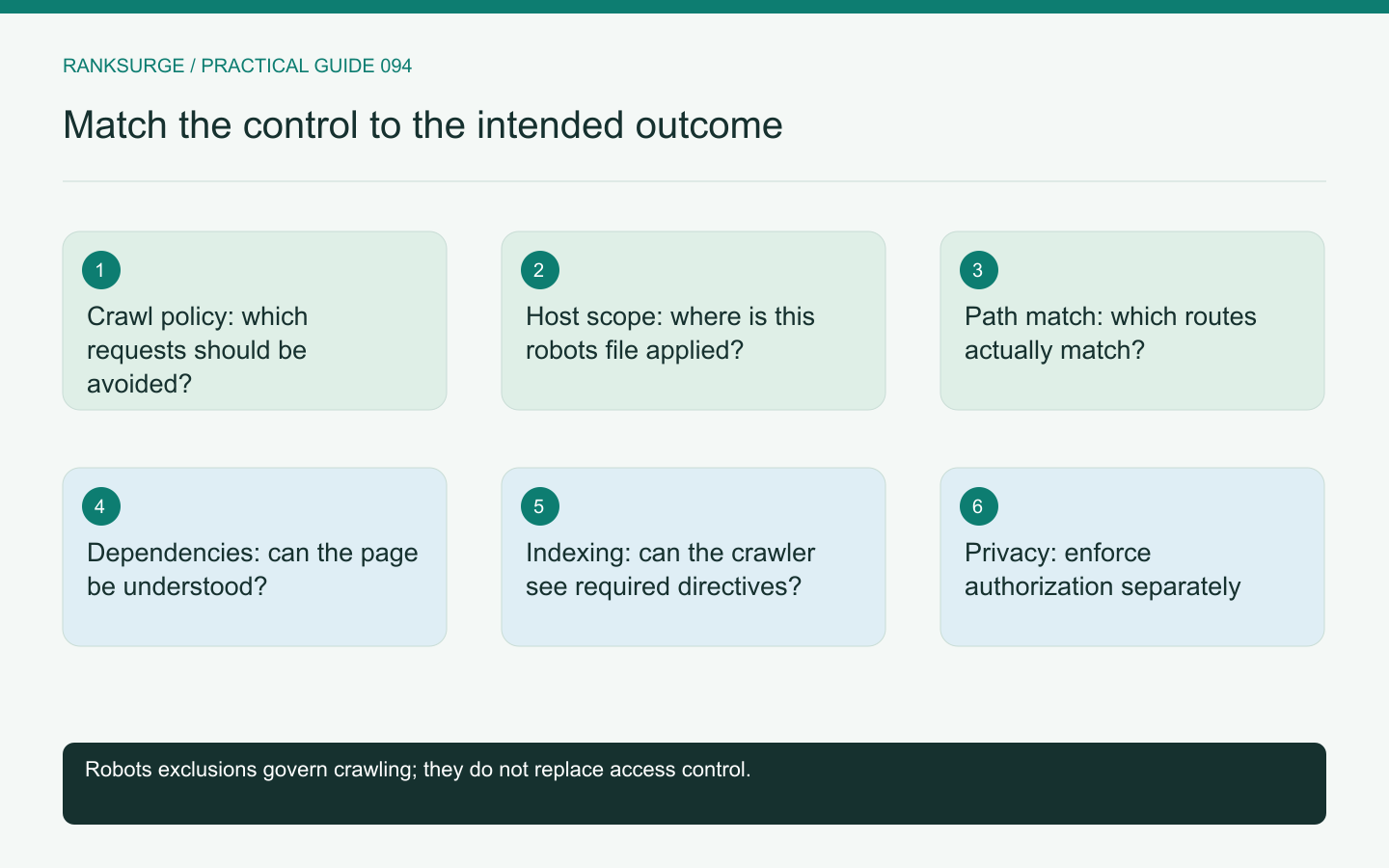
Audit robots exclusions by identifying the blocked resources and intended crawl policy, while keeping access control and search-index removal as separate concerns.
TL;DR
- Robots exclusions answer a crawl-access question: they tell compliant crawlers which requests to avoid and should not be treated as a privacy control or proof a URL cannot appear in search.
- Audit by design: name the desired outcome and capture the exact host and robots response so the proposed mechanism matches the actual goal and the host-specific policy.
- Verify deployment and acknowledge limits: validate representative routes after deployment, and report that a robots audit cannot guarantee all bots comply or the index state from the file alone.
Robots rules answer a crawl-access question
A robots exclusion tells a compliant crawler which requests it should avoid under the applicable rules. It should not be treated as a general privacy control or as proof that a URL cannot appear in search.
Start the investigation by naming the outcome the site owner wants. Reducing access to repetitive crawl spaces, preventing private-data exposure and removing a known URL from search are different objectives.
Google's robots introduction explains the basic boundary between crawl control and indexing. Keep that distinction explicit in the audit recommendation so the proposed mechanism matches the actual goal.
Capture the rule in its host context
Record the exact host, robots file response and applicable user-agent group. A rule on one host does not automatically describe another subdomain or environment.
For an illustrative site with a main domain and a documentation subdomain, inspect both relevant configurations rather than assuming a shared policy. A successful check on the marketing host says little about a separate service's published rules.
Preserve the observed file and date with the finding. The text may change during deployment, and a later reviewer needs to know which version produced the audit result.
Identify what the rule actually matches
Test representative paths from the affected group, including intended matches and nearby paths that should remain crawlable. Broad prefixes can include more routes than their author expected.
Suppose a rule intended to exclude an internal search route also matches a public search-guide section because the paths share a prefix. The fix requires a more precise policy, not a blanket removal of all restrictions.
Use the interpretation supported by the relevant crawler and validate with appropriate tooling. Avoid assuming that every crawler implements every extension or edge case identically.
Check whether required resources are affected
A page may be allowed while resources needed to understand or render it are restricted. Investigate the actual resource requests relevant to the affected page before drawing conclusions from the top-level URL alone.
Do not unblock every resource directory reflexively. First identify which blocked resources matter to the public page and whether their access policy is intentional.
For a JavaScript application, a blocked bundle or data route can change what a rendering system observes. Record that dependency as part of the finding rather than reporting only that the HTML URL was accessible.
Separate private content from crawl preferences
If the goal is to protect sensitive information, use the site's authorization and access controls. A published list of disallowed paths does not make the resources confidential.
The audit should escalate an exposed private route to the appropriate owner without presenting a robots edit as a complete privacy fix. Search controls and application permissions serve different purposes.
Keep the report itself restrained: describe the affected class of content and the necessary protection without copying sensitive data into a broadly shared SEO document.
Avoid blocking the evidence of an indexing instruction
If a page uses noindex as part of its intended search policy, a separate crawl block can prevent the crawler from retrieving that instruction. Google's noindex guidance explains this operational requirement.
Review the controls together before changing either one. A recommendation to “block the page in robots” may conflict with the mechanism chosen to communicate its indexing policy.
Document the desired end state and the reason for each control. That makes the implementation review more useful than a checklist that independently marks both settings as desirable.
Validate representative routes after deployment
Check the deployed robots response and test the affected path examples again. Include an important public page that should remain accessible and an intentionally restricted route that should retain its policy.
If the file is generated through deployment configuration, verify the correct environment. A staging policy copied into production can have broad consequences even when the rule syntax is perfectly valid.
Record which layer owns future changes so the next release does not overwrite the correction with an older generated file.
Review generated files as well as repository text
The file checked into a repository may differ from the response actually served through a CDN or application route. Validate the public response after deployment and note relevant cache behavior if the old policy persists. Otherwise the team may approve a correct source change while the crawler continues receiving a different file. The deployed observation is the acceptance evidence.
Report the limitation of the conclusion
A robots audit can confirm the observed rules and their expected effect for the tested crawler context. It cannot guarantee that all bots comply or establish the search index's current state from the file alone.
RankSurge can help organize the site-audit evidence, but the final recommendation should distinguish crawl access, indexing intent and confidentiality. That clarity lets the implementation team choose the right control and verify the behavior that actually matters.
Related reading: The Best Open Source SEO Tools in 2026.
Related reading: SEO for Startups: A Founder’s Handbook.