
Redirect Chains: Preserve the Intended Destination While Simplifying the Route
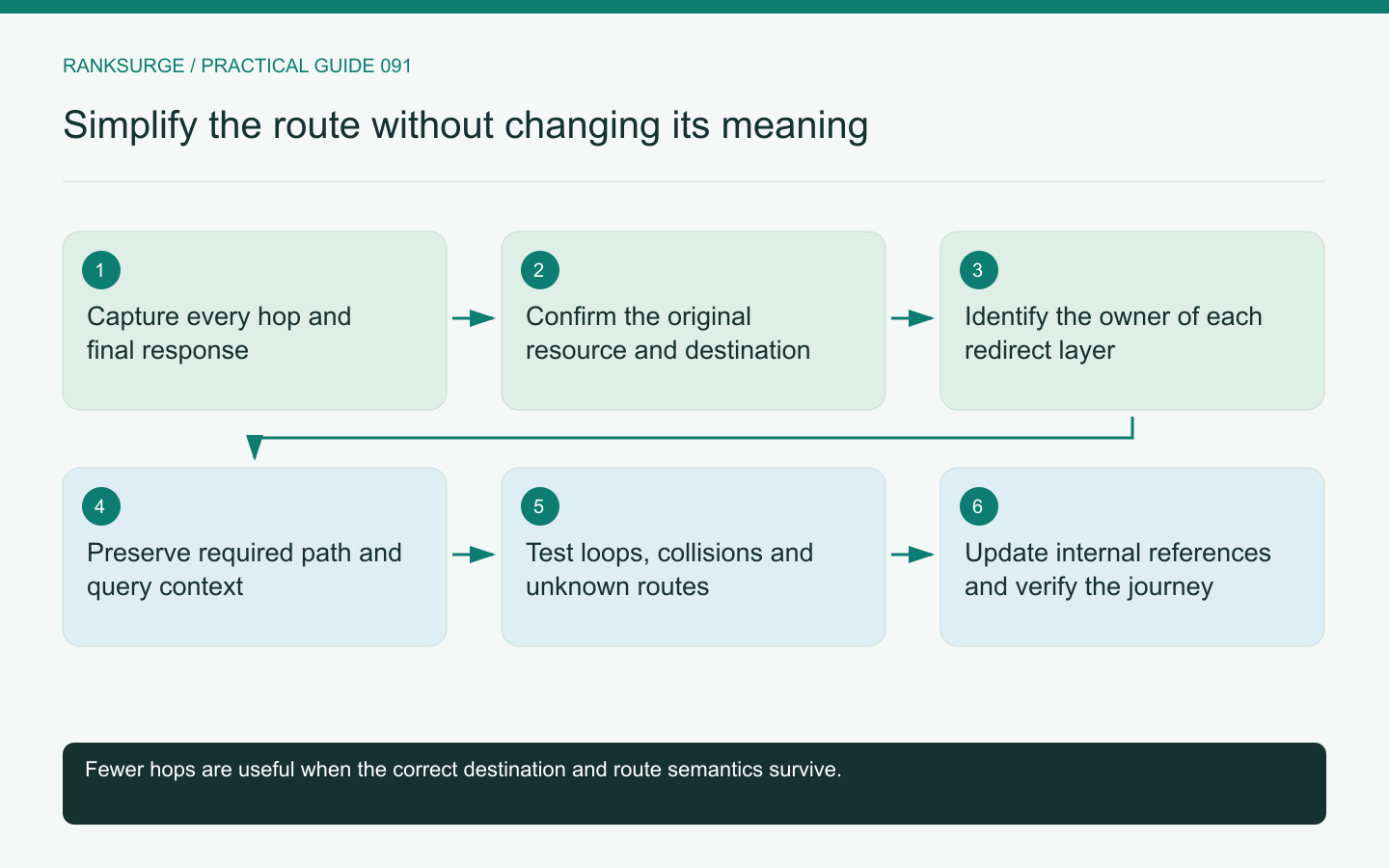
Audit redirect chains by preserving the intended page destination, tracing rule ownership and testing representative routes before simplifying intermediate hops.
TL;DR
- Prefer simplifying redirects only when the resulting route reliably reaches the intended content; the objective is a clear, reliable route to the intended content, not simply the smallest possible number of hops.
- Document and trace every hop, owner and response so implementers can reproduce and test changes; keep the full observed sequence as evidence explaining how current behavior was produced.
- Validate fixes across host/protocol/path variants to avoid loops or overbroad rules that hide missing content; include nonexistent paths and confirm the destination matches the original expectation.
A shorter chain is useful only if it lands correctly
A redirect-chain report shows that a request passes through several addresses before reaching its final response. The useful objective is a clear, reliable route to the intended content, not simply the smallest possible number of hops.
Before changing a rule, identify what the original URL represented and where a visitor should arrive now. A direct redirect to an irrelevant page is not an improvement merely because it removes intermediate steps.
Keep the full observed sequence as evidence. It explains how the current behavior was produced and gives the implementation owner a concrete route to test.
Trace each hop and its owner
Record the requested URL, response status, destination and final outcome. Note whether each step comes from the hosting layer, application routing, CMS or another service.
For an illustrative site migration, an old HTTP address may redirect to HTTPS, then to a new host, then to a renamed path. Those steps may have been added by different teams at different times.
The correction should account for all relevant layers. Editing an application rule may have no effect on an earlier host-level redirect, while a broad hosting rule can override a carefully maintained path mapping.
Confirm the permanence of the move
A permanent move and a temporary detour have different meanings. Choose the redirect behavior that matches the actual decision rather than converting every response to a permanent status to satisfy a checklist.
Google's redirect documentation explains the distinction and supported methods. Use that reference alongside the site's operational requirements.
A temporarily unavailable service page may need a different treatment from an article that has been permanently merged into a replacement. Record the owner-approved intent before changing the response.
Preserve meaningful path and query information
A redirect rule can accidentally drop a path segment, language choice or query parameter that the destination needs. Determine which information is functional and which is disposable tracking context.
For example, a documentation route may include a product version that selects materially different instructions. Sending every version to the newest guide could mislead a user maintaining an older integration.
Do not preserve every parameter blindly either. The appropriate mapping depends on the application. Test representative URLs and document the intended handling rather than relying on a generic “copy everything” rule.
Update internal references where appropriate
When the preferred destination is stable, internal links should generally point to that destination rather than continuing to send users through historical addresses.
Inspect navigation, related-content modules, sitemaps and canonical references as relevant to the change. A corrected redirect can remain useful for old external links while the current site stops producing unnecessary intermediate requests.
Keep the distinction between maintaining backward access and continuing to publish obsolete URLs. The former may be intentional; the latter often indicates that another source of route data still needs updating.
Test loops and broad-rule collisions
A rule that works for one sample can conflict with another normalization rule. Test host variants, trailing-slash behavior, case where relevant and a selection of real paths from the affected family.
Include a nonexistent path in the validation set. An overly broad redirect can send every unknown URL to a plausible page, hiding missing content behind a successful-looking destination.
Also inspect whether a destination redirects back to an earlier address under a different request condition. A loop can be conditional on host or protocol, so one successful browser visit is not sufficient evidence for every route variant.
Keep a rollback and ownership record
Document the previous rule, the intended replacement and the tested examples. If several systems own parts of the route, name the person responsible for coordinating the final behavior.
This record is useful when an old campaign, integration or bookmarked URL behaves differently after the cleanup. The team can distinguish an expected change from an accidental loss of context.
Avoid deleting historical mappings without checking whether they still serve a legitimate destination. Simplifying the route should not make older valid links unusable merely because they no longer appear in the main navigation.
Check references outside the main navigation
Emails, downloadable documents and integration guides can continue using historical addresses after the website is updated. Where those materials are actively maintained, update them to the preferred route too. Preserve valid redirects for older copies that cannot realistically be recalled.
Verify the final route as a user
Open the original URL, confirm the final address and read the destination's main content. Check that the page matches the expectation created by the original link text or known resource.
Then rerun the affected audit set and preserve the before-and-after sequence. RankSurge can help surface the observation, while the implementation belongs to the routing systems that generate it.
A complete redirect-chain fix leaves a relevant destination, coherent rules and updated internal references. The improved path should be understandable to both the person following the link and the team maintaining it.
Related reading: SEO for Startups: A Founder’s Handbook.
Related reading: The Best Open Source SEO Tools in 2026.