
Ranking URL Changes: Distinguish a Better Page From an Unstable Handoff
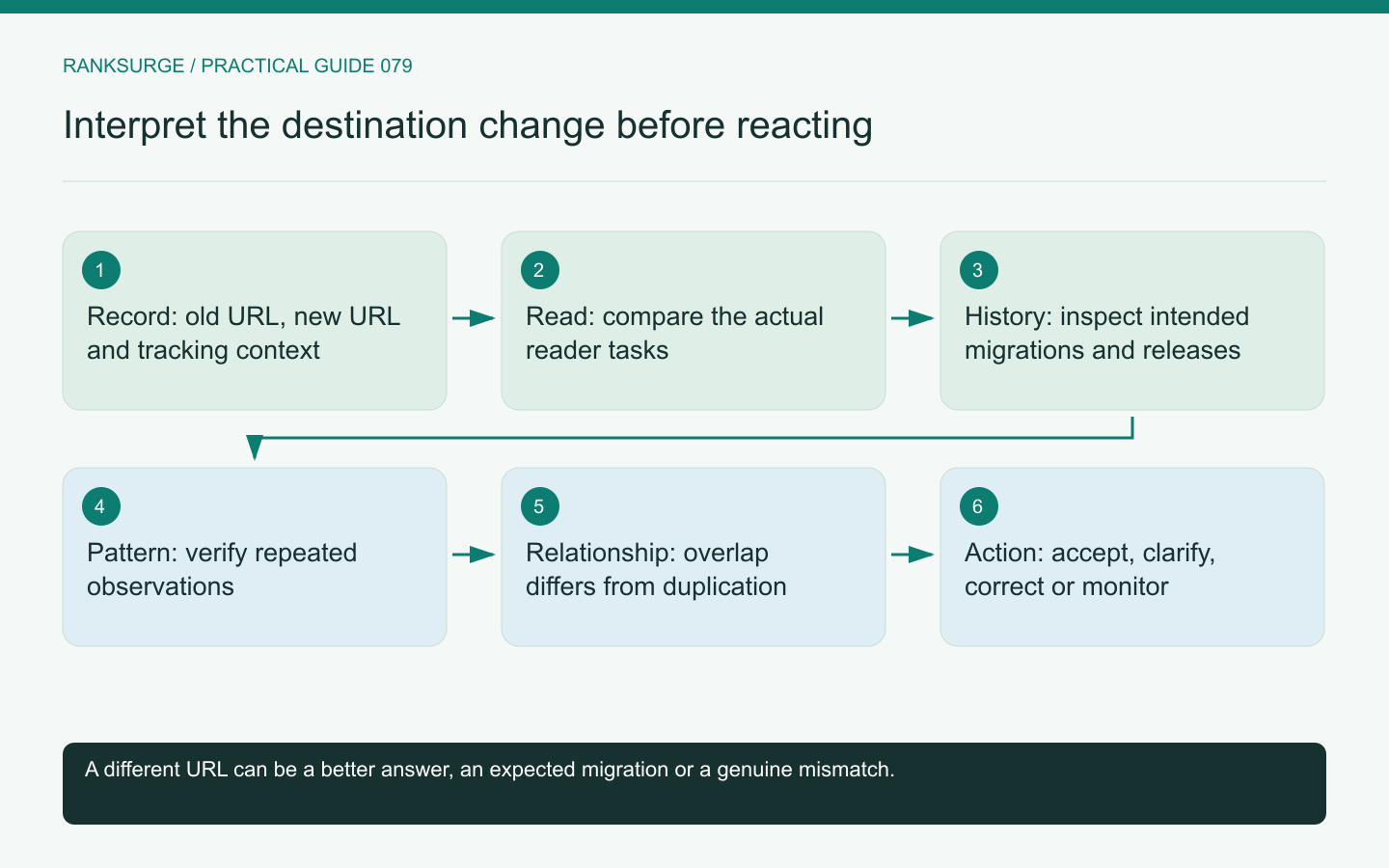
Investigate ranking URL changes by comparing page purpose, migration history and repeated observations before treating every handoff as keyword cannibalization.
TL;DR
- Decide whether the new URL is the better destination or an unstable substitute by judging which page actually helps searchers complete the intended task and whether the change was expected.
- Use a methodical inspection: record old and new URLs, query, location, device and dates, then open both pages and write each page’s primary purpose and intended next action.
- Treat measurement and migration bounds as the success check: keep measurement history, verify planned redirects or canonical changes, and report context and unresolved uncertainty before acting.
A different ranking URL can be useful or problematic
When a tracker shows a different page for the same query, the change deserves interpretation. The new page might be a better answer, an intended migration destination or an unexpected substitute that serves the reader poorly.
Start by recording the old and new URLs, query, location, device and observation dates. Confirm that the tracking configuration stayed the same. A changed matching rule or market can create an apparent handoff that is really a measurement change.
Do not call the event cannibalization before reading the pages and understanding their intended roles.
Compare the reader task each page serves
Open both pages and write their primary purpose. A broad product page, a buyer guide and implementation documentation can legitimately cover related language while answering different questions.
For an illustrative scheduling query about timezone support, documentation may be a more useful destination than a generic product announcement. If search begins showing the documentation, the URL change can align better with the reader's need even if the team originally expected the announcement to rank.
Evaluate the answer, not just whether the URL matches a preferred spreadsheet row.
Include the intended next action in that comparison. A page can answer the opening question but send the reader to an obsolete signup route or an unsupported offer. The destination review should therefore follow the primary link, not stop at a heading that appears relevant to the query.
Check for an intentional migration
Review recent redirects, canonical changes, navigation updates and content moves. The handoff may be the expected result of a planned site change.
Google's site-move guidance is relevant when URLs have changed intentionally. Compare the observed destination with the migration plan and verify that the live routing and content behave as intended.
Keep the old-to-new mapping in the investigation record. A successful migration should not be reported as an unexplained lost page simply because the original URL no longer appears in the tracker.
Inspect whether the new page creates a mismatch
A new destination can be technically accessible while failing the query's task. For example, an old seasonal landing page may replace a current product guide and present outdated availability.
Check the title, introduction, core answer and next action. If the content is wrong or stale, address that factual issue directly. Do not begin by adding more keyword repetitions to the desired page.
Also inspect internal links and duplicate content relationships where relevant. A confusing site structure can make the intended page role less clear, but the diagnosis should be based on actual evidence rather than a generic assumption.
Look for a repeated pattern
One configured check is a snapshot. Review subsequent observations and relevant first-party page–query evidence before deciding that the handoff is persistent or unstable.
For the scheduling example, alternating between a broad page and documentation may warrant a closer look at their overlapping scope. A single appearance during a migration may need monitoring rather than immediate restructuring.
Do not repeatedly change the pages after every fluctuation. That creates a moving target and makes it harder to understand which intervention, if any, addressed the actual issue.
Separate editorial overlap from canonical equivalence
Two pages serving the same task may need an editorial consolidation review. Two duplicate or very similar URL versions may need a canonicalization review. Those are related but distinct decisions.
Google's canonicalization guidance concerns signals for representative URLs. It should not be used as a blanket instruction to canonicalize every page that shares a topic.
Read the content before deciding. A useful supporting guide should not disappear simply because a tracker sometimes prefers it for a query the team assigned elsewhere.
Choose an action that matches the evidence
Possible actions include accepting the better destination, clarifying page roles, improving the intended answer, correcting a migration error or continuing to observe. State the reason and the expected behavior.
For a mismatched old page, the immediate action may be to correct outdated claims and determine its proper future. For a stronger documentation page, the right action may be to update the tracking target and internal navigation deliberately.
Keep the original measurement history intact when deliberately changing the target. Otherwise the report can hide the fact that the definition of success changed during the investigation.
Report the handoff as a page decision
A useful summary explains which URL appeared, what task it serves, whether the change was expected and what the team will do next. Include the observation context and unresolved uncertainty.
Rank tracking becomes more valuable when it monitors destinations as well as positions. The question is not only whether a number improved, but whether searchers are being directed to a current, accurate page that helps them complete the intended task. That is the standard against which a ranking URL change should be judged.
Related reading: Ranking for the Wrong Half of Your Audience.
Related reading: SEO for Startups: A Founder’s Handbook.