
Rank-Tracking Tool Selection: Match Checks to the Questions You Need Answered
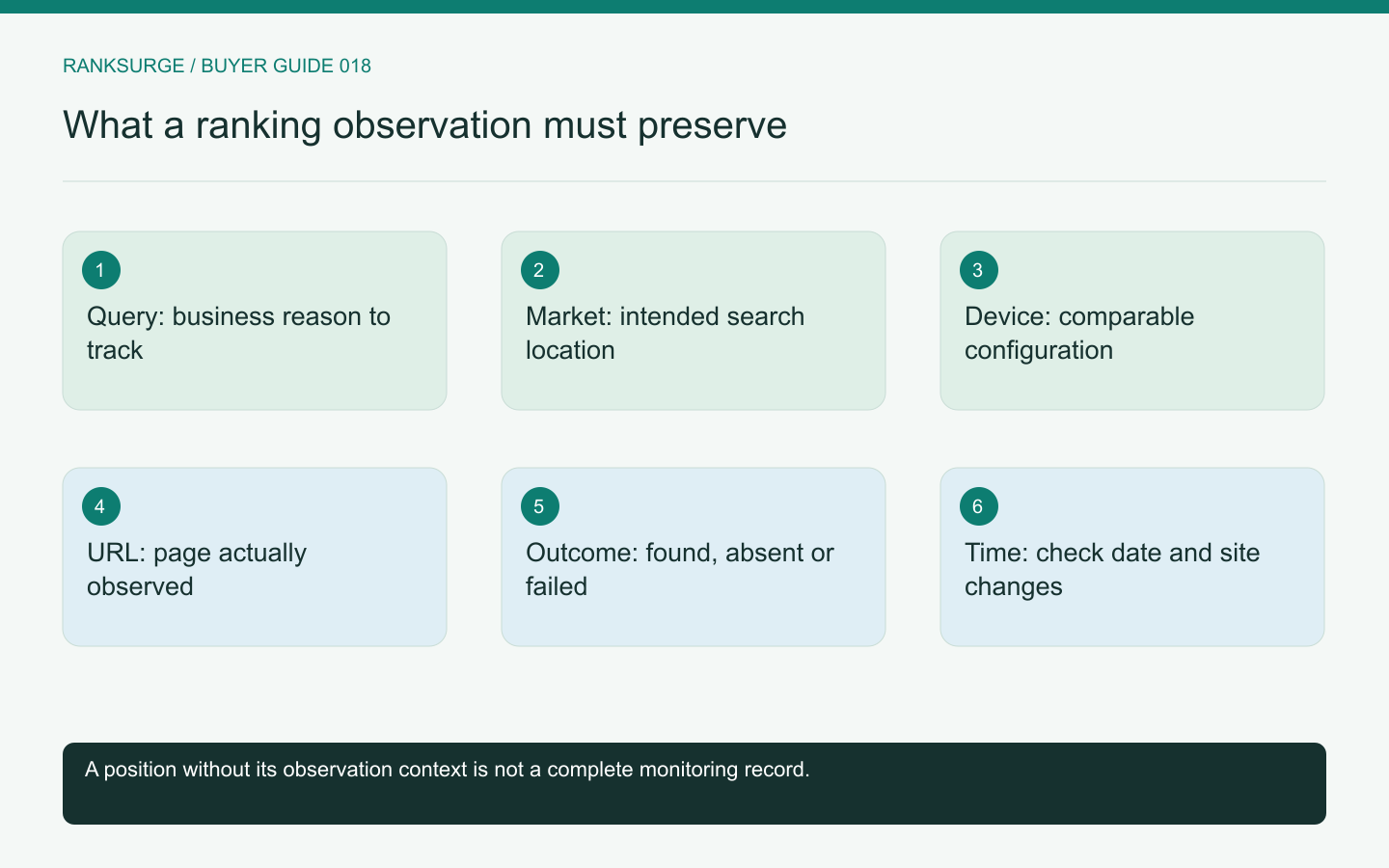
Choose a rank tracker by testing market and device configuration, ranking URLs, missing results and the investigations your team needs to perform.
TL;DR
- Select the rank tracker whose observations preserve the investigation context and provide consistent, defined search‑context evidence so the team can support decisions rather than rely on isolated position numbers.
- Build and trial a representative tracking set—small, purpose‑tied queries configured identically across candidate tools—and inspect the observed ranking URL, not just position movement, to know which page actually ranks.
- Validate missing or failed checks and match check frequency to actionable responses: test how gaps are reported, set an investigation threshold, and avoid reacting to single, uncorroborated movements.
Start with the question a ranking check answers
A rank tracker is useful when it observes a defined search context consistently enough to support a decision. “Track our keywords” is not a complete requirement. Specify which market, device, domain and page matter, how often the team needs evidence and what action a change might trigger.
For a product launch, you may want to see whether the intended page begins appearing for a small set of relevant searches. For a migration, you may need to understand which URL appears after redirects change. These tasks require more than a position number.
Choose the tool whose observations preserve the context your team will need during an investigation.
Build a representative tracking set
Use a small group of queries tied to different page purposes: a product category, an integration, a support question and a branded query. Include only markets your business can meaningfully serve. Add a target page where your workflow needs one.
Record why each query belongs in the set. A large list selected solely by volume can become expensive noise. The tracking set should reflect important business questions and current work, not every phrase returned by keyword research.
During a trial, configure the same set in each candidate tool. Check whether market and device settings are visible when viewing and exporting results. A position without those settings is difficult to compare later.
Inspect the ranking URL, not just movement
If a keyword moves upward, ask which page now appears. The change may reflect a better page, a different page or an unexpected handoff between similar URLs. A graph alone may hide that distinction.
For example, an integration guide and a product landing page might both be relevant to a query. Your interpretation depends on what the searcher expects and which page the business intended to rank. A higher position for the wrong page is not automatically a success.
Ask the tool to preserve observed URLs and enough search context to investigate meaningful changes. Do not assume a domain-level improvement proves the page you edited caused it.
Test missing and failed observations
A tool can fail to complete a check, or it can complete a check without finding the domain within its measured scope. Those outcomes should not be treated as the same result. Ask how the platform represents each and how they affect charts or alerts.
Use documented test behavior or inspect a real historical example rather than forcing unsupported requests. Determine whether the report shows gaps explicitly or silently carries forward an older value.
This matters during incidents. A sudden blank row might reflect a collection problem rather than a search change. Your team should be able to identify the difference before launching a content rewrite or alarming a client.
Evaluate device and market comparisons
RankSurge's rank-tracking page describes location-based configurations, ranking URLs and optional mobile and desktop observations. During evaluation, test the particular combinations your team needs. The existence of both device options does not make their results interchangeable.
Keep comparisons controlled. A mobile result in one location and a desktop result in another do not establish a device-only difference. Save configuration changes so a later report can explain why the series is no longer directly comparable.
If local search is central to the business, determine whether a standard location check answers the question or whether a geographic grid is required. Those are different observation designs and may require different tooling.
Related reading: SEO for Startups: A Founder’s Handbook.
Related reading: How to Prompt Claude Code for SEO.
Match frequency to a response process
More frequent checks can reveal short-lived changes, but they also consume capacity and create more signals to interpret. Ask what the team would do with a daily observation that it could not do with a weekly one.
A migration review may justify a temporary higher frequency. A stable, low-priority page may not. Build the budget around actual configurations and frequencies rather than assuming every keyword needs the same cadence indefinitely.
Define an investigation threshold using persistence, affected page importance and corroborating evidence. A one-check movement should not automatically trigger a change. The tracker should support careful review rather than train the team to react to every fluctuation.
Check the reporting handoff
Export a small history and ask another teammate to explain the observation context and any gaps. Verify that dates, markets, devices and URLs remain attached to the values. Include annotations for meaningful site changes in your own workflow if the tool does not store them.
The final purchase note should name the demonstrated configurations, limitations and cost of the intended monitoring plan. Record what would require another tool, such as a different search surface or a more granular local view.
Choose a rank tracker that makes a change understandable. The value is not a constantly moving chart; it is a consistent observation record that helps your team decide when to investigate, what to inspect and when the evidence is too weak to justify action.