
Rank-Tracking Baselines: Save Location, Device and Target URL Together
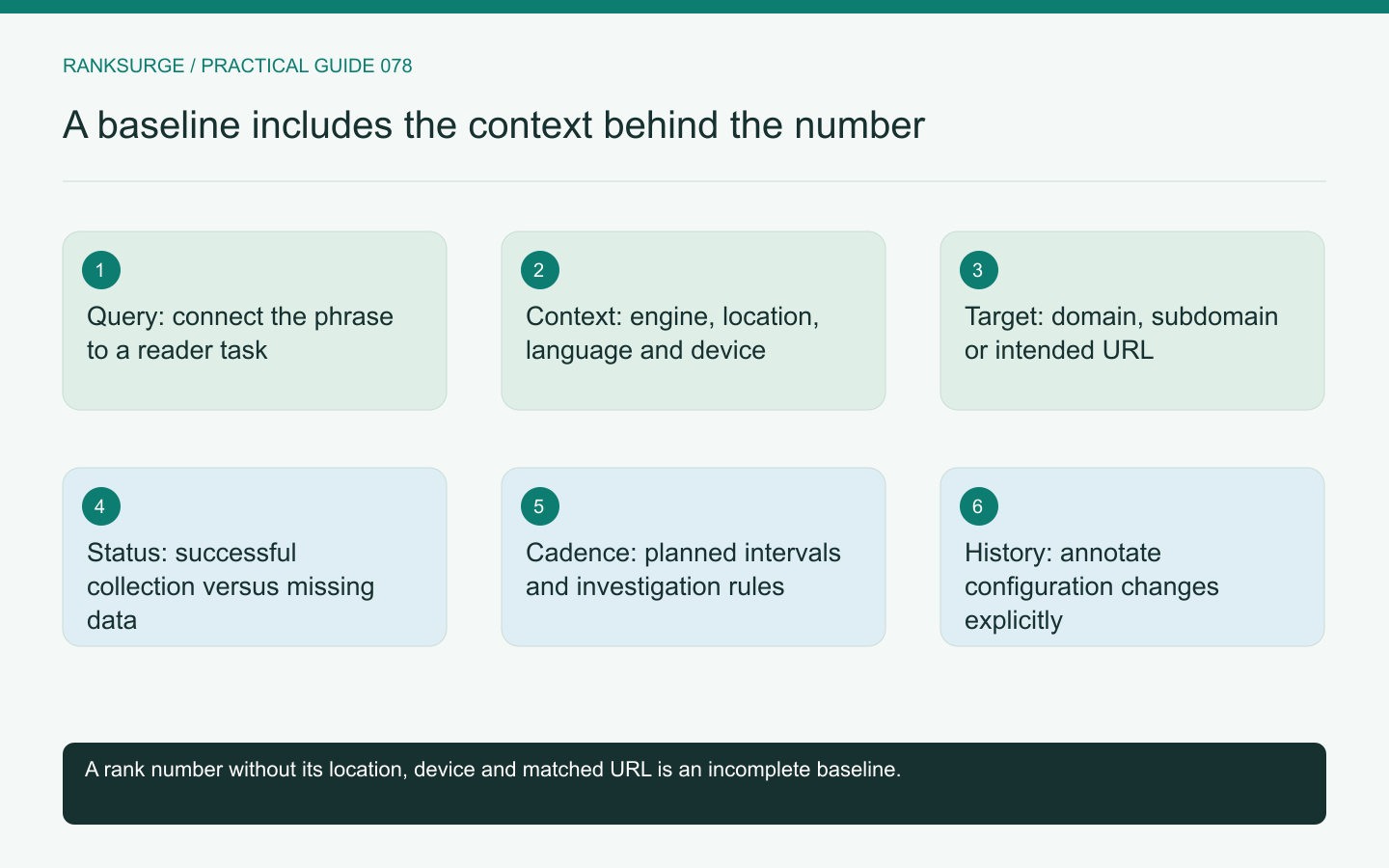
Build a rank-tracking baseline with a fixed query context, target matching policy and successful initial observations before interpreting movements.
TL;DR
- Define a baseline as a full observation: record the query, context, device and what counts as a match so the initial measurement anchors future decisions and comparisons.
- Build a reproducible matching method: choose and test a target-matching rule, and save both the observed URL and the rule so changes reveal real destination shifts.
- Treat changes to configuration or cadence as measurement events: pick a usable check frequency and mark configuration shifts as a new series or annotated transition so histories stay honest.
Define the observation before storing the first rank
A rank-tracking baseline is more than the first number in a chart. It should specify what was searched, under which context and what counted as a match for your site.
Record the query, search engine, market or location, language where applicable, device and target policy. A change in any of these can alter the observation independently of a content change.
Begin with a small set of meaningful reader tasks rather than an unqualified list of every phrase in a research export. The baseline should support decisions the team actually plans to make.
Related reading: How to Use Vellum and OpenSEO for Your SEO Engine.
Choose the target matching rule
Decide whether success means any URL on the domain appears, a particular subdomain appears or one intended page appears. These are different tracking questions.
For an illustrative scheduling product, a broad domain match might report visibility when an old article appears instead of the current buyer guide. That can be useful discovery evidence, but it does not establish that the intended destination is performing as planned.
Test the rule with a fixture containing the expected page, a sibling path, a subdomain and an unrelated domain with a similar name. Confirm which should count before collecting the baseline. A matching bug can otherwise create an apparently consistent series that measures the wrong target.
Store both the observed URL and the target rule. This makes later URL changes visible instead of reducing every result to a number with no destination context.
Keep location and device explicit
A desktop check for one country is not automatically comparable with a mobile check for another. Preserve the requested settings in the observation record rather than relying on defaults that may change.
DataForSEO's organic SERP documentation describes results in the context of the requested query and location. Use the actual provider's supported configuration and retain it with the baseline.
Do not present one configured observation as the universal result every person sees. It is a repeatable measurement context that helps the team investigate changes over time.
Record collection success separately from position
A failed request, an incomplete result and a successful check that does not find the target should not produce the same baseline value. The first observation must be valid before it can anchor a comparison.
Keep a status and collection timestamp alongside the rank. If the initial check fails, mark the baseline pending rather than inventing a position or copying a value from a different context.
This separation prevents an operational error from appearing as a dramatic ranking improvement when the next successful check finally returns a real result.
Save the first observed destination
Open the matched page and verify that it is the intended content. Note unexpected redirects, old branding or a page type that does not serve the target reader task.
For the scheduling example, the observed URL might be a generic homepage while the target query asks for a specific integration. The baseline can capture that mismatch and lead to a content or navigation investigation.
Do not immediately rewrite the site because of one observation. First confirm the result and compare it with other relevant evidence, including the site's existing page purpose and first-party performance data.
Choose a cadence the team can use
Select a checking frequency based on the decision horizon and available capacity. A critical migration may justify closer observation than a stable reference page, but more frequent checks do not automatically produce better decisions.
Record the intended cadence and what constitutes a missed check. A chart with irregular gaps can be misread if the viewer assumes every point represents the same interval.
Also define when the team will investigate a change. A thoughtful threshold can combine repeated observations, destination changes and business importance rather than reacting to every small movement.
Handle configuration changes as a new series or annotation
If the target location, device or matching rule changes, preserve that fact. Do not silently append the new observations to the old series as though the measurement remained identical.
The team may choose to start a new baseline or maintain a clearly annotated transition. Either approach is more honest than showing an unexplained jump that readers attribute to SEO work.
Keep the earlier configuration available for historical interpretation. The purpose is not to freeze tracking forever, but to make changes in measurement distinguishable from changes in the observed result.
Review the baseline package before relying on it
A complete package includes configuration, successful initial observation, matched URL, date, status and the reader task being monitored. Add the reason the query belongs in the tracked set.
RankSurge's rank-tracking workflow can support ongoing observation, but the baseline design remains a methodological decision. A clear starting record makes later movements useful because the team knows what was measured, what stayed constant and what a change should prompt them to inspect.
Related reading: The Best Open Source SEO Tools in 2026.