
Rank-Tracking Alerts: Set Thresholds That Lead to an Investigation
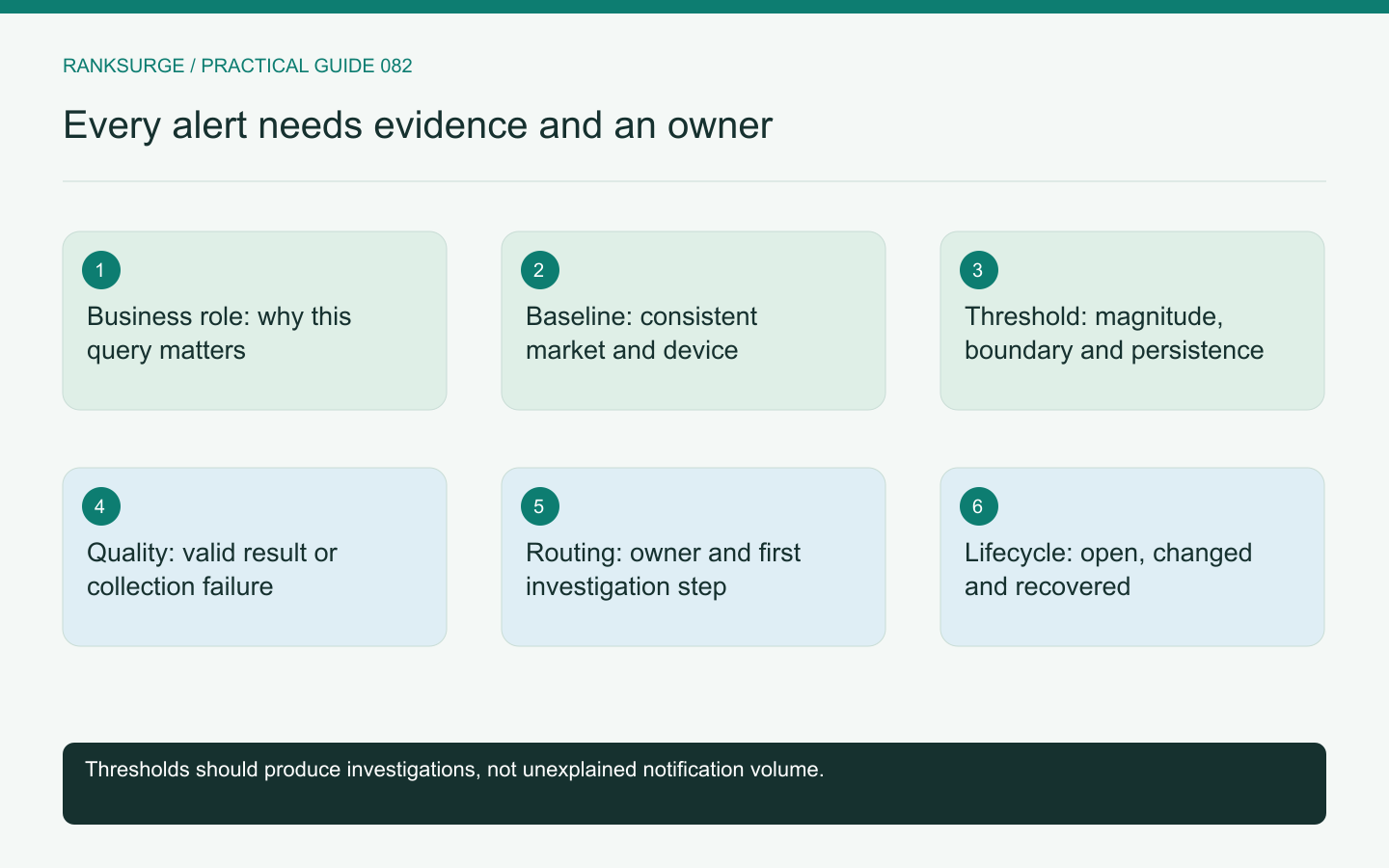
Set rank-tracking alerts around business relevance, persistence and measurement quality so each notification has a clear investigation owner and next step.
TL;DR
- Set alerts to prompt a predefined investigation: choose thresholds only after defining who will act and what to investigate so notifications drive useful checks, not noisy updates.
- Build a stable comparison and layered rules: record consistent query, URL, market and device settings, and combine absolute, relative and persistence thresholds to reflect context.
- Evaluate alerts by outcomes, not volume: review which alerts led to useful action, adjust thresholds and verify automated capabilities so alerts reliably prompt investigation rather than false alarms.
An alert should trigger a decision
A rank-tracking alert is useful when someone knows what to investigate after receiving it. A stream of unexplained “position changed” notifications can create noise without improving the website.
Define the decision before choosing the threshold. A sudden disappearance of a revenue-critical page may require a technical check. A small movement among low-priority research terms may belong in a weekly review.
The same numerical change can deserve different responses depending on the query's role, the landing page and the confidence in the measurement. Build that context into the alert policy rather than sending every movement to the same channel.
Create a baseline that represents the comparison
Record the query, target URL or domain, location, device and result type. Keep the measurement depth and collection schedule consistent enough to support the comparison you intend to make.
DataForSEO's SERP collection documentation provides an example of the settings that can affect a result snapshot. A threshold cannot correct a baseline that silently changes its search context.
If you intentionally change the tracking market or device, mark the transition. Otherwise the first result under the new configuration may trigger an alert that looks like an SEO incident but is really a measurement change.
Use more than one kind of threshold
An absolute threshold asks whether a page crossed a meaningful boundary, such as leaving the observed first group of results. A relative threshold asks how much its position changed. A persistence rule asks whether the observation repeated.
These rules serve different purposes. A movement from second to fifth may be important for a priority query even though the change is only three positions. A movement deep in the observed results may be less urgent despite a larger numerical difference.
Choose thresholds as operational policy, not as universal SEO laws. Label any example values as illustrative and revise them after seeing how many useful investigations the policy produces.
Keep missing observations out of rank arithmetic
A failed collection task, an unobserved URL and a confirmed result outside the inspected depth are not interchangeable states. Do not convert all of them into an invented rank and subtract it from yesterday's value.
DataForSEO's error documentation distinguishes task-level outcomes that need inspection. A successful HTTP request alone does not establish that every requested result was collected successfully.
Route collection failures to a data-quality investigation. Route valid observations of a missing target to the appropriate visibility investigation. This separation prevents provider errors from producing false alarms about the website.
Attach a small investigation packet
An alert should include the affected query group, old and new observations, timestamps, market settings and the URL involved. It should also identify the person or team responsible for the first check.
For an illustrative product-category alert, the first check might be whether the intended page still returns normally and whether another internal URL replaced it. The next check could compare the current result types and recent site changes.
The notification does not need to contain the entire analysis. It needs enough evidence to let the owner begin without reconstructing the monitoring configuration from scratch.
Control repeated notifications during one incident
If a page remains in the same degraded state for several days, sending the same alert every morning may obscure new problems. Group related observations into an open investigation and notify again when the state materially changes.
Define recovery separately from acknowledgment. Someone reading the alert does not mean the page recovered, and one improved measurement may not satisfy the team's chosen recovery policy.
Keep a record of suppressed duplicate notifications so the monitoring history remains understandable. Quieting the channel should not erase evidence that the condition persisted.
Name the escalation boundary
Specify when the first owner should involve engineering, content or the commercial team. A normal page with a changed result mix may need editorial analysis; a broken response or accidental access restriction may need immediate technical attention. Do not make the ranking analyst responsible for guessing who can fix each system. Include an escalation contact and a short description of the evidence already checked, so the next person can continue the investigation without repeating every initial step.
Review the alert policy itself
After several review cycles, examine which alerts led to useful action, which were measurement noise and which important problems arrived without an alert. Adjust query groups, thresholds or routing based on those outcomes.
Avoid judging the policy only by notification volume. A quieter system is not better if it misses the pages the business depends on.
Use RankSurge's available monitoring evidence as the input to a documented operating process; verify any automated alert capabilities before relying on them. A good threshold makes a meaningful investigation timely. It does not claim to diagnose the cause of a rank change on its own.
Related reading: SEO for Startups: A Founder’s Handbook.
Related reading: The Dark Query Problem: Why Search Console Hides Most of Your Searches.