
Parameter URLs in a Crawl: Distinguish Useful Variants From Repeated Content
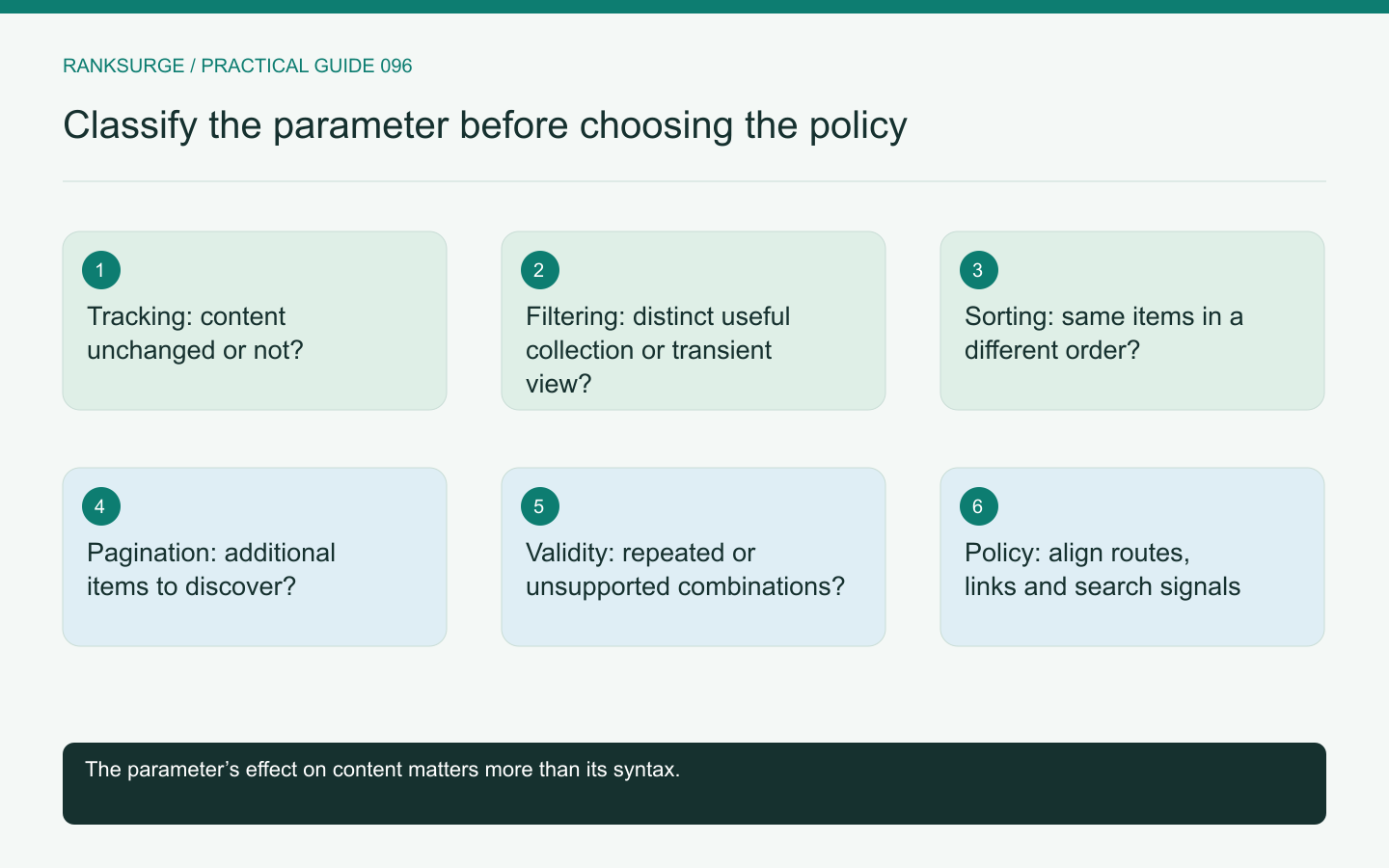
Classify parameter URLs by their effect on content and customer tasks before choosing canonical, crawl or navigation policies for each variant family.
TL;DR
- Decide parameter treatment by what each parameter does: treat variants that change primary content differently from tracking or pagination, rather than blanket-removing query strings or counting every combination.
- Use an evidence-first workflow: inventory observed routes and representative URLs, then test order, repetition and generated combinations to reveal normalization issues or accidental address inflation.
- Validate changes by rerunning representative combinations and grouping by parameter family; success is a documented policy per meaningful family with fewer accidental URLs and preserved customer tasks.
A parameter is not automatically a duplicate
A URL parameter can select a product variant, filter a collection, change sorting, identify a page of results or carry campaign tracking. Those functions have different implications for content and discovery.
Begin by identifying what each parameter does in the application. Removing every query string from an audit comparison can hide meaningful differences, while treating every combination as unique can exaggerate the size of the content inventory.
The useful unit of analysis is the parameter's effect on the page and reader task, not the presence of a question mark in the URL.
Build a parameter inventory from observed routes
Collect representative URLs and group the parameter names and combinations. Record the page family, visible effect and whether the parameter changes the primary content.
For an illustrative store, a tracking value may leave the page unchanged, a color filter may change the displayed products and a page number may expose additional items. A single policy applied to all three would be difficult to justify.
Keep unknown parameters in a separate investigation group. Their names may suggest a purpose, but the application behavior is the evidence that matters.
Distinguish a useful landing page from a transient view
Some filtered views may serve a distinct customer search need. Others are temporary browsing preferences or combinations with little independent value.
Ask whether the view has a stable purpose, enough relevant content and a clear place in the site's information architecture. Do not create indexable landing pages for every theoretical combination merely because the interface can generate them.
Likewise, do not assume that every filter should be hidden from discovery. A carefully chosen category or attribute page may be useful when it genuinely answers a customer need and is maintained as part of the site.
Investigate the size of the generated URL space
Multiple filters, sort orders and repeated parameters can produce a large number of addresses. Inspect whether the application generates nonsensical or duplicate combinations and whether links expose them unnecessarily.
Google's faceted-navigation guidance explains the resource and discovery concerns created by expansive faceted URL spaces. Use that reference to frame the investigation, not as a reason to remove useful navigation from customers.
A good correction can preserve the browsing experience while making the public URL policy more deliberate. The implementation choice depends on which views the business wants discovered.
Test order and repetition behavior
Compare equivalent parameter combinations in different orders and inspect repeated or unsupported values. Determine whether the application normalizes them, ignores them or produces different output.
For example, two filter orders may show the same collection while generating separate links throughout the site. A repeated filter could create an empty state or an accidental loop through new addresses.
Document these behaviors with concrete examples. They often reveal a route-generation problem that can be corrected at the source rather than managed indefinitely through audit exclusions.
Coordinate canonical and crawl decisions
Choose the preferred content relationship first, then review the appropriate canonical, linking and crawl behavior. These controls have different purposes and should not be applied as interchangeable switches.
If a variant is equivalent to a preferred page, review the canonical policy. If the concern is an unnecessary crawl space, evaluate the crawl strategy. If the page should be private, use access controls rather than an SEO directive.
Keep the chosen rules consistent with the site's navigation and sitemap. Contradictory signals often reveal that different components are generating URLs under different assumptions.
Preserve the user journey during cleanup
A shared filtered URL may be valuable to a customer even when it is not intended as an independent search landing page. Test bookmarks, browser navigation and copied links before changing the parameter model.
Do not silently drop a selected size or region if that changes the buying context. Explain any migration behavior where the old URL can no longer represent the requested view accurately.
For commerce routes, include a test that moves from the filtered collection to a product and back. The SEO cleanup should not make ordinary browsing frustrating or discard the user's deliberate selections.
Keep analytics interpretation in the review
Changing URL behavior can change how page views are grouped in reporting. Ask the analytics owner whether the correction affects existing reports or saved comparisons. This does not justify preserving accidental duplicates, but it does mean that a cleaner route policy should ship with an understandable measurement transition.
Validate by parameter family
After implementation, rerun representative combinations and compare response behavior, visible content, canonical declarations and generated links. Keep useful variants and intentionally suppressed combinations in separate acceptance groups.
RankSurge can help surface the crawl pattern, while the application team owns the route semantics. A successful audit outcome is a documented policy for each meaningful parameter family, with fewer accidental URLs and a preserved customer task—not a blanket rule that all query strings are bad.
Related reading: SEO for Startups: A Founder’s Handbook.
Related reading: The Best Open Source SEO Tools in 2026.