
Pagination SEO Audits: Verify Discovery Across the Whole Collection
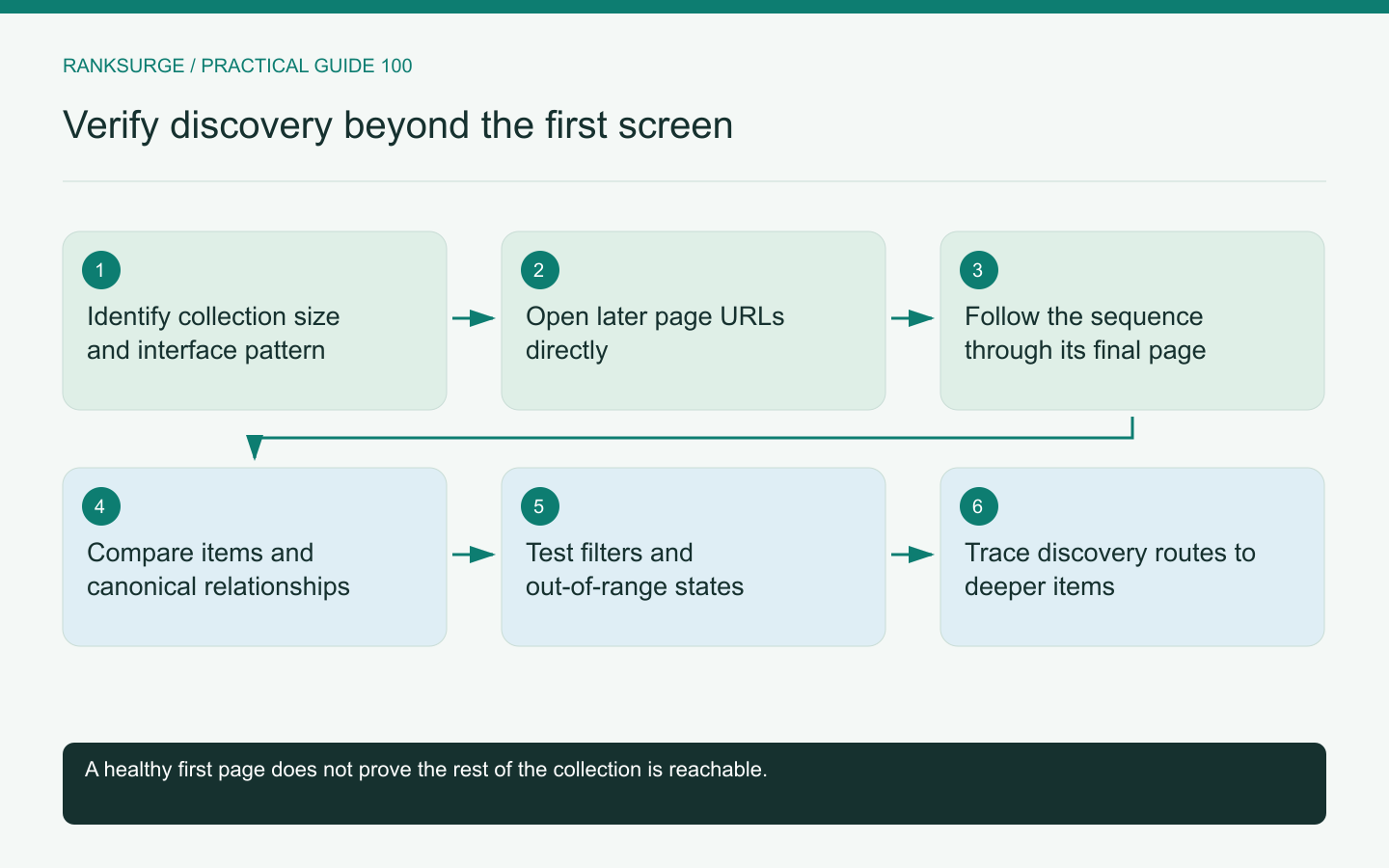
Audit pagination by checking whether later collection items remain discoverable, deep links work and each page’s URL and canonical behavior match its content.
TL;DR
- The audit's decision: follow the collection far enough so later items are discoverable, not just the first page; verify the whole discovery path rather than optimizing only page one.
- Practical method: start with the expected collection size and inspect underlying routes, stable page URLs, and the actual link destinations instead of judging only the visible first screen.
- Meaningful limit and success check: confirm the last valid page, next invalid page, and empty states; report incomplete coverage if the audit stopped before reaching the last pages.
The first collection page is not the whole collection
A category or article archive can look healthy while items beyond the first page are difficult to discover. An audit needs to follow the collection far enough to understand how later items become reachable.
Start with the expected collection size and the interface pattern: numbered pages, a load-more button, infinite scrolling or a combination. Then inspect the underlying routes and links rather than judging only the visible first screen.
The central question is whether users and appropriate crawlers can reach the items the site intends to make public, including those that are no longer near the top.
Identify stable collection states
Determine whether later portions of the collection have distinct usable URLs and whether those URLs load the expected content directly.
For an illustrative article archive with twelve pages, open a middle page in a clean browser session. It should not depend on first clicking through the previous pages to establish hidden application state.
Google's pagination guidance provides the search reference for paginated and incremental-loading experiences. Use it to review the implementation without assuming that a smooth scrolling interface automatically provides a complete discovery path.
Inspect the links that connect the sequence
Check the actual destinations behind next, previous and numbered controls. Confirm that important routes are represented in a form that can be discovered, not only triggered through an opaque script action.
A load-more interface can coexist with a sensible underlying URL structure. The audit should identify whether that structure exists and whether the visible controls preserve it appropriately.
Do not infer completeness from one working next button. Follow several steps, including the final page, and check that the sequence does not repeat the same content or generate endless empty states.
Compare content across adjacent pages
Inspect whether page boundaries expose distinct items and whether sorting is stable enough for the intended experience. Rapidly changing collections may require particular care when items move between requests.
Suppose a new article is inserted at the top while a reader navigates from page one to page two. Depending on the application's ordering model, the reader might see a repeated item or miss one. Record the observed behavior and ask the product owner what consistency the experience should provide.
This is partly an application-design question. An SEO audit should identify the discovery consequence without claiming that one pagination implementation fits every changing dataset.
Review canonical behavior for the actual content
A later collection page usually contains different items from the first page. Do not assume that every page should declare page one as canonical merely because the layout and category heading are shared.
Inspect the site's intended canonical policy and compare it with the content relationship. If a separate view-all page exists, verify what it actually contains and whether it is usable before treating it as an equivalent destination.
Keep canonical decisions connected to real content, not a generic rule that every archive variant is a duplicate.
Test filters and pagination together
A filtered collection may have fewer pages than the unfiltered one. Check what happens when a person applies a filter while on a later page, or opens a URL combining a filter with an out-of-range page number.
The application should provide an understandable result rather than silently showing unrelated items. Preserve the intended filter when navigating through the remaining collection.
For an illustrative product catalog, selecting a size should not disappear when the user clicks next. A route that drops the filter can undermine the buying task even if every destination returns a successful response.
Confirm discovery of deeper items
Choose several items from later pages and trace their internal discovery routes. They may also be linked through relevant categories, related-item modules or other useful structures.
Do not add arbitrary links solely to satisfy a crawl count. The routes should help a reader find the content in a meaningful context.
Compare the known collection inventory with the inspected set and keep any crawl limits visible. If the audit stopped before reaching the last pages, report incomplete coverage rather than concluding that the deeper items are absent.
Validate the final page and empty states
Test the last valid page, the next invalid page and a collection with no results. Confirm that the interface and response behavior match the intended state and do not produce an endless sequence of new empty URLs.
After a correction, repeat the direct-load, navigation, filter and deep-item checks. RankSurge can help organize the audit evidence, while the collection component and routing system own the implementation.
A complete pagination audit verifies the whole discovery path. The outcome should preserve a useful browsing experience and make later content reachable, rather than optimizing the first page while leaving the rest of the collection effectively invisible.
Related reading: SEO for Startups: A Founder’s Handbook.
Related reading: The Best Open Source SEO Tools in 2026.