
Page-Level Competitor Research: Understand One Winning Page Before Copying Its Topics
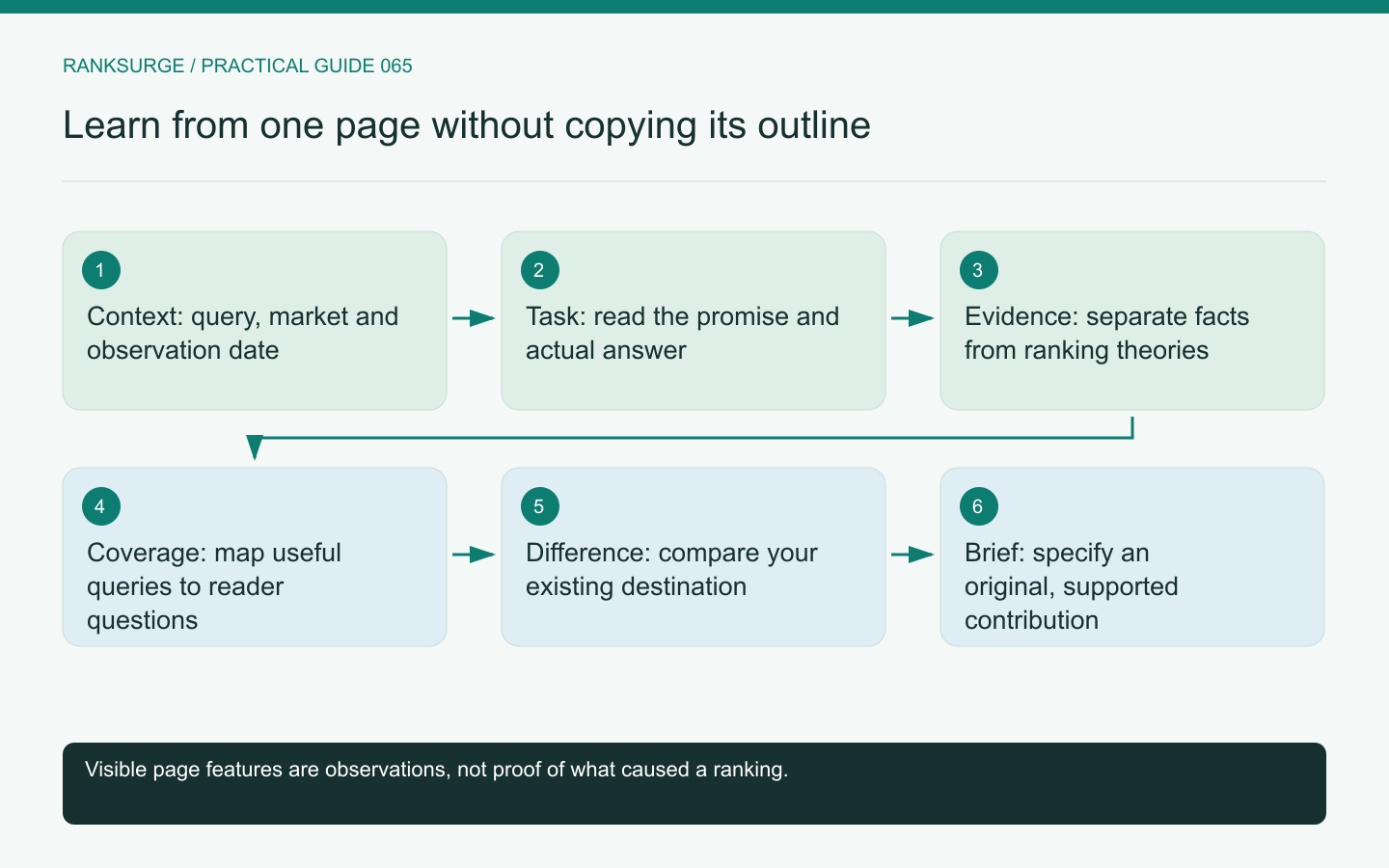
Analyze a competitor page by its reader task, evidence and current result context before deciding what your own site should improve or create.
TL;DR
- Main decision: focus competitor research on one page and the specific reader decision it serves, aiming to produce a better brief for your site rather than reconstructing someone else’s article.
- Useful method: perform a page-level workflow—read the page as a prospective user, record concrete evidence, and separate observable page qualities from unproven ranking theories before building a plan.
- Limit and success check: deliver a reviewable brief listing decision, evidence, original contribution and scope; the research succeeds only if it yields a distinct, supportable answer rather than a polished copy.
Begin with one page and one reader decision
Domain-wide keyword exports can hide what an individual page actually does well for a reader. A page-level review narrows the question: what task does this destination serve, and what can your team learn from its answer without copying it?
Choose a page connected to a relevant customer decision. Record the query, market and date that led you there. Do not call it a winning page solely because a tool reports traffic; inspect the result context and the page itself.
The goal is a better brief for your own site, not a reconstruction of someone else's article.
Read the page as a prospective user
Start with the promise in the title and introduction. Then ask whether the body delivers the information needed to make the decision. Note where the page becomes concrete through examples, comparisons, limitations or supporting documentation.
For an illustrative workflow-automation comparison, a reader may need to understand who each option suits, what integrations are supported and where implementation work remains. A long list of features is not necessarily the same as a useful selection framework.
Record the task the page actually solves, even when it differs from the keyword label in the export.
Separate observable qualities from ranking theories
You can observe that a page contains a clear comparison table, current references or a detailed worked example. You usually cannot prove from that observation alone that any one element caused its ranking.
Keep the notes disciplined: “includes a current integration example” is evidence; “ranks because it has six headings” is an unsupported causal claim. This distinction prevents superficial copying of visible features that may not be responsible for performance.
Also note limitations and missing information. A highly visible page can still leave an important reader question unanswered, which may reveal a more useful direction for your own content.
Map the page's queries to its sections
If the research source provides page-level keywords, group them by the questions the page addresses. Look for a coherent central task and supporting subquestions. Preserve source dates and unknown metrics.
Do not assume every reported keyword is intentionally targeted or equally important. Some may be incidental, ambiguous or unrelated to the page's main purpose. Inspect a representative sample of current results before turning them into a content plan.
RankSurge's keyword research workflow can support this evidence gathering. The interpretation should remain attached to the page and the reader task, not become an unqualified list of phrases to repeat.
Related reading: SEO for Startups: A Founder’s Handbook.
Related reading: How to Use Vellum and OpenSEO for Your SEO Engine.
Verify product claims against primary sources
A competitor article may describe its own product accurately, incompletely or with promotional emphasis. If your proposed page will make factual claims about that product, verify them in the vendor's current documentation or other authoritative first-party material.
Do not copy prices, limits or availability from an old comparison merely because it ranks. Record what was checked and when. If the evidence is unavailable or ambiguous, narrow the claim or leave it unresolved.
For the automation example, a listed integration does not automatically establish that every workflow or operation is supported. The meaningful comparison may require checking the actual operation the buyer needs.
Compare the task with your own inventory
Read the closest existing page on your site. Identify whether the gap is missing content, missing evidence or a mismatch in presentation. These lead to different actions.
A current guide may already serve the same decision but lack a clear explanation of tradeoffs. Improving that guide can be more useful than creating a second page with a slightly different title. A genuinely different operational problem may deserve its own destination.
Write the proposed action in one sentence and explain why it does not duplicate existing coverage. This is the bridge from competitive observation to an editorial decision.
Define an original contribution
Specify what your team can add based on real knowledge: a worked workflow, a transparent limitation, a reproducible checklist or a decision aid grounded in supported capabilities. Avoid merely increasing the word count or adding more product names.
Google's helpful-content guidance is a useful quality reference. The practical test is whether a reader gains a clearer answer from your page, not whether your outline resembles a currently visible result.
For the automation comparison, an original contribution could be a scenario showing where a human approval remains necessary. That is useful only if the scenario and product behavior are accurate.
Finish with a reviewable brief
The brief should contain the reader decision, existing destination if any, required evidence, original contribution, excluded scope and maintenance needs. Link the observed competitor page as research context, not as a writing template.
Before drafting, ask another reviewer to explain the difference between the proposed article and both the competitor page and your own closest content. If the difference is only a headline variation, refine the task. Page-level research succeeds when it produces a distinct, supportable answer rather than a more polished copy of an existing one.