
Noindex Investigations: Confirm the Intended Audience Before Removing the Directive
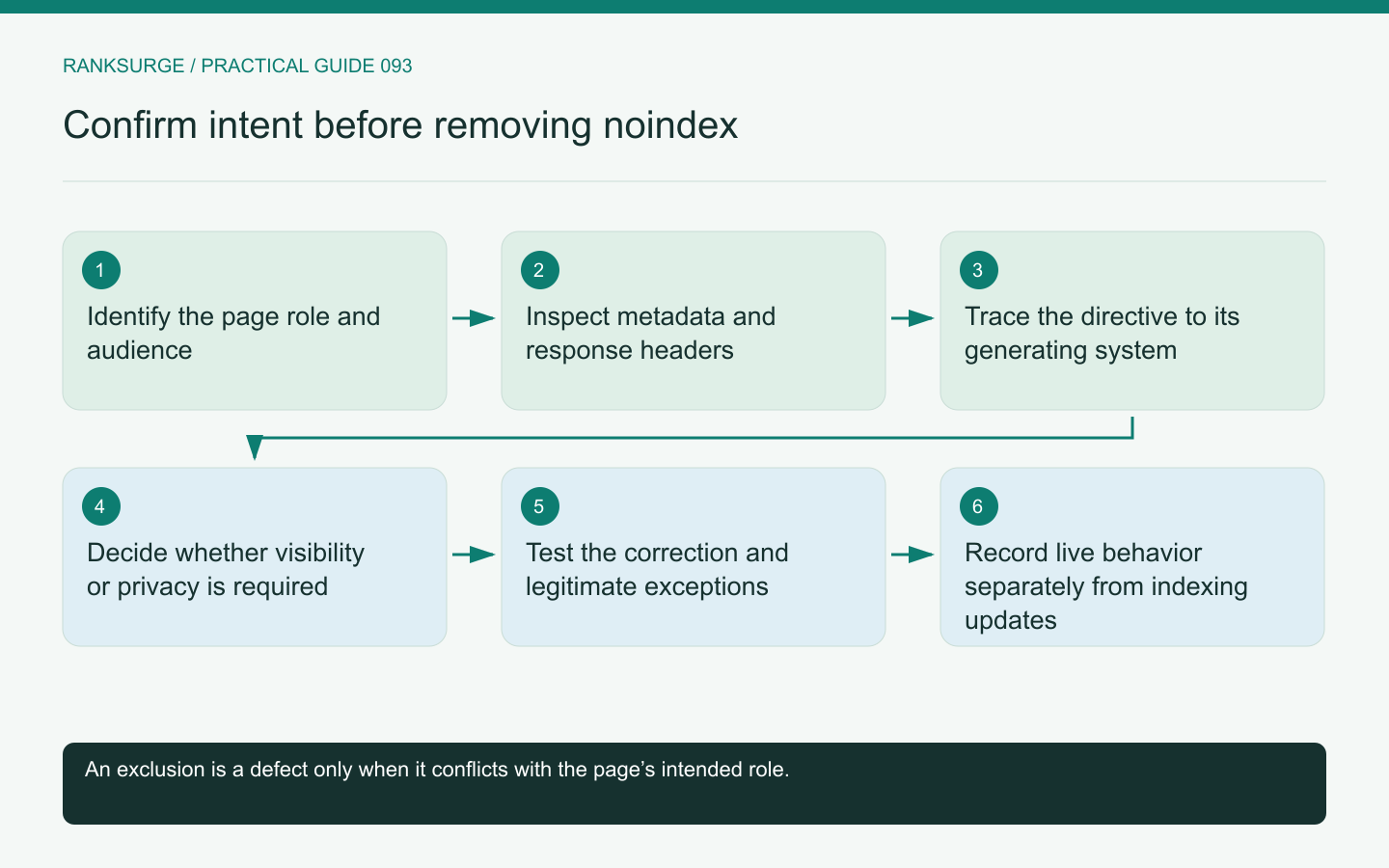
Investigate noindex findings by confirming the page’s intended audience and the source of the directive before removing a deliberate exclusion or fixing an accidental one.
TL;DR
- Do not treat every noindex as an error: confirm whether the page is intentionally excluded by identifying its role and intended audience before removing the directive.
- Follow a scoped, evidence-driven process: inspect robots metadata and headers, trace the directive's source, and confirm the owner's visibility intent before changing site-wide behavior.
- Verify fixes at the right level and record outcomes: confirm the live response, keep crawling/indexing checks separate, and close audits by documenting intent, source, changes and verification.
Noindex can be correct
A noindex finding is not automatically an SEO defect. Some public pages are useful to existing users but are not intended to appear in search results.
Before removing the directive, identify the page's role and intended audience. A search landing page, an internal utility view and a duplicate campaign variant can require different treatment.
The audit should ask whether the observed directive matches the owner's decision. Treating every noindex as an error can expose pages that were intentionally excluded and create a larger governance problem than the original warning.
Identify the exact directive and response
Inspect the page's robots metadata and relevant HTTP headers. Record the URL, response status and the directive actually observed, including whether it applies to a specific crawler.
Google's noindex documentation describes supported implementations and the need for the crawler to access the directive. Use it as the technical reference rather than relying only on a tool's simplified label.
If the crawler could not retrieve the page, separate that access problem from the indexing instruction. A missing observation should not be interpreted as proof that a noindex is absent or present.
Trace the source of the instruction
The directive may come from a CMS checkbox, shared layout, environment setting, route handler or response-header rule. Find the source before editing the output.
For an illustrative launch, a staging setting may accidentally remain enabled on production. If the value is injected by a shared configuration, manually editing a few pages will not correct the underlying cause.
Conversely, one deliberately excluded utility route should not cause the team to remove a sensible site-wide mechanism for controlling non-search pages. The fix should match the scope of the actual error.
Confirm the desired audience with the owner
Ask whether the page should be publicly discoverable, accessible only through a direct link or protected behind authentication. These are different goals.
Noindex is not an access-control mechanism. If the content should be private, the appropriate application or infrastructure protection needs review independently of search visibility.
For a public event page that is no longer promoted, the owner may still want historical access while excluding it from future search discovery. Record that decision rather than assuming every old page should either rank or be deleted.
Check whether the content is ready for indexing
If the noindex is accidental, confirm that the page's content, canonical relationship and public response are otherwise ready before removing it.
A production URL may still contain placeholder copy, test data or an incorrect canonical inherited from staging. Removing the directive without checking those conditions can expose an unfinished page while leaving the real launch problem unresolved.
Keep the review proportionate. The goal is not an endless prepublication checklist, but enough evidence that the proposed visibility change matches the actual state and purpose of the page.
Test the correction at its true scope
For a shared template or environment fix, inspect several affected page families and an intentionally excluded page that should remain unchanged. This catches broad corrections that accidentally remove legitimate exclusions.
Check both the HTML and response headers when the implementation can emit directives through either route. A visible metadata edit may be ineffective if another layer continues sending a conflicting header.
Preserve the deployment or configuration change reference with the audit finding. That helps later reviewers understand when the public behavior changed and which system now owns it.
Keep crawling and indexing observations separate
After the correction, verify the live response first. Search-engine processing is a later observation and may not immediately reflect the newly deployed directive.
Do not repeatedly toggle the setting because a search result has not changed instantly. Confirm the live implementation, use the available inspection tools appropriately and monitor the relevant evidence over time.
If another access restriction prevents the crawler from seeing the page, investigate that separately. The indexing instruction and the ability to retrieve it are linked operationally, but they are not the same control.
Keep historical intent when ownership changes
A new team may inherit pages whose exclusion rationale is no longer obvious. Store the reason with the page family or configuration, together with the owner who approved it. This prevents a later cleanup from reversing an intentional decision simply because the original discussion is unavailable.
Close the finding with the intended state
A complete audit note states whether noindex was intentional, which source generated it, what changed if anything and how the current behavior was verified.
For intentionally excluded pages, keep the rationale so the next audit does not reopen the same question without context. For accidental exclusions, identify the preventive improvement, such as a clearer environment boundary or a launch check on representative public routes.
RankSurge can surface the observation, while the owner and implementation team determine the correct visibility policy. The objective is alignment between audience intent and deployed behavior, not the indiscriminate removal of every exclusion.
Related reading: SEO for Startups: A Founder’s Handbook.
Related reading: The Best Open Source SEO Tools in 2026.