
Mixed-Intent SERPs: Decide Whether Your Page Belongs Before Writing It
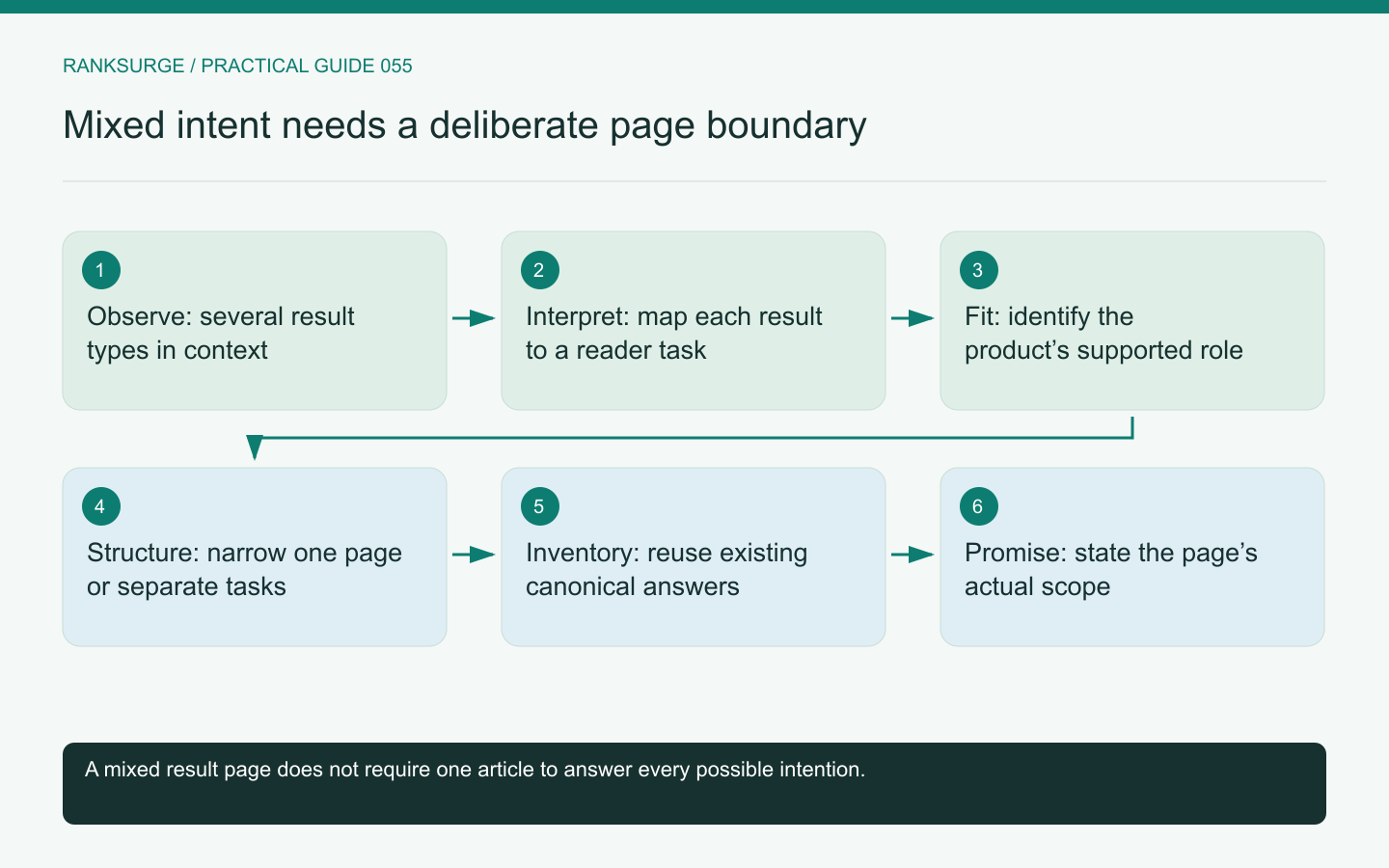
Review mixed-intent search results by separating reader tasks, matching page formats and deciding when one page cannot honestly answer the whole query.
TL;DR
- Decide whether your product belongs in mixed-intent results by reading the query as a customer requirement and stating that boundary in the page plan rather than stretching one page across all needs.
- Use a small result-purpose table and explicit reader-task mapping: record the query and lookup context, inspect representative results, and compare interpretations instead of forcing a single intent label.
- Treat SERP composition as provisional: keep the observation date and reasoning, aim for a defensible page purpose, and choose the branch the site can answer well rather than universal certainty.
Treat a mixed result page as evidence of several needs
A search-result page can contain product pages, definitions, tutorials and comparison articles for the same query. That mixture is a reason to inspect the audience carefully. It is not an instruction to combine every possible answer into one oversized page.
Start by recording the query and the lookup context. Then identify the reader task each representative result appears to serve. The goal is to understand the range of needs visible in the results, not to invent a single intent label that makes the planning spreadsheet easier to sort.
Build a small result-purpose table
For an illustrative query such as notification service, the results might include a product category, a technical architecture explanation and a specific platform's documentation. These are hypothetical examples, not a report of a measured live result set.
Create columns for result URL, page type, likely reader task and relevance to your product. Use cautious wording: appears to help a developer design a system, or appears to help a buyer compare services. The page title alone may not reveal the full task, so open the relevant results.
This table makes disagreement useful. A product manager and an SEO analyst can compare their interpretations instead of arguing over a one-word intent label.
Separate the user's stage from the page format
A tutorial can serve someone evaluating whether a product fits their stack. A comparison can serve an existing customer deciding whether to migrate. Informational and commercial purposes can overlap without making every page equally suitable for every reader.
Ask what decision your proposed page would help with and what evidence it can supply. A product-specific tutorial may be appropriate when the instructions are verified. A broad category comparison requires different research and a transparent selection method.
Do not choose the blog format merely because it is easy to publish. Some needs are better served by documentation, a product page or an interactive utility.
Check whether your product belongs in the result set
Read the query as a customer requirement. Does your product address that requirement directly, partially or not at all? A broad term may cover several categories, only one of which fits your offering.
For an illustrative email provider, a query about notification services could include mobile push and operational paging. The provider may contribute to an email-specific section while being an incomplete answer to the broader task. State that boundary in the page plan.
RankSurge's keyword research workflow can help inspect SERPs, but it cannot make an unsupported product capability true. The final brief should retain the product-fit decision alongside the search observations.
Related reading: SEO for Startups: A Founder’s Handbook.
Related reading: Ranking for the Wrong Half of Your Audience.
Decide between narrowing and separating
If one coherent audience can benefit from a page that explains the category and then narrows to a specific decision, a single page may work. Its title and introduction should make that scope clear.
If the tasks require substantially different evidence, separate pages may be more useful. A buyer comparison and a detailed error-resolution guide can share a topic without sharing a good structure. Give each a distinct purpose and connect them only where the reader has a natural next question.
Avoid creating one page per keyword variation. The reason to separate is a different reader task, not a different arrangement of the same words.
Review existing coverage before adding pages
Search your site inventory for answers to each task in the result-purpose table. An existing guide may already cover one branch of the mixed intent. Improving its clarity or adding a useful link can be better than commissioning a new competing page.
Record the intended canonical destination for each selected task. If two proposed briefs cannot explain how their reader decisions differ, merge or narrow them before drafting.
This review is especially important after a large keyword import. Several source queries may lead to the same underlying task even when their automated intent labels differ.
Write an introduction that sets honest expectations
The opening paragraph should tell the reader which part of the topic the page addresses. For example, an email-focused architecture guide can say it covers application email decisions and identify when another channel needs separate treatment.
Do not promise a universal answer and then quietly limit the discussion to your own product. Google's helpful-content guidance provides a useful standard for adding real value to the intended audience rather than writing primarily to capture a query.
An honest scope can still be commercially useful. It attracts readers whose needs the page can satisfy and helps others choose a more appropriate resource.
Preserve the uncertainty and revisit the result
Search-result composition can change. Keep the observation date and the reasoning behind the page choice so a later review can distinguish a changed market from a weak original assumption.
The useful outcome is not perfect certainty about every searcher's intention. It is a defensible page purpose grounded in observed results, supported product knowledge and existing coverage. When the query contains several needs, choose the one you can answer well instead of stretching one article across all of them.