
Missing Rank Positions: Record the Check Failure Separately From Not Found
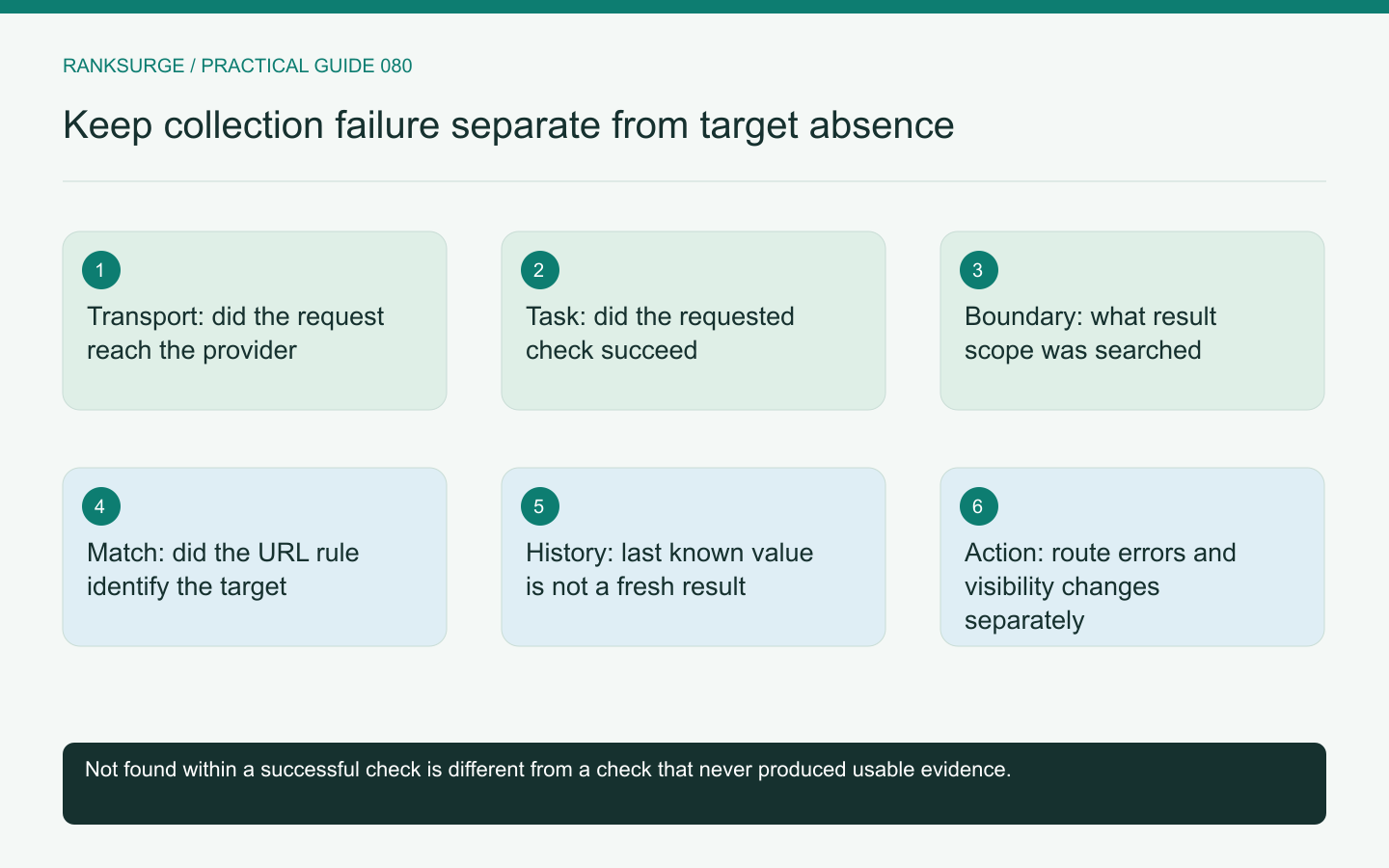
Represent missing rank positions with explicit collection and matching states so API failures, limited search depth and true observations are not confused.
TL;DR
- Record missing positions as explicit states rather than inventing ranks, since fabricated positions distort averages and conceal the true problem needing attention.
- Define observable states and preserve collection boundaries and matching policy so operators can distinguish a visibility question from a collection problem.
- Validate behaviour with fixtures and preserve attempt history—retries must not rewrite failures; honest missingness beats manufactured continuity for trend reports.
Missing is a state to explain
A blank position can mean the check failed, the task is still pending, the response was incomplete or the target did not appear within the searched results. Those meanings should not collapse into one numeric value.
Start by defining the states your tracker can observe and what evidence establishes each one. The report should help an operator distinguish a search-visibility question from a collection problem.
A missing value is not automatically the worst possible rank. Assigning an invented position can distort averages, alerts and later comparisons while hiding the real issue that needs attention.
Separate transport success from task success
An HTTP response alone may not establish that the requested research task completed successfully. Inspect the provider's documented task status and error fields.
DataForSEO's error reference describes its status model and exceptional conditions. Use the actual contract rather than treating every response body as a valid result set.
Store a sanitized error category and task identifier when appropriate. Do not turn authentication failures, exhausted allowances or invalid parameters into “not ranking,” because the system did not obtain the evidence required for that conclusion.
Record the search boundary
A successful check can only report within its requested and returned scope. Preserve the engine, location, device, result type and search depth or equivalent collection boundary.
For an illustrative check that searches a limited result set, “target not found within this check” is more accurate than “the page is not indexed” or “the site has no rank.” Those stronger claims require different evidence.
The DataForSEO organic SERP overview provides context for configured result collection. Your reporting language should reflect the actual limits of the observation.
Related reading: How to Use Vellum and OpenSEO for Your SEO Engine.
Related reading: The Dark Query Problem: Why Search Console Hides Most of Your Searches.
Verify the matching rule before diagnosing visibility
A result may be present but fail the application's URL-matching rule. Differences involving subdomains, redirects, alternate paths or a changed target can create a false absence.
For a hypothetical product guide, the tracker may expect the old path while the search result points to a newly deployed destination. The collection succeeded; the interpretation needs a migration review.
Use a small fixture containing a valid new path, an unrelated similar path and a subdomain variant. A deterministic matcher test can resolve the ambiguity more cheaply than repeatedly purchasing the same live search result.
Keep the returned URL evidence and the matching policy version. This lets an investigator distinguish a real absence from a parser or configuration issue without rerunning every historical check.
Preserve the last known result without pretending it is current
A dashboard may show the most recent successful position as context, but it should also display its collection time and the status of the latest attempt. Do not carry the old value forward as if a new observation confirmed it.
For example, “last observed at position 8 three days ago; today's check failed” communicates two useful facts. A chart that silently repeats 8 for all three days creates a false sense of stability.
Likewise, a later successful observation should not be reported as a dramatic improvement from an invented failure rank.
Design alerts around the actual state
Operational alerts should address repeated collection failures, invalid configuration or stale evidence. Visibility alerts should rely on valid comparable observations and the team's documented investigation threshold.
For the product-guide example, a provider error may need a credential or request review, while a successful not-found result may need a page and query investigation. Sending both to the same “ranking dropped” alert wastes attention and can trigger unnecessary content changes.
Keep the message concise but precise enough to route the work to the right owner.
Handle retries without rewriting history
A retry can produce a new successful observation, but it should not erase the fact that the original scheduled check failed. Preserve the attempt history at a level appropriate for operations and report the final outcome clearly.
Use the provider's documented retry guidance and avoid uncontrolled loops that consume capacity without changing the underlying problem. An invalid parameter needs correction; repeating it rapidly is unlikely to help.
If the final result remains unavailable, leave it unavailable. Honest missingness is more useful than a number manufactured to keep a chart continuous.
Test the states before relying on trend reports
Create fixtures for a successful match, a successful limited-scope absence, a pending task, a provider error, malformed data and a changed target URL. Verify the chart, alert and export behavior for each.
Check that missing states do not become zeros during serialization or spreadsheet export unless the file clearly preserves their meaning elsewhere. Review any aggregate calculations that combine the observations.
RankSurge rank research is most useful when it distinguishes what was measured from what could not be measured. A trustworthy tracker explains the missing position and its next action instead of turning uncertainty into a misleading ranking claim.