
Low Search Console CTR: Inspect Queries and Result Appearance Before Rewriting Titles
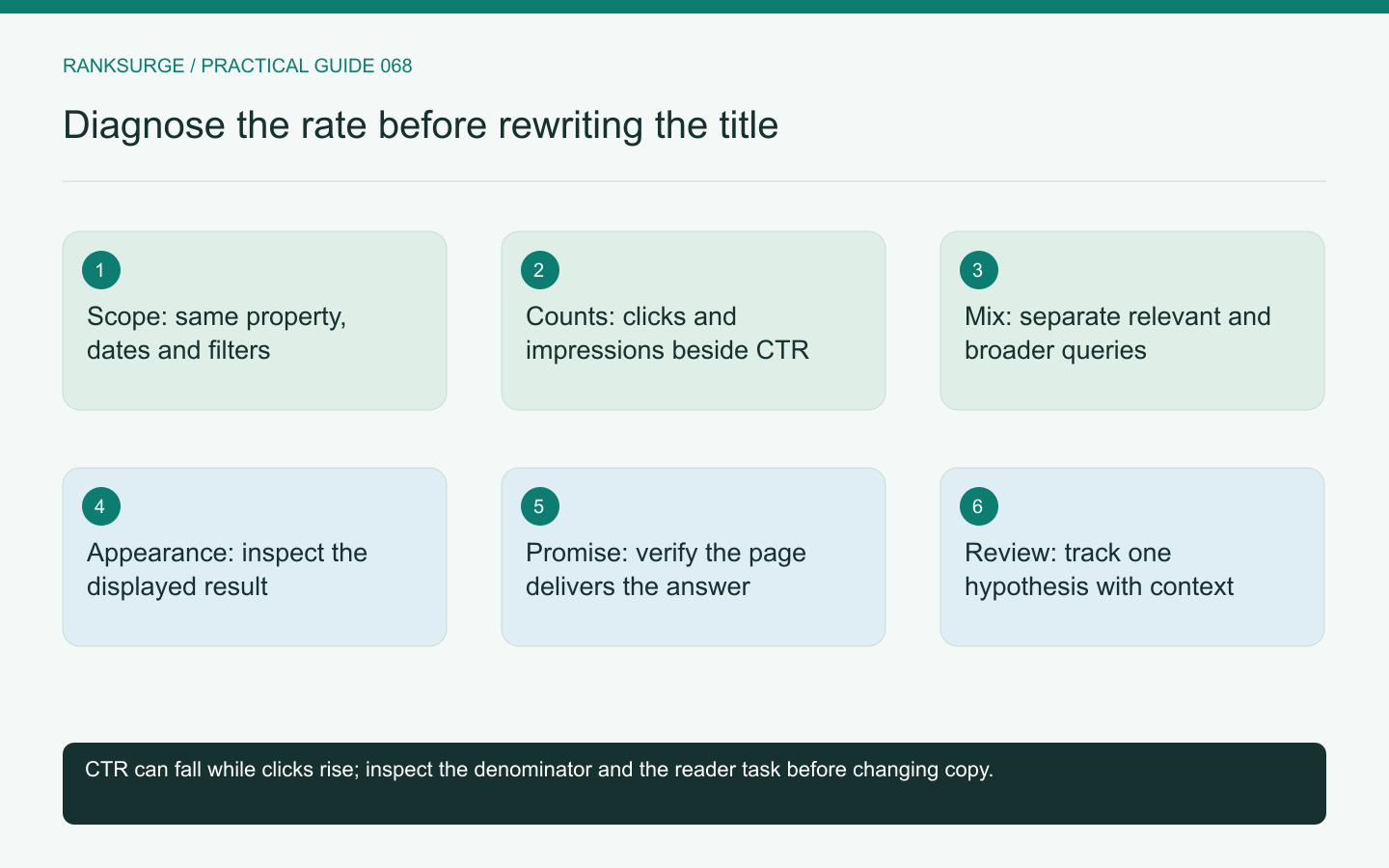
Diagnose low Search Console CTR through query mix, page fit and observed result appearance before changing titles or claiming an uplift opportunity.
TL;DR
- Start from a specific page and question: don’t treat a low site-wide CTR as a diagnosis; investigate a relevant page that receives impressions but appears to attract fewer visits before rewriting titles.
- Use a measured inspection method: confirm the report’s denominator and scope, review the query mix and actual result appearance, and compare the result’s promised task with the page’s answer.
- Check limits and success criteria explicitly: keep counts beside rates, note measurement uncertainty and context changes, and end with a defensible reader‑facing decision tracked by recorded hypotheses and versions.
Start with a specific page and question
A low site-wide click-through rate is not, by itself, a diagnosis. Different pages and queries serve different tasks, and the mix can change over time. Begin with a specific concern: a relevant page receives impressions but appears to attract fewer visits than expected.
Write the expectation and the evidence behind it. Avoid comparing every page with a universal CTR benchmark that ignores query intent and result context. The investigation should identify a plausible improvement, not merely produce a red number on a dashboard.
Confirm the denominator and scope
CTR relates clicks to impressions within the selected report. Record the property, date range, search type and filters before comparing periods or pages. A changed scope can create a changed percentage without any modification to the page itself.
For an illustrative guide, 20 clicks from 1,000 impressions is 2 percent. If the guide later receives 30 clicks from 3,000 impressions, CTR falls to 1 percent while clicks rise. The arithmetic alone does not tell you whether the content became less useful.
Keep counts beside the rate so the team can see what actually moved.
Inspect the query mix
Review which visible queries contribute to the page's impressions and whether their intent matches the content. A page may begin appearing for broader or less relevant terms, changing the aggregate rate even when its core queries remain stable.
For example, a detailed guide to scheduling-software procurement might appear for both a narrow buyer query and a broad definition. Those searchers may have different reasons to click. Treating them as one audience can lead to an inappropriate title rewrite.
Group related tasks and preserve unknown or ambiguous cases. Do not assume that every impression represents a qualified prospect who should have visited the page.
Look at the result people encounter
Inspect current results for representative queries in the relevant context. Note the visible title, surrounding information and other result elements. The result seen today is a snapshot, so avoid pretending it perfectly reconstructs the entire reporting period.
Google's title-link documentation explains that the displayed title link can be derived from several sources. Check the actual appearance rather than assuming it always matches the HTML title exactly.
If the displayed promise is unclear or inconsistent with the page, investigate that mismatch before inventing a more dramatic headline.
Compare the promise with the page's answer
Read the introduction and main content as a visitor. Does the page clearly solve the task implied by the query and title? A vague title may hide a useful answer, but a highly specific title cannot compensate for missing substance.
For the procurement example, “Scheduling Insights” may fail to communicate a practical selection framework. A clearer title could name the decision and audience accurately. It should not claim a comprehensive comparison or current benchmark unless the content supports that promise.
Choose wording that helps the right reader recognize the answer. Maximizing curiosity without delivering on it is not a useful optimization goal.
Separate content issues from measurement uncertainty
Low counts can make rate changes unstable. A small number of additional clicks can materially move a percentage, so report the scale and avoid strong conclusions from tiny samples.
Also consider changes in device, country, position distribution and query mix. These factors can influence interpretation without proving a causal explanation on their own.
Use the Search Console performance report to narrow the analysis where appropriate. Keep the investigation focused; slicing until a favorable pattern appears is not the same as testing a stated hypothesis.
Related reading: The Dark Query Problem: Why Search Console Hides Most of Your Searches.
Make one justified change with a record
If the evidence supports a title or content clarification, record the previous version, new version, target task and expected improvement. Note the release date and other meaningful changes made at the same time.
For the procurement guide, the hypothesis might be that a clearer audience and decision label helps relevant searchers identify the page. Keep a screenshot or saved rendering of the previous result where practical, with its observation date and context. The stated hypothesis is more precise than “increase CTR” and gives reviewers a way to assess whether the proposed change is honest and useful.
Do not promise a specific uplift unless it comes from an appropriate measured result, and do not apply one page's result indiscriminately across the site.
Review usefulness alongside the rate
After enough relevant evidence accumulates, compare like-for-like context as far as possible. Report clicks, impressions, query mix and any unresolved uncertainty. A rate improvement caused by losing broad impressions is different from attracting more relevant visits.
The final recommendation may be to keep the change, revise the page further or leave the title alone. A good CTR investigation ends with a defensible reader-facing decision, not an automatic instruction to rewrite every headline that falls below an arbitrary threshold.
Related reading: SEO for Startups: A Founder’s Handbook.