
Local SEO Grids: Read Coverage Patterns Instead of Averaging Away the Map
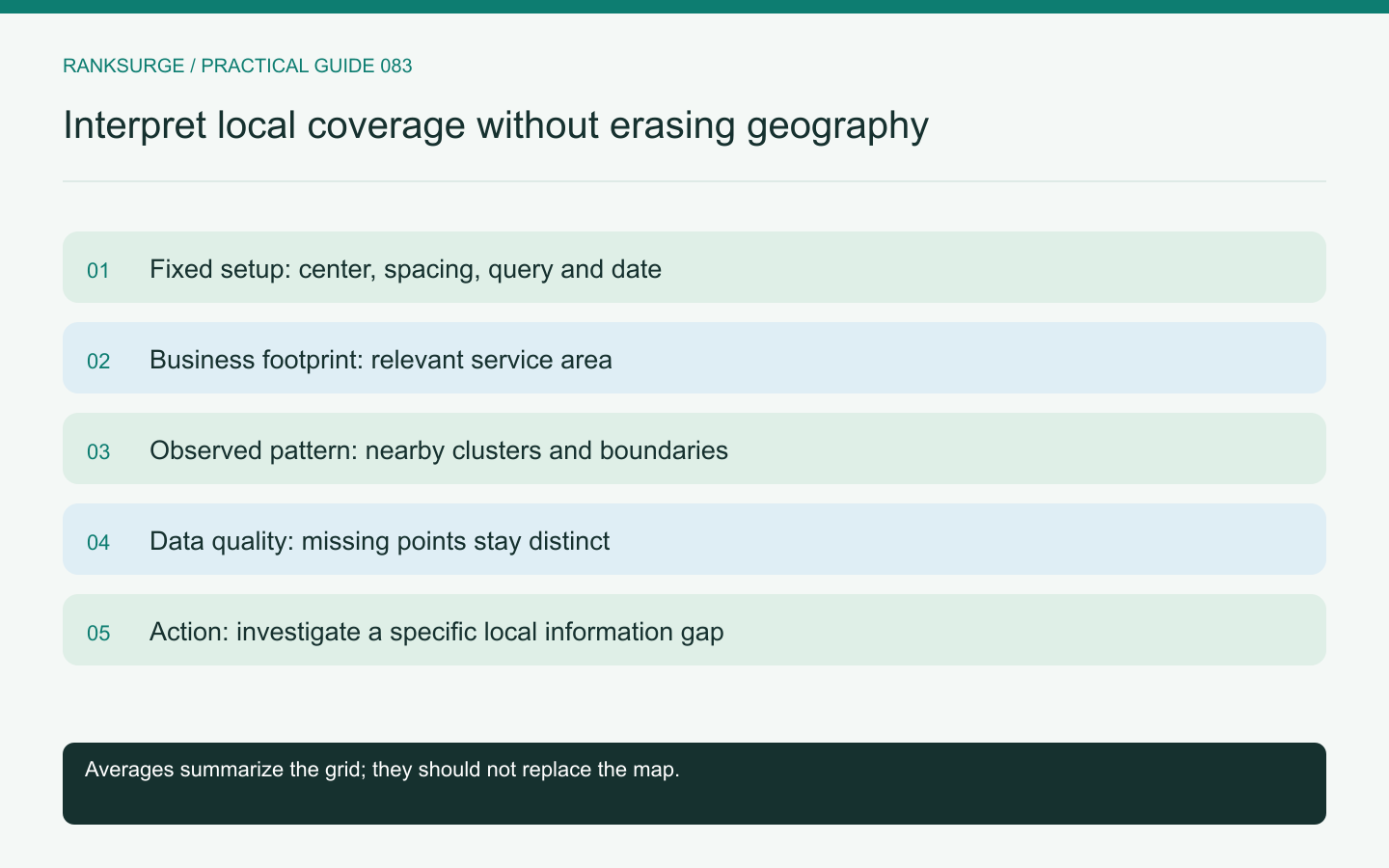
Interpret local SEO grids as geographic observations, preserving location, query and coverage context instead of reducing every map to one average rank.
TL;DR
- Decide by reading the geographic pattern on a local SEO grid instead of relying on a single averaged score; investigate where the business is visible and whether those locations matter to customers.
- Use a reproducible collection setup and separate views per service or query so comparisons remain like‑for‑like and actionable rather than masking problems across mixed results.
- Report coverage with explicit limits: preserve missing or out‑of‑range points, name the priority area and measurement details, and highlight consistent neighboring gains or losses as the success check.
Read the map before the average
A local SEO grid samples search visibility from multiple geographic points. Its value is the pattern across those points, not merely the single score produced by averaging them.
A business can appear prominently near its location and poorly across a river, transport barrier or distant suburb. One average can hide that distinction and encourage an unrealistic conclusion about the whole service area.
Start by asking where the business is visible, where it is not observed and whether those locations matter to its actual customers. The map is an investigation aid, not a guarantee of what every individual searcher will see.
Preserve the collection setup
Record the query, grid center, spacing, geographic extent, collection date and result type. Keep device and provider settings where available.
Two maps with different spacing or boundaries are not directly comparable. Expanding the grid into more distant areas can lower an average even when visibility at every previously measured point remains unchanged.
For an illustrative clinic, compare the same set of neighborhood points before claiming a decline. If the second report adds outer suburbs, show those new points as an expanded coverage view rather than blending them silently into the historical baseline.
Distinguish weak coverage from irrelevant territory
The desired footprint should reflect where the business can realistically serve customers. A map can contain locations that are geographically nearby but commercially unimportant or inaccessible under the business model.
Mark the priority service area separately from the full measured area. That lets the team distinguish a visibility gap in a key neighborhood from low visibility in a region where it does not operate.
Do not redefine the priority area after every unfavorable result just to improve the score. Agree on the business context first, then use the map to evaluate that context consistently.
Compare like-for-like business results
Local results can include businesses with different service models, locations and specialties. Before treating a visible profile as a direct competitor, check whether it serves the same customer task.
A specialist practice and a general facility may both appear for a broad query while competing differently for a more specific one. Record the distinction rather than assuming every map result belongs in the same comparison group.
Google's local ranking guidance identifies relevance, distance and prominence as important context. A grid helps observe the geographic pattern; it does not isolate the contribution of each factor.
Keep missing points explicit
A point with no usable collection result should not be colored as if the business definitely ranked last. Preserve collection failures and unobserved results as distinct states when the data allows.
Similarly, an observed result outside a tool's displayed range is not an exact position unless the underlying collection actually measured it. A visual legend should explain the meaning of each color and symbol.
If several neighboring points fail during a run, investigate the collection before declaring a geographic visibility collapse. A convincing map can still be based on incomplete evidence.
Turn one pattern into a bounded investigation
Suppose a restaurant is consistently visible around its location but rarely appears in a nearby neighborhood for a cuisine query. First check whether comparable businesses dominate that neighborhood and whether the restaurant's profile accurately represents the cuisine and service.
Then review whether the website and profile provide useful, accurate information for that customer need. Do not respond by inserting neighborhood names into a business name that does not use them in the real world.
The action should address a verified information or customer-experience gap. The map alone does not justify creating thin location pages for every low-performing point.
Keep different services in different map views
A business may perform well for one service and poorly for another across the same area. Preserve separate query views before producing an overall local summary. Combining a branded query with several service queries can make the coverage look stronger while hiding the actual acquisition problem. If a summary is needed, explain which queries contribute and why. The underlying maps should remain available so an owner can see whether a proposed action addresses one service gap or a broader visibility pattern.
Report coverage with its limitations
A useful summary names the priority area, the query, the stable measurement setup and the most important geographic pattern. Include a separate count or list of points with incomplete observations.
When comparing periods, highlight consistent gains or losses across relevant neighboring points rather than celebrating one isolated improvement. Keep operational changes and collection changes in the notes so later reviewers can interpret the history.
If using RankSurge alongside a local grid provider, verify the available integration and export fields instead of assuming native grid collection. The practical goal is a defensible local investigation: a clear statement of where visibility appears weak, why that area matters and what evidence should be checked next.
Related reading: SEO for Startups: A Founder’s Handbook.
Related reading: The Best Open Source SEO Tools in 2026.