
Local Review Research: Extract Service Problems Without Inventing Customer Opinions
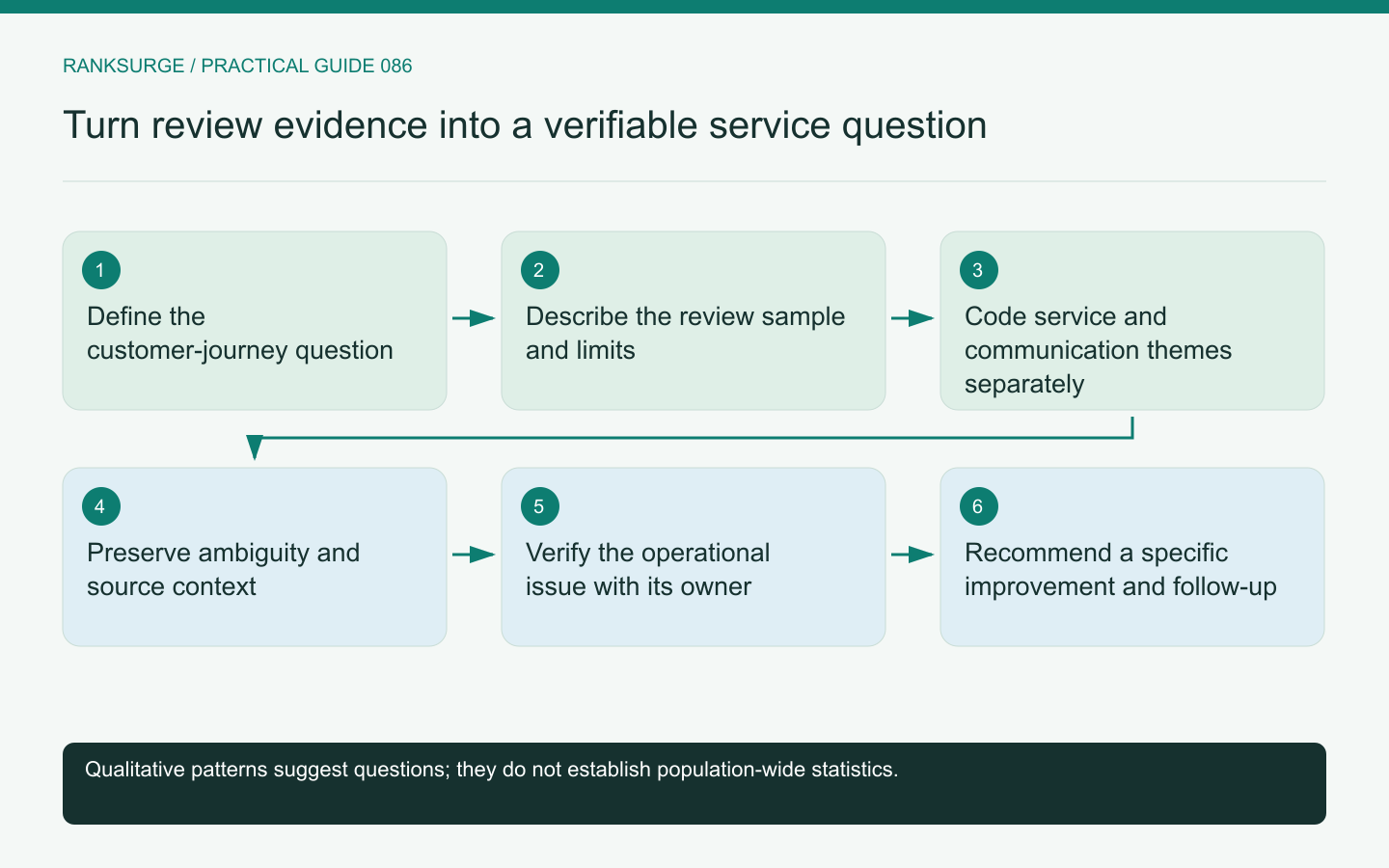
Use local reviews as bounded qualitative research: preserve context, distinguish recurring service themes and turn findings into verifiable improvements.
TL;DR
- Main decision: use local reviews as limited evidence to surface customers’ expressed questions and frustrations, not as a representative survey—define a bounded decision and keep findings tied to observable statements.
- Useful method: document the sample and scope, code distinct journey stages, preserve uncertainty in interpretation, and convert recurring themes into specific, verifiable improvements with assigned responsibility.
- Meaningful limit and check: avoid inferring frequency or inventing motivations from review counts; produce a small traceable research note that lists uncertainties and recommended verification steps.
Reviews are evidence of expressed experiences
Local reviews can reveal the questions and frustrations customers describe in their own words. They are not a representative survey of every customer, and a research summary should not imply otherwise.
Define the decision you want the review research to inform. A clinic might investigate appointment communication; a repair business might investigate how estimates are explained. A bounded question produces more useful findings than a broad instruction to summarize everything people say.
Keep the analysis tied to observable statements. Do not invent customer motivations, demographic characteristics or experiences that the reviews do not establish.
Choose and describe the sample
Record the business profiles, observation date, review period, languages and selection method. If you inspect only recent reviews, say so. If a platform shows a selected subset first, do not assume that subset represents the full history.
For an illustrative comparison of three repair shops, a researcher might review a fixed recent period for each location. The resulting notes can support a qualitative comparison within that scope, not a claim about the percentage of all customers who experience a problem.
Keep inaccessible or missing material visible as a limitation. Do not compensate for a small sample by adding plausible-sounding complaints.
Separate the service from the surrounding journey
A review can discuss booking, arrival, the core service, payment and follow-up in the same paragraph. Code those as separate themes where the distinction helps the decision.
For example, “The repair worked, but nobody explained when collection would be possible” contains a positive service outcome and a communication problem. Labeling the entire review as simply negative loses the actionable detail.
Also distinguish a complaint about a third-party booking platform from a complaint about the business's own process. The customer experience may cross both, but the owner needs to know which part can be changed directly.
Preserve uncertainty in interpretation
Use a short evidence note for each theme and retain a reference to the review where appropriate. Avoid copying unnecessary personal information into shared research documents.
If a sentence is ambiguous, mark the interpretation as uncertain rather than forcing it into a category. A reference to “waiting” could mean waiting for an appointment, waiting at the premises or waiting for a response afterward.
A second reviewer can examine a small sample of coded items to check whether the categories are being applied consistently. Disagreement is useful evidence that a theme definition needs clarification.
Compare patterns without manufacturing statistics
Counts can help organize the reviewed sample, but they should remain attached to that sample. “Five of the reviews we examined mentioned unclear estimates” is different from “customers usually receive unclear estimates.”
Do not infer the frequency of an operational problem from review frequency alone. People choose whether to leave a review, and their reasons for doing so are not controlled by the researcher.
Use recurring themes to identify questions for the business owner. Ask whether the underlying process already addresses the issue and whether the public information explains that process clearly.
Turn a theme into a concrete improvement
Suppose several examined reviews describe uncertainty about what an initial service fee includes. A useful response could be to verify the fee policy and improve the booking page's explanation.
That recommendation is more defensible than adding a claim such as “most transparent pricing in the city.” The research supports a need for clarity; it does not establish market leadership.
Assign an owner and a validation step. After the explanation changes, inspect the booking journey and ask support whether the same question still arises. Do not promise a ranking improvement from the copy edit.
Keep research separate from review solicitation
Review analysis should not become a process for filtering out unhappy customers before requesting feedback. Follow the platform's current rules for obtaining reviews and responding to them.
Google's review guidance is a primary reference for businesses using its profiles. Keep any request workflow honest and avoid incentives or practices that conflict with the platform's requirements.
The researcher's role is to understand existing evidence, not to produce favorable opinions on behalf of customers or rewrite their experiences into testimonials.
Separate public copy from internal findings
A research theme may be useful internally without being appropriate as a public claim about a named competitor. Before publishing a comparison, verify the factual basis and avoid presenting isolated complaints as settled characteristics of the business. The internal analysis can retain nuance that a short marketing sentence would otherwise erase.
Deliver a small, traceable research note
Summarize the question, sample, themes, uncertainties and recommended checks. Include a few concise paraphrased examples rather than a wall of copied reviews.
RankSurge can support the wider competitor research process, while the review analysis remains a human judgment about limited evidence. A strong result gives the business a service question it can verify and improve, without turning a selective public sample into an invented claim about every customer.
Related reading: SEO for Startups: A Founder’s Handbook.
Related reading: Ranking for the Wrong Half of Your Audience.