
Local Competitor Categories: Check the Business Match Before Comparing Reviews
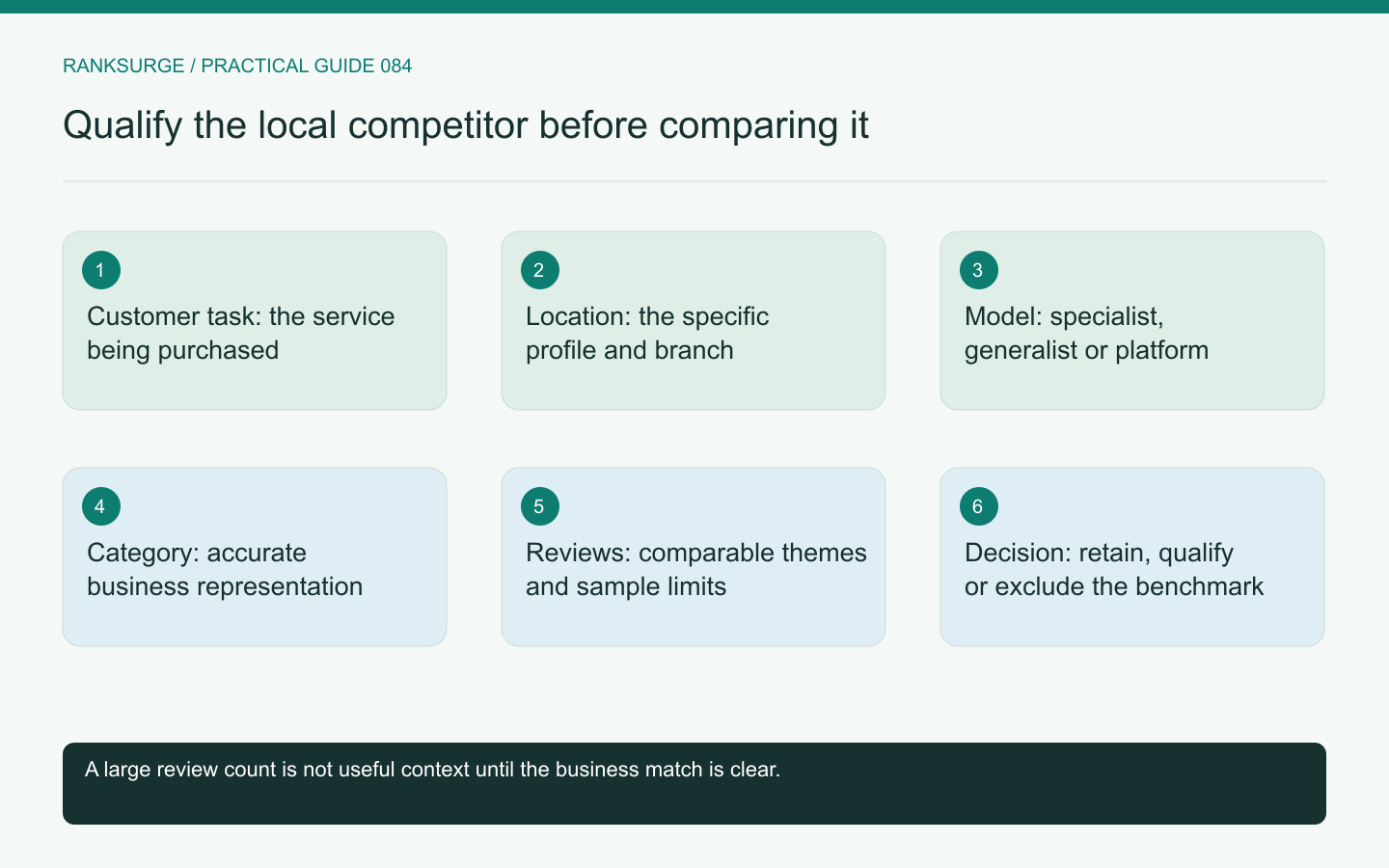
Choose meaningful local competitors by checking category, customer task and service model before comparing profile reviews or making category changes.
TL;DR
- Don’t equate shared category with interchangeability: decide whether a competitor actually offers the specific service the customer is trying to buy before using their review totals as benchmarks.
- Build a query- and location-specific comparison group by collecting appearing businesses, inspecting their public profiles and websites, and recording category, services and geographic context.
- Treat review counts as descriptive evidence only: flag unclear service models, add confidence notes, and report composition changes so trend shifts reflect competitor changes, not assumed quality gains.
A shared category is only a starting point
Two businesses can share a broad category while serving different customer needs. Comparing their review counts without checking that difference can produce an impressive spreadsheet and a weak recommendation.
Start with the service the customer is trying to buy. Then identify which local businesses genuinely offer that service in the relevant area and under a comparable operating model.
A walk-in repair shop, a specialist commercial contractor and an online-only service may all appear around a broad keyword. They should not automatically become interchangeable benchmarks for the same local profile decision.
Build the comparison group from actual results
Collect the businesses that appear for the priority query and location, then inspect their public profile and website. Record the category shown, the services offered and the geographic context.
Keep the query-specific search competitor separate from the business's broader commercial competitor list. A company that competes for contracts may not appear in the same local result set, while a directory may compete for search attention without delivering the service itself.
This distinction helps explain why a familiar competitor is absent from one report and an unfamiliar business is prominent. Neither observation requires changing the comparison rules to fit expectations.
Check the business model before the review total
For an illustrative dental search, a general practice, an orthodontic specialist and an emergency clinic may attract different visit patterns and customer expectations. Their review volume and themes can reflect those differences.
Record the type of service, typical customer task and visible location structure before comparing totals. A multi-location brand's overall reputation should not be treated as the review history of one local profile unless the data actually represents that location.
Use review counts as descriptive evidence. They do not, by themselves, prove service quality, conversion performance or the reason a profile ranks above another.
Treat categories as factual representation
The purpose of a business category is to describe what the business actually is. It is not a field for listing every keyword the marketing team wants to target.
Google's business representation guidelines require accurate representation and advise a limited set of categories describing the core business. Check the current guidance before proposing edits.
If a competitor uses an inaccurate category, copying it is not a sound strategy. Document the observed difference, verify your own services and choose a representation that the business can substantiate.
Compare review themes within the same customer task
A total review count can hide the issues that matter to a particular purchase. For a repair service, customers may discuss response time, estimate clarity, repair quality or appointment communication.
Read a bounded, clearly described sample and label themes without inventing a representative percentage. If the sample covers only recent reviews or a particular language, state that limitation.
Separate comments about the business's actual service from complaints about unrelated booking platforms, parking or another branch. Those comments can still matter to the experience, but they should not be assigned to the wrong operational category.
Use a simple comparison record
For each candidate competitor, record the profile identity, location, observed category, service match, query where it appeared and the reason it belongs in the comparison group.
Add a confidence note when the public website does not make the service model clear. It is better to keep a candidate provisional than to build a recommendation on an assumed offering.
An illustrative three-business comparison might retain two direct service matches and move a third into a broader search-context group. That is a useful analytical result even though it reduces the size of the headline competitor list.
Revisit the comparison group when the service changes
A business that adds a new service or closes a location may need a different benchmark set. Preserve the old group with its observation dates instead of rewriting historical reports as though the new competitors had always been included. This makes later trends interpretable. A rising average review count across a changed group may reflect the addition of larger businesses, rather than a sudden improvement by the original competitors. Report that composition change before drawing conclusions from the aggregate.
Recommend changes with evidence and ownership
If the research reveals that your profile omits a real core service, verify the service with the business owner before proposing a category or service-description update. Record the current value, proposed value and supporting evidence.
Do not combine several speculative edits into one untraceable change. A careful record makes it easier to review whether the final profile remains accurate and to understand later visibility observations.
RankSurge can help organize competitor and search research, but local profile edits require their own authorized workflow. The outcome should be a defensible comparison group and an accurate representation of the business, rather than a race to copy the category or review count of whichever profile currently appears first.
Related reading: SEO for Startups: A Founder’s Handbook.
Related reading: Ranking for the Wrong Half of Your Audience.