
Keyword Trend Validation: Check Whether the Topic Survives the News Cycle
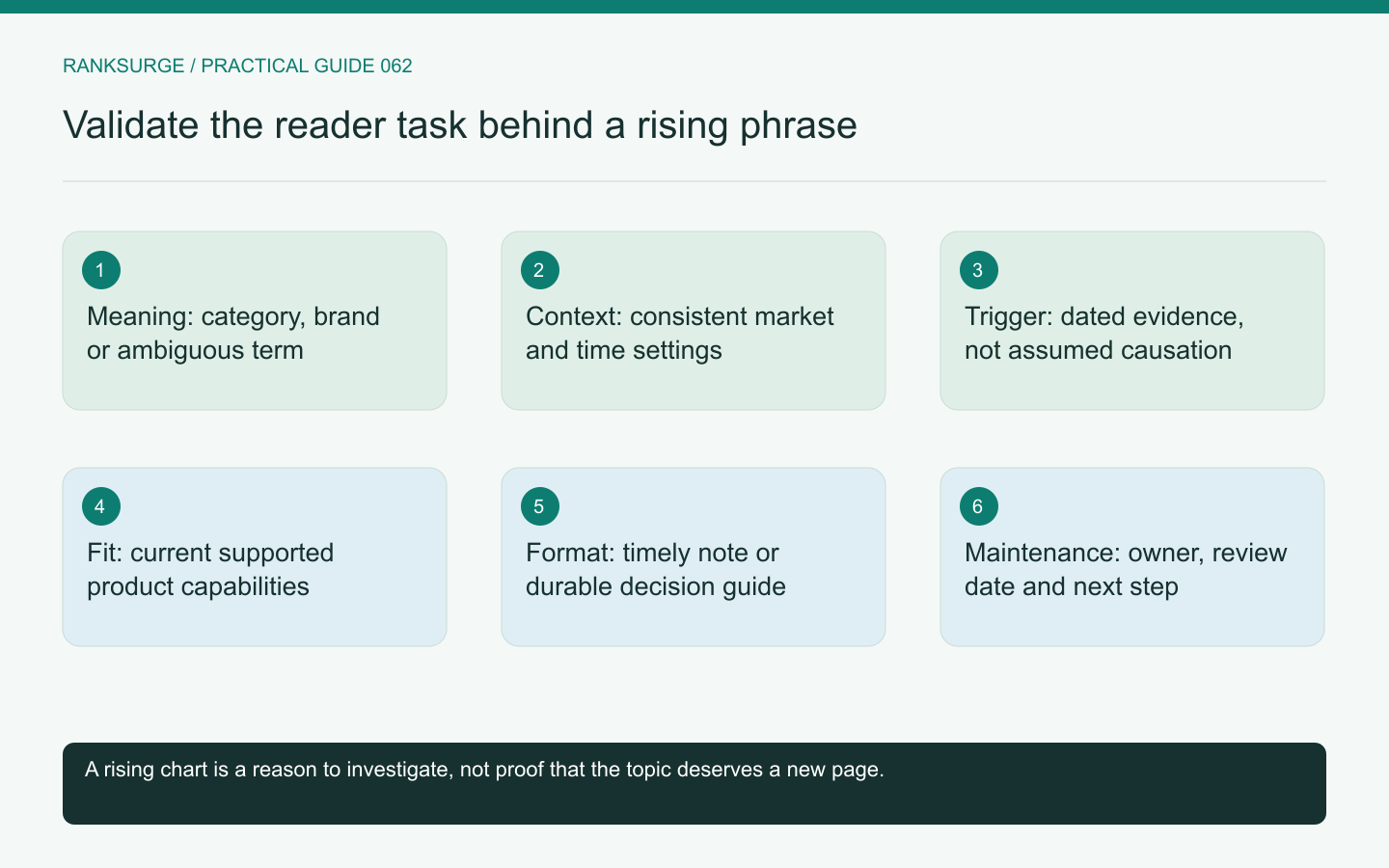
Validate a keyword trend by checking meaning, source context and a durable reader task before committing to content that may outlive the news cycle.
TL;DR
- Decide whether a rising keyword merits content by testing if the reader’s need outlives the news cycle; approve topics that answer durable tasks rather than attach the product to a fleeting phrase.
- Use a reproducible validation method: interpret the term, inspect current results, compare consistent trend settings, and hypothesize the triggering event before choosing the appropriate editorial format.
- Require a maintenance and fit check: estimate which claims will change, assign review ownership, and run a bounded validation brief whose outcome is publish, investigate further, update, or decline.
Ask what remains useful after the attention fades
A rising keyword can signal a new customer need, a short-lived news event or ambiguous curiosity. Before commissioning an article, ask what the reader will still need when the immediate attention changes.
For an illustrative software team, a newly popular phrase about autonomous reporting might reflect interest in a specific announcement. The durable task could be evaluating permission boundaries, verifying data sources or deciding which reporting steps can safely be automated. That task may deserve content even if the announcement's name does not.
The research goal is to identify a useful answer, not simply attach the product to a rising phrase.
Verify what the term actually refers to
Read the current results and relevant primary sources. A familiar word may have acquired a new meaning, or a phrase may refer to a brand rather than a category. Do not assume that a broad product description matches the actual search context.
Write a one-sentence interpretation and note plausible alternatives. If the term is ambiguous, inspect the different result types before deciding which audience your page would serve.
For the reporting example, distinguish an announcement summary, a general automation tutorial and a buyer's evaluation. They may share vocabulary while requiring very different evidence and maintenance.
Compare like-for-like trend views
Record the query or topic selection, market and time range. Google's comparison guidance distinguishes search terms from topics; they should not be treated as identical inputs.
Use consistent settings when comparing candidate trends. Changing several settings at once can create apparent differences that come from the query setup rather than the underlying opportunity.
The Google Trends data explanation also makes clear that the chart is one signal with limitations. A visible rise does not establish buying intent, product fit or a reliable revenue forecast.
Find the event behind the change
Look for a plausible trigger such as a product release, policy announcement, outage or widely discussed demonstration. Use dated primary sources where possible and separate the date of the event from the date of commentary about it.
Do not claim causation merely because two things happened near each other. Record the trigger as a hypothesis unless the evidence supports a stronger statement.
For editorial planning, the hypothesis is still useful. It helps identify whether the proposed article needs fast factual updates or whether the underlying reader problem can be addressed in a stable guide.
Test the topic against product reality
Ask what the product can currently do and what the team can substantiate. A trend is not a reason to imply capabilities that are still planned or unsupported.
For the autonomous-reporting example, a product that exposes read-only research tools should not be described as automatically making and publishing business decisions. A useful article could instead explain how to review agent-generated findings and preserve approval boundaries.
Keep the factual limitation in the brief. This gives the writer a clear scope and prevents promotional pressure from expanding the claims as the draft develops.
Choose between a timely note and a durable guide
A timely note can explain a specific change, its source and who is affected. A durable guide should solve a recurring task with examples and a structure that remains useful after the announcement is no longer new.
Do not disguise a short update as a comprehensive guide by adding generic background. Conversely, do not force an evergreen decision framework into a headline that depends on a fleeting event.
For the reporting topic, the durable guide might offer a source-verification worksheet and examples of unsupported inferences. The timely note might describe one newly released integration. Those are different editorial products with different review needs.
Estimate maintenance before approving the work
List which claims are likely to change: supported integrations, product availability, pricing, documentation or terminology. Assign a review owner and decide how readers will see the source date.
If the team cannot maintain a fast-moving comparison, narrow the article to stable evaluation questions and link to current official references. Avoid presenting a dated snapshot as a permanent verdict.
This is also a practical prioritization check. A high-attention topic that requires constant specialist review may be less suitable than a quieter question the team can answer accurately and maintain well.
Define a bounded validation step
Before committing a large content batch, write one brief with the reader task, evidence, product fit, intended destination and reasons it differs from existing coverage. Have another reviewer challenge the strongest assumption and identify the evidence that would change the recommendation.
The outcome can be publish, investigate further, update an existing page or decline the idea. A trend that fails the fit test is still useful research because it prevents the team from spending time on an answer it cannot responsibly provide. Choose the topic because its complete case is persuasive, not because the chart points upward.
Related reading: SEO for Startups: A Founder’s Handbook.
Related reading: The Dark Query Problem: Why Search Console Hides Most of Your Searches.