
Keyword Seed Expansion: Grow Coverage Without Drifting From the Product
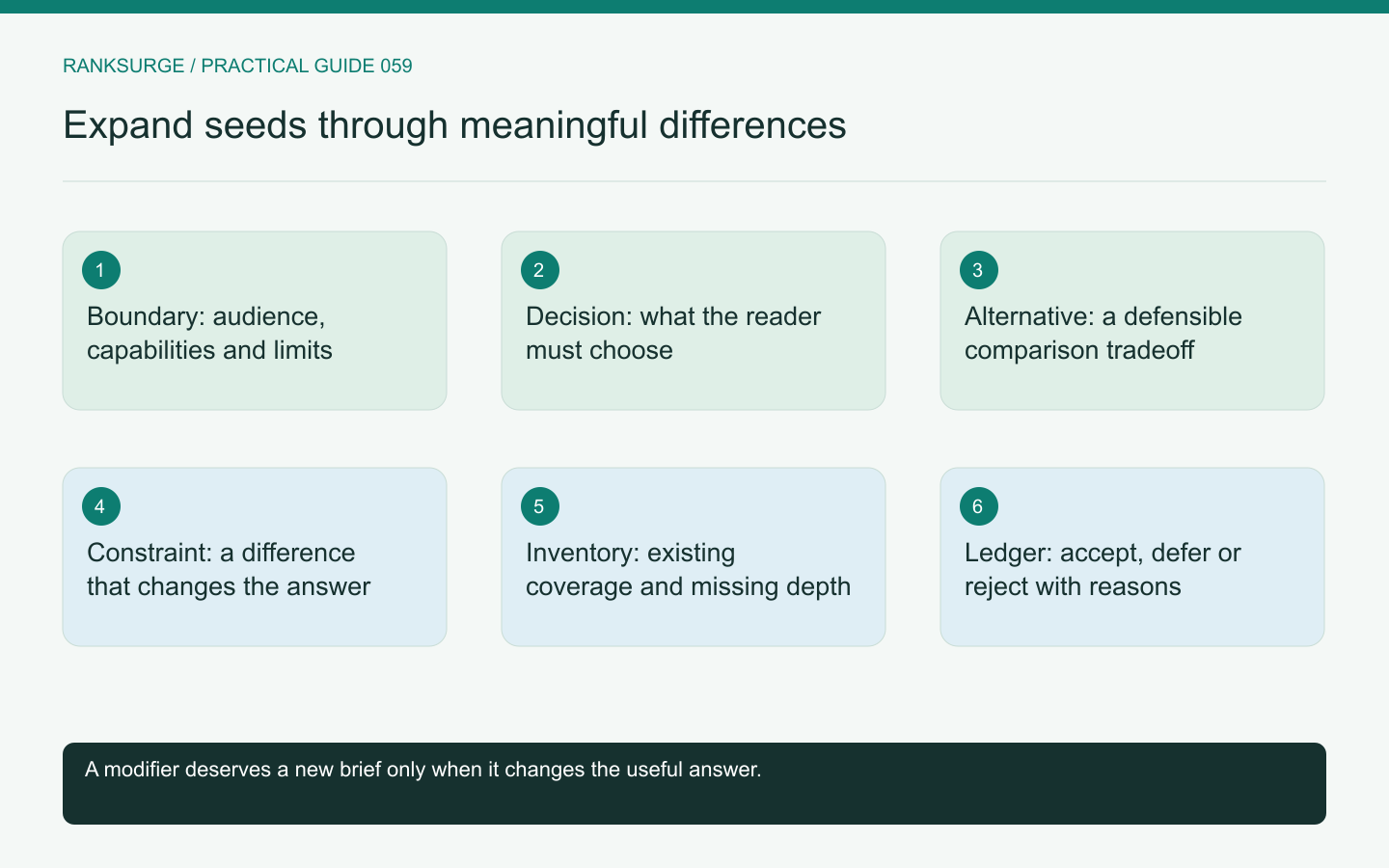
Expand keyword seeds through customer tasks, alternatives and constraints while filtering unsupported topics and duplicate page ideas before measurement.
TL;DR
- Treat a keyword seed as a product-bounded starting point: define the product’s audience, capabilities and decisions it can credibly support, and reject directions that cannot become honest, useful pages.
- Expand by framing real reader decisions and labeling intent: map each question to the task it represents, the evidence needed, and constraints that materially change the recommended answer.
- Stop when new phrases no longer change the plan and keep a rejection ledger: record why branches were rejected, require a second reviewer to explain accepted versus rejected candidates before writing.
Give the seed a product boundary
A keyword seed is a starting point for investigation, not permission to pursue every related subject. Begin with the product's actual audience, capabilities and limits. Write down which decisions the business can help a reader make with credible information.
For an illustrative scheduling product, appointment reminders may be a valid seed. Hospital staffing software might be adjacent in vocabulary but outside the supported product and the team's expertise. A large list is less valuable when many entries cannot become honest, useful pages.
Keep that boundary visible throughout expansion. It is easier to reject weak directions early than to repair a calendar filled with unsuitable briefs.
Expand by reader decision
Take the seed and ask what a prospective or existing customer needs to decide. The scheduling example could produce questions about choosing reminder channels, comparing appointment tools, handling timezone changes and understanding cancellation workflows.
These are different tasks, not just alternate phrasings. Each suggests its own evidence and possible destination. A commercial comparison may need current vendor documentation, while a timezone explanation may need a worked example and product-specific behavior.
Label intent after examining the task. A technical setup question does not become buying intent merely because the product can appear in the answer.
Use alternatives without making every rival a page
Competitor names can reveal evaluation language, but a comparison should have a real decision behind it. Ask what tradeoff a reader is trying to resolve: deployment, workflow, support, billing or a specific capability.
A hypothetical “calendar tool alternative for shared reception desks” might deserve investigation if the product genuinely supports that use case and the comparison can be substantiated. Fifty nearly identical alternative pages with swapped names would not automatically provide fifty distinct answers.
Record the intended comparison criteria before approving the topic. If the criteria are indistinguishable from an existing page, consider improving that page instead.
Add constraints that change the answer
Useful expansion often comes from a meaningful constraint: a supported platform, a type of user, an integration boundary or a documented operational requirement. The constraint should change the recommended evaluation or implementation, not just the article title.
For example, a team coordinating across timezones may need a different worked example from a single-location service business. A new country name alone is not enough if every recommendation remains unchanged.
This test protects the plan from mechanically generating region, year and adjective variants. Ask what additional evidence the constrained topic requires. If there is none, the supposed new topic may be a duplicate.
Keep observation separate from interpretation
When using related searches, keyword suggestions or competitor research, preserve where each candidate came from. The source can show that a phrase exists in a dataset; it does not establish that the phrase fits your business or deserves a page.
RankSurge's keyword research features can support candidate discovery and comparison. Add an editorial note that explains the proposed reader task and the reason the product can contribute.
Measure shortlisted candidates in the relevant market after the fit review. Unknown volume should remain unknown. Do not assign a favorable number simply because the topic seems promising.
Related reading: SEO for Startups: A Founder’s Handbook.
Related reading: Ranking for the Wrong Half of Your Audience.
Test each candidate against existing coverage
Compare the proposed task with the full inventory, including older articles and documentation. Read likely matches rather than relying only on exact-title similarity.
Suppose the site already has a comprehensive guide to appointment reminders that explains timing, consent and channel choice. A new “best reminder timing” page may repeat one section without adding enough value. An update or a clearer internal anchor could be the better action.
By contrast, a documented integration failure that requires a specific diagnostic procedure may deserve a separate reference. The difference is the user's task and the depth needed to solve it.
Keep a rejection ledger
For every rejected branch, write a short reason such as unsupported feature, duplicate task, unrelated audience or insufficient evidence. Retain the seed and source so future research can understand the decision.
This is especially useful when agents or multiple writers expand the same topic. Without the ledger, the same attractive but unsuitable suggestions can reappear in every research cycle.
Allow reconsideration when product capabilities or evidence change. A rejection is a decision under current conditions, not a permanent ban on the subject.
Stop when expansion no longer changes the plan
Before stopping, select one accepted and one rejected candidate and have a second reviewer explain the difference from the notes alone. If the rationale is not understandable, improve the decision record before handing it to a writer.
Set a practical stopping condition: enough distinct, supportable tasks to fill the next review cycle, with evidence and destination decisions for each. More phrases are not necessarily more opportunities.
Google's helpful-content guidance is a useful check against producing pages primarily to capture variations. The final seed expansion should leave the team with a stronger set of answers it can create and maintain, not an impressive count that hides repeated or irrelevant ideas.