
Keyword Research Tool Selection: Test Intent and Coverage Alongside Metrics
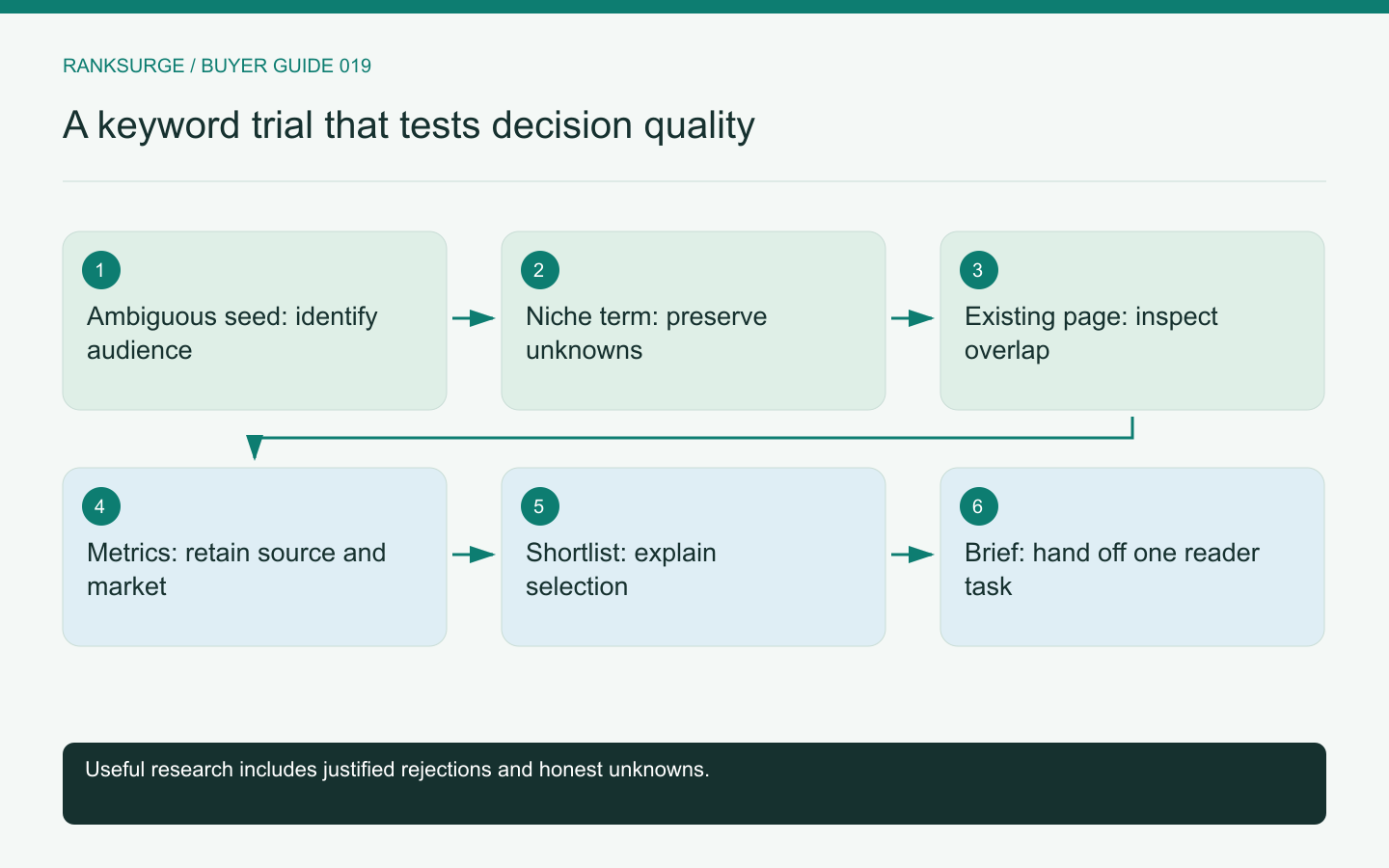
Compare keyword research tools with ambiguous seeds, niche terms and existing content so the evaluation measures useful page decisions, not suggestion volume.
TL;DR
- Choose the keyword research tool that demonstrably improves which pages to build under your real constraints; prioritize justified opportunities over sheer export volume so decisions, not data, drive work.
- Evaluate candidates with a practical seed test: use a small, mixed set of seeds and the same inputs across tools, then inspect results and search pages manually to assess fit and duplication.
- Accept tools that produce a compact, justified shortlist and honest handling of unknowns; measure end-to-end cost and ensure the brief remains portable and actionable for writers without rerunning research.
Test the shortlist you would actually use
A keyword research tool should help your team find searches it can satisfy and decide which pages deserve work. A long list of suggestions is only a starting point. During evaluation, test whether the tool helps you distinguish an attractive number from a useful opportunity.
Prepare a small set of seeds from your product, customer questions and existing pages. Include one ambiguous term, one narrow integration or use case and one topic already covered on the site. This combination reveals whether the workflow can handle fit, missing data and duplication instead of only expanding obvious phrases.
Use the same inputs across candidates and inspect the output manually.
Begin with an ambiguous seed
Consider a product that helps businesses collect client information. A seed such as “intake software” could span legal, medical, service and internal operations contexts. The right query for one product may be a poor fit for another.
Ask the tool to show the relevant search results and explain the audience implied by them. Record which page types dominate and whether your current product can meet the expectation. A difficulty score alone cannot answer that question.
Passing this task means the shortlist excludes plausible but irrelevant terms with a clear reason. Rejection quality is part of research quality. A tool that treats every related phrase as a content opportunity will create unnecessary work downstream.
Include a niche term with incomplete metrics
A specific integration or emerging category may have unavailable demand data. Check how the platform displays the missing value and how it appears in exports. Unknown should remain distinguishable from a measured zero.
Ask the researcher to decide whether the term deserves an editorial experiment based on product fit and additional evidence. The result should remain labeled as a hypothesis if demand is unmeasured. It should not acquire a confident opportunity score simply because the team wants another page to write.
This test reveals whether the workflow supports uncertainty honestly. Sparse data is common enough that a buying decision should account for it rather than only testing popular keywords with complete rows.
Check overlap with existing pages
Give the tool or research workflow your current content inventory. Ask whether the new terms belong on an existing page, require a genuinely different page or should be rejected. Similar wording does not always mean identical intent, but a different modifier does not automatically justify a new article either.
For example, two queries may both ask the buyer to choose the same category of software. A single strong comparison page may serve them better than separate pages with nearly identical advice. Another query may ask how to configure a specific integration and require a distinct implementation guide.
The output should explain the page decision. A cluster label without that explanation is not enough to commission content responsibly.
Inspect metrics in context
For each returned metric, identify the market, source and relevant date or period. Ask how difficulty is defined and whether it is comparable with scores from other providers. Treat CPC as one commercial signal rather than proof of your product's conversion potential.
RankSurge's keyword research page presents metrics alongside search-result inspection and saved opportunities. When evaluating it, focus on whether those pieces remain connected in the shortlist. The workflow should let a reviewer see why a term was selected rather than merely sort by the largest number.
Do not compare tools by which reports the highest volume. Different definitions or source coverage can explain differences, and the larger estimate is not automatically more accurate.
Related reading: SEO for Startups: A Founder’s Handbook.
Related reading: Ranking for the Wrong Half of Your Audience.
Test the handoff to content planning
Ask for a final brief containing the primary query, related terms, intended audience, page purpose, evidence and a reason it is distinct from existing content. Include the question the page must answer and the product facts it must not overstate.
Give the brief to a writer or product marketer. Can they identify the reader's task without asking for a new research session? Can they see which claims need current primary sources? If not, improve the handoff before blaming the writing process.
Keep the artifact portable. A useful shortlist should retain its market and rationale when exported or shared outside the research interface.
Compare the complete research cost
Measure the work required to reach that final brief, including manual search inspection, duplicate review and correction of misleading suggestions. Add the provider usage or subscription cost for repeating the workflow at your expected frequency.
A tool with fewer suggestions may still produce a better shortlist. A tool with broad coverage may be valuable when your team already has strong qualification methods. The choice depends on which part of the process needs support.
Buy the keyword research tool that improves page decisions under your actual constraints. The acceptance test is a small set of justified opportunities, with weak candidates rejected and unknowns preserved. That output is far more useful than a large export that transfers every hard decision to the next person.